Think about the last week.
How many times did your mood shift because of something someone said?
How many times did good news make you feel invincible — and bad news make you feel like everything was falling apart?
How much of your mental energy went into reacting to things that, in the bigger picture, didn't matter much at all?
Most people spend their entire lives on this emotional rollercoaster — up when things go well, down when they don't. And they call it being human.
The Gita calls it being unsteady. And it offers a way out.
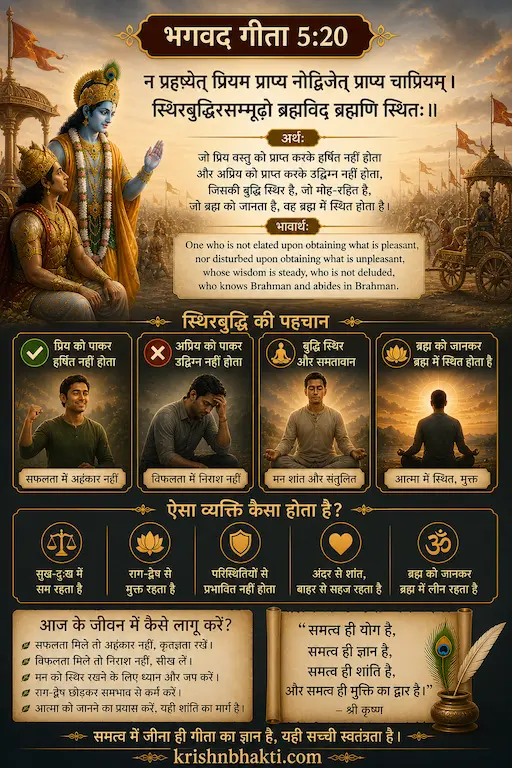
In Chapter 5, Verse 20, Krishna describes a person who has mastered something that most people spend their whole lives chasing without ever finding — a mind that doesn't need the world to behave a certain way in order to stay at peace.
न प्रहृष्येत्प्रियम् प्राप्य नोद्विजेत्प्राप्य चाप्रियम्।
स्थिरबुद्धिरसम्मूढो ब्रह्मविद् ब्रह्मणि स्थितः॥
— Bhagavad Gita, Chapter 5, Verse 20
Breaking Down the Verse — Word by Word
"Na prahṛṣyet priyam prāpya" — upon receiving what is pleasant, do not rejoice excessively. Do not let the good news carry you away.
"Na udvijet prāpya cāpriyam" — upon receiving what is unpleasant, do not become agitated. Do not let the bad news break you.
"Sthira-buddhiḥ" — one of steady intellect. Someone who can think clearly regardless of what is happening around them.
"Asammūḍhaḥ" — undeluded, free from the fog of attachment and confusion.
"Brahma-vit" — one who knows Brahman, who has genuine self-knowledge.
"Brahmaṇi sthitaḥ" — established in Brahman. Living from the deepest, most stable ground there is.
The Question Everyone Has — Does This Mean Suppressing Emotions?
Absolutely not. And understanding this distinction is everything.
Srila Prabhupada, in Bhagavad Gita As It Is, is clear on this point: the verse is not asking for emotional numbness. It is asking for proportionality. A natural smile when good news arrives is not "prahṛṣyet." It becomes prahṛṣyet when the elation is so overwhelming that judgment disappears — when success inflates the ego, when praise makes you reckless. Similarly, natural sadness at a loss is not "udvijet." It becomes udvijet when the grief is so consuming that it paralyzes all function — when failure becomes identity, when criticism becomes verdict.
Swami Mukundananda uses a powerful image: a skilled sailor is not one who avoids storms. The ocean will always have storms. A skilled sailor is one who can navigate through them — who doesn't drop the rudder when the waves come. "Sthira-buddhiḥ" is that sailor. The storms come. The mind stays capable.
Gita Press draws particular attention to "asammūḍhaḥ" — undeluded. Delusion, in this context, is the mistaken belief that external events determine inner worth. When someone is convinced that they are good only when things go well — that their value rises and falls with circumstances — they are "sammūḍha," deluded. The undeluded person knows something deeper: that what they truly are cannot be added to by success or taken away by failure.
What Do "Pleasant" and "Unpleasant" Look Like in 2025?
Krishna used "priyam" and "apriyam" — pleasant and unpleasant.
In today's world, they look like this:
Pleasant —
A post goes viral. A client says yes. A performance review is glowing. Someone publicly praises your work. The numbers go up.
Unpleasant —
A post gets ignored. A proposal gets rejected. Someone criticizes you in front of others. The numbers go down. A plan falls apart.
And every single time the pleasant arrives — the mind jumps. Confidence surges. The world feels manageable.
Every single time the unpleasant arrives — the mind drops. Doubt creeps in. The world feels threatening.
This constant jumping and dropping — this is where enormous energy is lost.
Because when the mind jumps with success — arrogance enters, and clear thinking leaves.
When the mind drops with failure — despair enters, and clear thinking leaves again.
In both states, the quality of decision-making deteriorates. And poor decisions, compounded over years, shape an entire life.
The person with "sthira-buddhiḥ" is free from this cycle — and that freedom is a competitive advantage unlike any other.
A Real Example — Two People, One Setback
Two people lose an important client on the same day.
The first person spends three days unable to function. They replay every conversation. They catastrophize the future. They cannot sleep. By the time they surface, they have lost a week of productive work on top of the client.
The second person feels the disappointment — genuinely, fully. That evening, they sit down and ask: what can I learn from this? What would I do differently? By the next morning, they are back at their desk with a clearer strategy.
Same loss. Same external event.
The difference was not talent or resilience in the conventional sense.
The difference was the relationship each person had with the unpleasant.
The first was "udvijet" — shaken, agitated, consumed.
The second was "sthira-buddhiḥ" — steady, clear, functional.
One of them let the event define the next week. The other let the event inform the next step.
"Brahma-vit Brahmaṇi Sthitaḥ" — Why This Goes Deeper Than Psychology
Here is where this verse transcends self-help entirely.
The Gita is not just describing a useful mental habit. It is describing a spiritual state.
The person who is sthira-buddhiḥ and asammūḍhaḥ is called "brahma-vit" — one who knows Brahman. And they are described as "brahmaṇi sthitaḥ" — established in Brahman.
What does this mean?
Prabhupada explains: the Supreme is by nature perfectly equanimous — unchanging, unaffected, complete in itself. When a human being cultivates that same quality of inner steadiness, they begin to reflect the divine nature. They are not just mentally healthier. They are spiritually closer to the source of all existence.
This is why the Gita frames equanimity not as a technique but as a destination. The steady mind is not a tool for success — it is a glimpse of what we actually are beneath the noise.
Four Practical Ways to Build Non-Reactive Steadiness
1. Insert a pause before every reaction.
Swami Mukundananda emphasizes this as the foundational practice: before responding to any significant piece of news — good or bad — take one breath. One conscious pause. That single moment interrupts the automatic reaction and creates space for a chosen response. It sounds small. It changes everything.
2. Remember impermanence — in both directions.
Gita Press points to "asammūḍhaḥ" as rooted in the recognition that nothing external is permanent. In good times, remember: this will change. In difficult times, remember: this will also change. This is not pessimism. It is accuracy. And accuracy is the foundation of a steady mind.
3. Separate your identity from your outcomes.
Prabhupada returns to this again and again: the root of emotional instability is the equation "I am good when my results are good." As long as self-worth is pegged to outcomes, the mind will always ride the wave of circumstances. Shift the identity to the soul — which is neither increased by success nor diminished by failure — and the wave loses its power.
4. Practice steadiness in small moments first.
Swami Mukundananda teaches that sthira-buddhiḥ is not built in crises — it is built in ordinary moments. Someone cuts you off in traffic — practice steadiness. A small plan goes wrong — practice steadiness. A casual comment stings — practice steadiness. These small moments are the training ground. What you build there becomes available when the real storms come.
The Rock and the Leaf
A leaf moves with every breeze.
A rock stays through every storm.
The world will spend its entire energy turning you into a leaf — because reactive people are predictable, and predictable people are easy to influence.
Choosing to be the rock is the most countercultural, most powerful decision you can make.
Not because rocks don't feel the storm. But because the storm does not decide where the rock stands.
When pleasant arrives — receive it with grace, not ecstasy.
When unpleasant arrives — receive it with steadiness, not collapse.
And when that begins to happen — even occasionally, even imperfectly — you will know that "sthira-buddhiḥ" is no longer just a concept.
It is becoming who you are.
To read
The Winner's Mindset: Decoding Gita 5:19 for Modern Success.
https://krishnbhakti.com/english-blogs/gita-shloka-5-19winners-mindset-decoding-gita-modern-success