Think about the last time you said something you immediately regretted.
The words were out before you could stop them. The anger — or the desperation, or the craving — moved faster than your judgment. And in those few seconds, something was damaged that took weeks or months to repair.
Or maybe it was never fully repaired.
We have all been there. We will all be there again — unless something changes.
The ancient world understood this problem deeply. Armies were lost, kingdoms fell, lives were destroyed — not because people lacked intelligence or capability, but because in critical moments, the impulse moved faster than the wisdom.
Krishna addressed this directly. And what he said in Gita 5:23 is one of the most practically powerful instructions in the entire text.
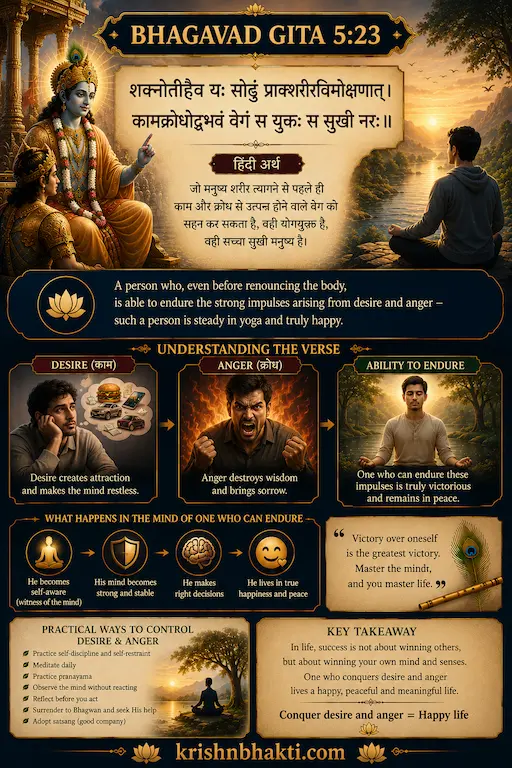
शक्नोतीहैव यः सोढुं प्राक्शरीरविमोक्षणात्।
कामक्रोधोद्भवं वेगं स युक्तः स सुखी नरः॥
— Bhagavad Gita, Chapter 5, Verse 23
Breaking Down the Verse — Word by Word
"Śaknotīhaiva yaḥ soḍhum" — one who is able to withstand, right here in this life. "Iha" — here, now, in this very existence. Not in some future state. Now.
"Prāk śarīra-vimokṣaṇāt" — before the liberation from the body. Before death. In this lifetime, with this body, in these circumstances.
"Kāma-krodha-udbhavaṁ vegam" — the impulse arising from desire and anger. "Vega" — force, rush, momentum. Not a gentle suggestion from within. A surging, driving force.
"Sa yuktaḥ sa sukhī naraḥ" — that person is yukta, that person is happy. Two emphatic "sa" — that one, that one specifically. Only that person.
The Most Important Question — What Is the Difference Between Withstanding and Suppressing?
This distinction is everything.
Srila Prabhupada, in Bhagavad Gita As It Is, is precise on this point: "soḍhum" does not mean suppression. A person who forcibly suppresses desire and anger does not eliminate them — they compress them. And compressed energy, as anyone knows, eventually explodes with far greater force than it would have originally. "Soḍhum" means to endure — to feel the impulse fully, to recognize it clearly, and to choose not to act on it in the heat of the moment. The impulse is witnessed, not denied. The action is withheld, not the feeling.
Swami Mukundananda describes desire and anger as waves — they rise, peak, and fall. The untrained person acts during the peak. The trained person waits. Not forever — just long enough for the wave to begin descending. And in that brief waiting, something remarkable happens: judgment returns, perspective returns, the long-term consequences of acting on the impulse become visible again. The impulse hasn't been destroyed. It has simply been outlasted.
Gita Press focuses on "vega" — the word Krishna chose for desire and anger. Not the desires and angers themselves, but their velocity. Their momentum. This is precise and important. The problem is not that desire arises — it always will. The problem is the speed at which it demands action. "Soḍhum" is the practice of inserting time between the arising and the acting. That time is where wisdom lives.
Why Kāma and Krodha Together?
Krishna pairs desire and anger in a single phrase: "kāma-krodha-udbhavam."
This is not arbitrary.
Prabhupada explains that these two forces share a common origin. Desire, when obstructed — when the thing wanted is denied or delayed — becomes anger. They are two expressions of the same underlying energy. This is why they appear together in the verse and throughout the Gita. Master one and you are partway to mastering both. Fail at one and the other is usually not far behind.
Desire says: I must have this, now.
Anger says: How dare something prevent me from having this.
Same root. Different face. One vega.
A Real Example From Today's World
Two people receive the same critical feedback on their work — delivered publicly, somewhat harshly, in front of colleagues.
In both, the same impulse arises: the flush of humiliation, the surge of anger, the urge to defend, to retaliate, to make the critic regret their words.
The first person follows the vega.
They respond immediately, sharply. The defense comes out as an attack. The room goes quiet in the wrong way. The colleague who delivered the feedback becomes an enemy. The team remembers what happened. Trust is damaged — not just with the critic, but with everyone who watched.
The second person withstands the vega.
They feel the same flush, the same surge. But they say nothing in that moment. They breathe. They let the meeting continue. Later — privately, calmly — they address what was said. What began as a conflict becomes a productive conversation. The same circumstances. A completely different outcome.
This is "soḍhum." This is "yukta."
Not the absence of the impulse. The presence of the pause.
"Ihaiva" — Why This Life, Why Now?
Krishna's use of "ihaiva" — right here, in this very life — carries urgency.
Gita Press explains this carefully: the practice of withstanding impulse cannot be deferred. It is not something that becomes easier "later" or "in better circumstances." The vega of desire and anger that is not worked with in this life does not disappear at death — it carries forward, often with greater force. The time to begin is always now. The life in which to begin is always this one.
Swami Mukundananda adds a different dimension: "ihaiva" also means the reward is immediate. This is not a practice whose benefits are deferred to some future spiritual state. The person who masters their impulses is happier now — in this life, in these relationships, in this work. The verse ends with "sukhī naraḥ" — a happy person. Not eventually happy. Happy.
Four Steps of Krishna's Strategy
1. Name the impulse the moment it arises.
Prabhupada points to awareness as the foundation. When desire or anger surges, name it internally before doing anything else. "This is anger." "This is craving." Research in neuroscience now confirms what the Gita has always taught: naming an emotion creates a measurable reduction in its intensity. The act of labeling creates the first distance between you and the vega.
2. Create a gap before responding.
Swami Mukundananda emphasizes that the entire practice lives in the gap between the impulse and the action. That gap can be one breath. It can be counting to ten. It can be physically leaving the room. The size of the gap matters less than its existence. Any gap at all is a beginning.
3. Feel the vega without acting on it.
Gita Press is clear: "soḍhum" means enduring, not suppressing. Let the feeling be fully present. Don't deny it, don't pretend it isn't there. Simply don't act from it while it is at its peak. This is the practice. It is uncomfortable. It is also the only thing that actually works.
4. When the wave descends, choose the response.
Prabhupada describes the "yukta" as someone whose response is chosen rather than automatic. When the vega has passed its peak — even slightly — ask: "What response here actually serves the situation?" That question, asked honestly, almost always produces a different answer than the one the vega was offering.
You Are Not the Impulse
When anger arises, the mind says: I am angry.
The Gita suggests a different framing: anger has arisen in me. I am not the anger.
When desire surges, the mind says: I need this.
The Gita suggests: this desire is moving through me. I am not the desire.
This small shift — from identification to witnessing — is perhaps the most important cognitive move a human being can make.
Because the moment you become the witness of the vega rather than its vehicle — you are no longer automatically carried by it.
You can feel it fully. You can even respect its power.
And then you can choose.
That choosing — conscious, deliberate, wisdom-informed — is what Krishna calls being "yukta."
And only that person, he says — twice, for emphasis — is truly happy.
That happiness is available to you. In this life. Starting now.
To read
The Trap of Sensory Pleasures: Why They Lead to Pain