Have you ever had one of those nights where sleep just won't come?
Everyone in the house is out. The room is quiet. You're lying there with nothing but your own thoughts — and somewhere in that silence, a question sneaks in that you'd never dare ask yourself in daylight.
"Why does my life look like this?"
And before you can even sit with that question, something in you already has an answer ready.
"It's God's plan."
Fail an exam — God's plan.
Don't get the job — wasn't written for you.
Lose someone you loved — maybe it wasn't meant to be.
Give up on a dream — fate had already decided.
Here's the thing about us humans.
When something goes wrong, we hand it straight to God. When something goes right, we take all the credit ourselves.
We've been doing it so long, we don't even catch ourselves anymore.
But there's a verse in the Gita that sounds almost too simple when you first read it — and then one day it just lands differently, and something inside you quietly shifts.
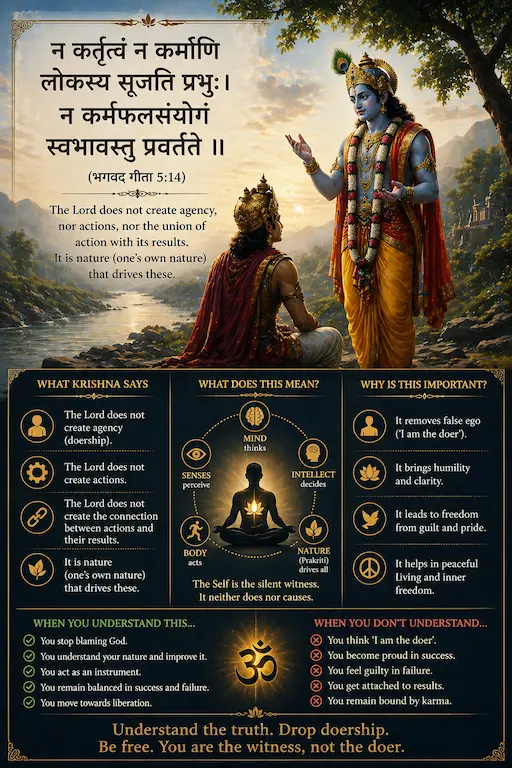
न कर्तृत्वं न कर्माणि लोकस्य सृजति प्रभुः।
न कर्मफलसंयोगं स्वभावस्तु प्रवर्तते॥
— Bhagavad Gita 5:14
Krishna is saying something radical here.
God doesn't plant the feeling of "I am the doer" inside you. He doesn't author your actions. He doesn't wire your actions to their consequences. All of that — every bit of it — is being run by your own nature.
Your swabhav.
Not God. You.
But hang on — didn't Krishna also say "just surrender to me"?
If you've genuinely spent time with the Gita, this should bother you.
Because in Chapter 18, verse 66, the same Krishna says —
सर्वधर्मान्परित्यज्य मामेकं शरणं व्रज।
अहं त्वा सर्वपापेभ्यो मोक्षयिष्यामि मा शुचः॥
— Bhagavad Gita 18:66
Abandon everything. Come to me alone. I will take care of the rest. Don't be afraid.
So which is it?
"Your nature is running your life" — or — "Leave it all to me"?
Both. And that's not a contradiction. That's the whole point.
The doctor who tells you two things
You go to a doctor feeling terrible. You've felt this way for months.
He doesn't hand you medicine and send you home.
He sits down and says — "You're sleeping at 2 AM. You skip meals. You haven't moved your body in weeks. This is what's making you sick."
That's the first conversation. Look at what you're doing.
Then he says — "Now follow this. Trust this process. Let me handle it from here."
That's the second conversation. Now let go.
Did he contradict himself? No.
He first made you see clearly — then he gave you somewhere to rest.
Krishna does the exact same thing across the Gita.
5:14 and 18:66 aren't fighting — they're talking to different people
5:14 is for the person who hasn't woken up yet.
The one who genuinely believes — "Whatever went wrong in my life, God did that to me. My luck is just bad. What am I supposed to do about it?"
That person needs to hear something uncomfortable. Your decisions built this. Your patterns built this. Your nature, running quietly in the background every single day — that built this.
Until that lands, nothing changes. The blame just keeps getting outsourced.
18:66 is for someone completely different.
Someone who has already woken up. Already stopped making excuses. Already rolling up their sleeves every day.
But now there's a new kind of exhaustion showing up.
The kind that comes from trying so hard for so long and still not being able to control how things turn out.
"I try. I give it everything. But some things are just out of my reach. The result isn't mine to decide. The future isn't mine to hold. I've done what I can — what now?"
To that person, Krishna says —
"What was yours to do, you did. What isn't — stop carrying it. That part's mine."
One verse for effort. One for peace.
5:14 — stop making excuses for what is in your hands.
18:66 — stop losing sleep over what isn't.
Not opposites.
A complete thought, split across two moments in the same book.
Swami Mukundananda says the entire Gita comes down to this — do your work fully, and hand the fruit over to God. The effort is yours to give. The outcome is His to decide. That's not weakness. That's the most honest way to live.
So who's actually doing anything here?
Krishna draws a line between two ways of working.
When ego is driving —
"I'm making this happen. My effort is what matters. It all depends on me."
— you become a prisoner of your own nature. Everything you do pulls you deeper in.
When surrender is underneath the same effort —
"I'm doing my part, but I know where this is really going. The result belongs to something bigger than me."
— the same action stops binding you.
Same work. Same hands. Same hours.
Completely different relationship to it.
Prabhupada said it clearly — the person who accepts that their own nature has been shaping their life, that person is taking real responsibility for the very first time. And only that person can truly surrender. Because if you're still pointing fingers at God, you haven't surrendered to Him — you've just handed Him the blame.
Awareness has to come first. Surrender follows. That's the order.
Why does your nature run so deep?
Swabhav isn't just a bad habit you picked up last year.
It's the slow accumulation of everything — what you saw growing up, what kept happening to you, what you kept choosing, what you kept thinking, until all of it became automatic. Until it became you.
First thing you do when you wake up?
Reach for your phone. That's swabhav.
Someone says something critical about you — before you've even processed it, you're already defending yourself.
That's swabhav.
A big opportunity shows up and something in you immediately says not yet, maybe later.
That's swabhav too.
And this quiet, invisible force decides what you do every day.
What you do every day decides where your life goes.
God isn't in that chain. You are.
The Gita tells us — God watches. He gave you a free will, a working mind, and your own nature. What you do with all of that is on you.
Think of it like sunlight.
The sun doesn't choose whose window to shine through. It gives the same light everywhere. But the house with open windows gets filled with it. The one with everything shut stays dark.
The sun showed up. You decided what to do with the window.
Can any of this actually change?
Yes. But not overnight. And not through motivation alone.
Three things genuinely shift your nature over time —
Watching yourself honestly.
Not judging, not fixing — just noticing. Why do I keep doing this? Where does this pattern come from? Most people never ask. That's why the same things keep happening.
Feeding your mind the right things.
Whatever you keep reading, listening to, spending time around — it seeps in slowly. The right books, the right conversations, the right people — they quietly start changing what feels natural to you.
Showing up small, every single day.
One good decision doesn't rebuild a nature. But one honest effort, repeated daily, across months and years — that builds a different person from the inside out.
And through all of it —
The result, the outcome, what happens next —
That's not yours to carry.
Give it up. Not because you're giving up — but because you were never supposed to be holding it in the first place.
That's where these two verses finally meet.
That's effort and surrender living together.
That's what the Gita has been saying the whole time.
So the next time something falls apart — stop for a second.
Before the story about God's will starts forming, ask yourself one honest question —
"What was my pattern here? What did I keep choosing? What did I keep avoiding?"
And when you've looked at that clearly, and done what you can —
Fold your hands. Breathe.
And say —
"The rest is yours."
That's not giving up.
That's not weakness.
That's the whole thing.
That's the Gita.
To read...
The Gita's Answer to Burnout: Work Hard, Carry Nothing... 👇👇