📅 2026-07-01
In the previous verse, Lord Krishna taught Arjuna the art of endurance and equanimity, explaining that a person who remains undisturbed by happiness and distress is alone eligible for liberation. When a sudden crisis strikes our lives in the modern world—whether it is the sudden loss of a job, the bitter breakdown of a long-term relationship, or the crushing weight of financial ruin—a deep sense of panic and insecurity grips our soul. We desperately try to hold onto everything, clawing desperately at passing moments, terrified of aging, losing our status, or being abandoned. Right in this exact psychological state of turmoil, Arjuna was consumed by a paralyzing illusion on the battlefield of Kurukshetra, trembling at the thought of death, loss, and the destruction of everything he held dear.
Life today for the modern youth is plagued by this exact same insecurity and existential dread. From the moment we wake up to the glaring notification lights on our smartphones to the quiet, lonely hours before sleep, we are haunted by constant anxieties—the fear of not being successful enough, the fear of missing out, the terror of loneliness, and the haunting impermanence of our bodies and relationships. In this glossy world of social media comparison, we tie our entire self-worth to things that are inherently fragile and fleeting. We spend our lives building castles on shifting sands, knowing fully well that the tide can wash them away at any second. We try to control the uncontrollable, pushing ourselves into chronic burnout just to preserve what is fundamentally un-preservable.
Amidst this modern chaos, many people fall into a common spiritual misconception. They assume that spirituality requires running away from the world, suppressing all emotions, or pretending that nothing matters. Young seekers often wonder: if everything in this world is temporary and destined to perish, what is the point of working hard, chasing dreams, or loving deeply? This nihilistic doubt pushes many either into reckless hedonism or debilitating depression. However, Lord Krishna in this verse does not ask us to run away from life; instead, He offers a revolutionary lens through which to view reality. He cuts through our superficial attachments and reveals a profound, unshakable truth that exists right behind the changing screens of our daily experiences.
When we look around us, change is the only constant. Today's newest gadget becomes tomorrow's electronic waste; today's blooming flower withers by evening; youthful skin develops wrinkles; and vibrant relationships sometimes turn into bitter memories. This relentless wheel of time never stops spinning. But behind this ever-shifting facade, is there anything stable? Is there a core reality within us that remains completely untouched by birth, decay, and death? Humanity has spent millennia searching for the answer to this very question in temples, laboratories, and ancient scriptures. Today's youth focuses intensely on physical fitness, career productivity, and mental wellness apps, yet that deep internal emptiness often remains untouched until we grasp the foundational wisdom delivered by Krishna in this verse.
Before we can truly understand this shloka, we must drop our deep-seated bias of treating sensory perceptions as the ultimate truth. Our eyes only see shapes, our ears only hear sounds, and our minds panic over changing circumstances. But this verse of the Bhagavad Gita grants us the inner vision to look beyond the sensory illusion. It teaches us that behind the theatrical play of life and death, there is a director who was never born and will never die. This is not just dry philosophy; it is a practical mental toolkit designed to eradicate fear, anxiety, and grief from our day-to-day existence. When you realize that the real 'You' cannot be destroyed, the fear of death and the panic of loss automatically dissolve.
Imagine sitting in a dark movie theatre watching an intense, high-stakes thriller where cities are burning, characters are weeping, and catastrophe is unfolding on the giant screen. You feel your heart pounding, but you remain seated comfortably because deep down, you know it is just light and shadow projected on a canvas, and the screen itself remains completely unharmed and stainless. Our human life functions in a very similar way. Our bodies age, our bank balances fluctuate, our emotions swing from joy to sorrow, but the pure consciousness observing all of this remains as untouched as the screen in the cinema hall. Krishna is directing Arjuna's attention toward this immutable reality so he can rise above his paralyzing grief.
This is the exact turning point where an ordinary, reactive human life transforms into the journey of a conscious seeker. As long as we identify exclusively with our temporary physical body and psychological fluctuations, we are doomed to live in perpetual fear. The moment we anchor our identity in the eternal spirit, an extraordinary fearlessness and inner stability awaken within us. Krishna's message is not an ancient relic meant only for ancient warriors; it is an absolute lifesaver for every modern individual navigating corporate cutthroats, relationship heartbreak, and existential anxiety. Let us now dive deep into the pristine Sanskrit text of this profound verse and explore its multi-layered meanings.
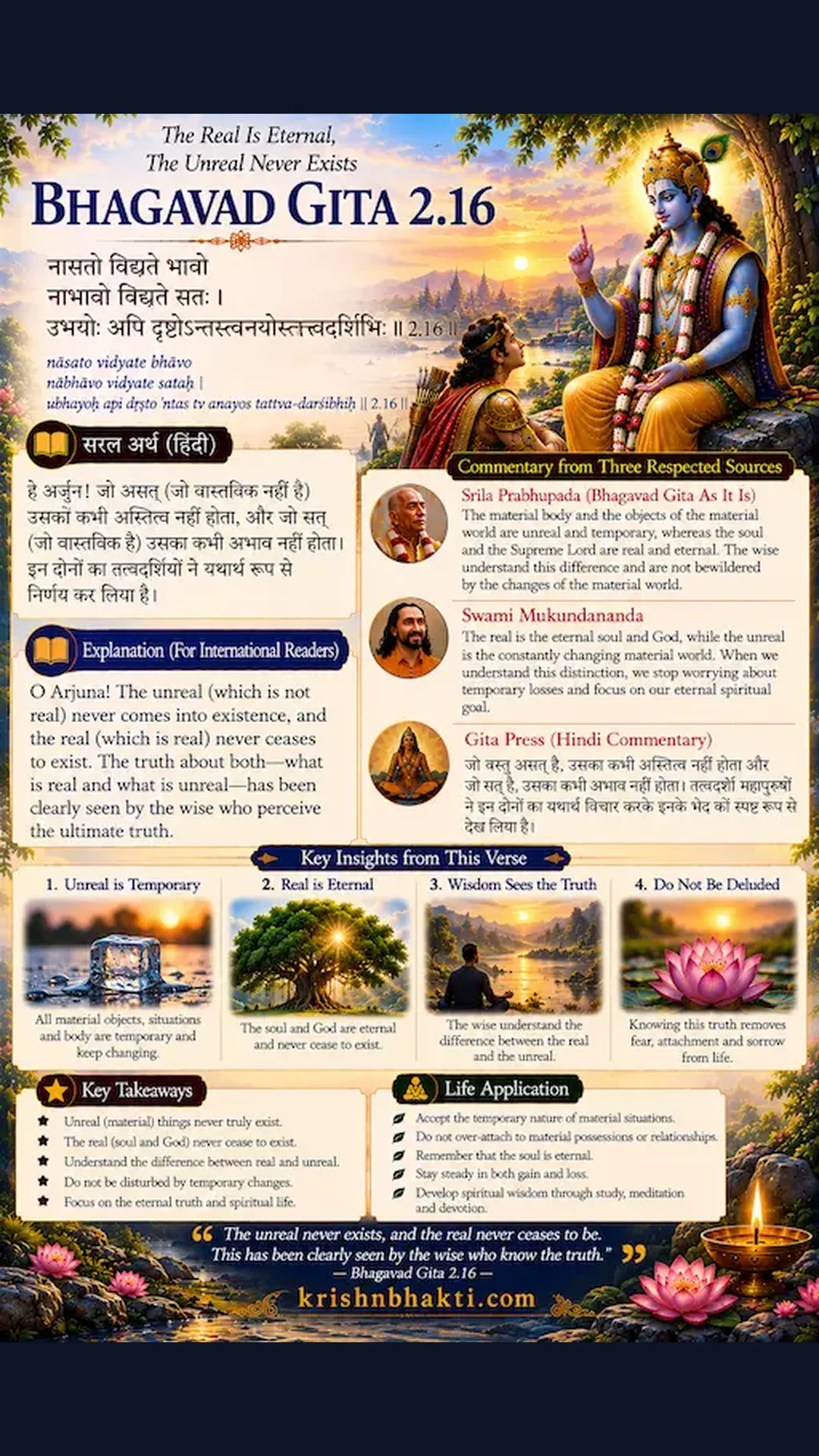
नासतो विद्यते भावो नाभावो विद्यते सतः।
उभयोरपि दृष्टोऽन्तस्त्वनयोस्तत्त्वदर्शिविभिः ॥ २.१६ ॥
Simple Meaning and Word-by-Word Breakdown
To fully grasp the depth of this shloka, let us break down its Sanskrit phrasing into conversational English. Lord Krishna declares— Nasato vidyate bhavah (Of the unreal, or the temporary physical body and material world, there is no endurance or permanent existence). Naabhavo vidyate satah (Of the real, or the eternal soul and Supreme Truth, there is no cessation or non-existence). Ubhayor api drishtah antah tu anayoh tattva-darshibhih (The conclusion about both of these—what is temporary and what is eternal—has been conclusively seen and established by those who perceive the truth, the seers of reality).
Here, the Lord uses two foundational philosophical terms: 'Sat' and 'Asat'. 'Sat' refers to that which exists across all times—past, present, and future—never changing and never perishing, which is our eternal soul and God. 'Asat' refers to that which is constantly mutating, existing now but vanishing tomorrow—such as our physical body, material circumstances, temporary emotions, and the entire physical universe. The fundamental error of an ordinary human being is treating the 'Asat' (the changing, temporary phenomena) as absolute reality and weeping when it changes, while completely ignoring the 'Sat' (the unchanging eternal essence) that resides within.
Three core takeaways emerge from this profound verse for our practical lives. First, everything in the material world possessing form and name is inherently temporary; expecting permanent stability from temporary things is a recipe for suffering. Second, the conscious observer within you—your true self—is indestructible, untouched by any weapon, unburned by any fire, and untouched by any tragedy. Third, true wisdom belongs only to those who clearly discern this fundamental difference between the transient and the eternal, anchoring their awareness in the unchanging rather than the changing.
Let us visualize this through a simple analogy. Imagine sitting by the bank of a fast-flowing river. Water molecules rush past continuously—one drop leaves, another takes its place. If you throw a tantrum demanding that the exact water droplet you touched a moment ago must stay still forever, you are demonstrating ignorance because a river's very nature is to flow. Similarly, the material world is a rushing river where bodies, minds, and situations constantly change. But the vast sky arching over the river remains completely still. The river changes; the sky remains. Krishna wants you to anchor your identity in that vast, unchanging sky of consciousness so the rushing river of life ceases to disturb your peace.
Deep Insights from Three Renowned Commentators
Swami Ramsukhdas Ji's Perspective: Swami Ramsukhdas Ji, in his characteristically direct and accessible commentary, explains that humanity's greatest blunder is clinging tightly to the 'Asat' while completely neglecting the 'Sat'. Emphasizing the phrase 'Nasato vidyate bhavah', Swamiji points out that investing your life in things that are inherently doomed to perish is the height of foolishness. The physical body will inevitably turn to dust, yet we spend our entire existence pampering it, decorating it, and treating it as our ultimate identity. Swamiji emphasizes that those with true vision (tattva-darshi) clearly perceive that nothing in this material universe remains permanently yours.
In his practical guidance for spiritual aspirants, Swamiji stresses that as long as our emotional anchor is hooked onto the shifting material world, anxiety, fear, and restlessness will inevitably plague us. He points out that Krishna is practically rebuking Arjuna for mourning over both the living and the dead, when wise sages mourn neither because they recognize that shedding a body is as casual as changing an old set of clothes. Swamiji's insight reminds us in our daily lives that whenever we suffer a loss—whether financial or relational—we must recognize that it belonged to the category of 'Asat', designed to pass away, and crying endlessly over it is simply a failure of discrimination.
A.C. Bhaktivedanta Swami Prabhupada's Perspective: Srila Prabhupada, the founder of ISKCON, interprets this verse through the pristine, loving lens of Bhakti yoga and Krishna consciousness. Prabhupada explains that the ultimate 'Sat' is not merely an abstract, impersonal energy or soul, but the Supreme Personality of Godhead, Lord Krishna Himself, from whom all individual souls emanate. Prabhupada repeatedly emphasizes that everything within the material creation is temporary and illusory ('Asat'), and only Krishna and devotional service rendered unto Him constitute eternal reality.
Prabhupada's devotional angle is deeply comforting. He teaches that when a devotee understands this material world to be a temporary creation managed by Krishna's energies, they stop clinging possessively to worldly possessions and relationships. Instead, they engage everything in the loving service of the Lord. Prabhupada often gives the analogy of a traveler staying in a guest house; the wise traveler does not claim ownership of the room's furniture because they know they must check out in the morning. Similarly, a wise devotee lives in this world fully engaged in duties, but keeps their heart anchored at the lotus feet of Krishna. This transforms a dry philosophical concept into a warm, joyous path of divine love.
Swami Mukundananda Ji's Perspective: Swami Mukundananda Ji bridges ancient Vedic wisdom with modern psychology, neuroscience, and relatable analogies. Swamiji explains that modern youth struggle with depression and chronic anxiety precisely because they expect permanent fulfillment from imperishable-seeking temporary sources. Providing a brilliant modern analogy, Swamiji compares material life to playing an immersive Virtual Reality (VR) video game. While wearing the headset, you might scream in terror as a virtual dragon attacks you, but the moment you take off the headset, you smile, remembering it was just a game and your physical body was never in actual danger.
Swamiji elaborates that our physical body and wandering mind function precisely like a VR headset. We get so immersed in the game of career stress, social media validation, and relationship drama that we genuinely believe our existence is threatened when things go wrong. Swamiji teaches young seekers to pause whenever a crisis hits and ask: "Is this Sat or Asat?" When your purified intellect recognizes that the painful circumstance is just a temporary glitch in the matrix, an immense wave of mental resilience arises. This modern framing serves as an incredible mental toolkit for today's generation to conquer daily stress.
Real-Life Applications in Modern Life
Let us bring these profound philosophical truths down to the ground level of our daily lives. Imagine you work as a software developer in a high-pressure tech startup. You spent six grueling months pulling all-nighters to deliver a critical software update. During the final company review meeting, your manager abruptly rejects your hard work due to shifting company priorities and gives the credit to someone else. A blistering wave of rage, humiliation, and despair surges through your chest. Your hands shake, your stomach knots, and you feel like your career is ruined and your efforts were utterly meaningless. You go home, lock yourself in your room, and lose sleep all night.
Now, apply the wisdom of Gita 2.16 to this exact scenario. When that intense frustration flares up within your mind, pause and interrogate the feeling: "This feeling of humiliation, this failure stamp—is it Sat or Asat?" Your awakened intellect will instantly reply that it is entirely 'Asat'—temporary. This project will change, this job will evolve, and most importantly, your core creative intelligence and intrinsic value have not diminished by a single fraction because of one manager's harsh feedback. The moment you perceive this professional setback as a passing cloud in the sky of your consciousness, the heavy emotional burden lifts, and you wake up the next morning ready to build anew.
A second common scenario revolves around romantic relationships and heartbreak. Among young adults today, painful breakups often trigger existential despair. When a romantic partner walks out of your life, it feels as though your entire identity has been ripped apart. An excruciating emptiness settles in your chest, disrupting your sleep, appetite, and focus. Thoughts of self-harm or worthlessness often creep in because you foolishly believed your existence depended entirely on that one person—a classic example of treating an 'Asat' (a temporary mortal relationship) as your ultimate reality.
When viewed through the lens of Bhagavad Gita 2.16, your perspective undergoes a radical shift. You realize that human relationships in this material world are transient gatherings of travelers at a railway station. People cross paths, share moments, and eventually part ways. Your eternal soul, however, remains complete, whole, and completely undamaged by anyone's departure. This realization does not make you cold or unloving; rather, it frees you from toxic clinging. You learn to love deeply without turning affection into a suffocating prison of emotional dependency.
A third scenario involves our obsession with physical appearance, aging, and bodily health. We live in an image-obsessed culture where a single receding hairline, weight fluctuation, or wrinkle can send someone into an emotional spiral. We spend fortunes at gyms and cosmetic clinics trying to arrest the clock. Yet, nature's law is ironclad: this physical vehicle is destined to age, weaken, and eventually dissolve. Accepting that the body is 'Asat' allows you to maintain healthy fitness habits without developing neurotic panic over natural biological changes. You recognize that just like changing old clothes, the soul will eventually exchange this worn-out vehicle for a new one.
A fourth scenario relates to the paralyzing trap of social media comparison. We scroll through feeds showing curated highlights of friends' luxurious vacations, promotions, and picture-perfect weddings, sliding straight into self-loathing and envy. We forget that the digital ecosystem we are consuming is the ultimate 'Asat'—a manufactured illusion where people project perfection while fighting unseen battles behind the screen. Applying the wisdom of Gita 2.16 helps you break free from the addictive loop of virtual validation. You anchor your self-worth in your authentic inner growth and duty, detached from the synthetic applause of the internet.
Frequently Asked Questions (Self Q&A)
Q1: Does this verse mean we should become completely detached recluses and abandon our families, careers, and worldly responsibilities?
Answer: Absolutely not! This is a very common misconception among beginners. Swami Ramsukhdas Ji clarifies that Lord Krishna never advocates for escapism or laziness. He is urging Arjuna to fight the greatest battle of his life, not run away from it. The crucial difference lies in your internal consciousness. When you understand that worldly phenomena are temporary ('Asat'), you fulfill your duties with utmost dedication and sincerity, but you stop identifying your happiness with their permanence. You love your family and work diligently in your career, knowing that the stage belongs to the Lord. This is true inner renunciation, not external cowardice.
Q2: When a deep personal tragedy strikes, such as the death of a loved one, doesn't telling yourself 'this is just temporary' sound cold and emotionally insensitive? Is grieving forbidden in the Gita?
Answer: Srila Prabhupada and other enlightened masters explain that the Gita does not expect you to become an unfeeling stone. When a loved one passes away, experiencing grief and shedding tears is a completely natural human emotion. Even great sages and avatars experienced sorrow during times of physical separation. The difference is whether your grief is a temporary emotional wave or a permanent state of despair. Internalizing Gita's wisdom transforms raw, blinding grief into a peaceful acceptance of cosmic order. It allows you to honor the memory of your loved one without destroying your own mental equilibrium.
Q3: If everything in this world is temporary and already predetermined to perish, why should I study hard, grind at work, or strive for success?
Answer: Swami Mukundananda Ji addresses this practical doubt by explaining that understanding the temporary nature of material results does not promote laziness; rather, it liberates you from performance anxiety. Think of a professional athlete playing a championship match. They know the game will end in a few hours and the trophy will eventually gather dust, but does that knowledge stop them from playing with absolute passion? Of course not! In fact, because they aren't paralyzed by the fear of losing, they play at their absolute peak performance. Similarly, knowing that worldly results are transient allows you to pour 100% effort into your work without being crushed by anxiety over the outcome.
Q4: How can I train my mind not to panic when I face the loss of material comforts like money, status, or possessions?
Answer: Swami Ramsukhdas Ji explains that fear of loss arises when we claim false ownership over things. The moment you shift your mindset from 'owner' to 'custodian', the fear vanishes. Imagine staying in a five-star hotel suite equipped with luxurious amenities. You enjoy the comfort fully while you are there, but you don't panic when it's time to check out because you never claimed ownership of the room. When this profound realization settles into your heart, the acquisition of comforts brings no arrogant pride, and their loss brings no devastating grief.
Q5: How does this verse connect to the previous verse (2.15) where Krishna talks about equanimity in happiness and distress?
Answer: This is a profound philosophical link. In the previous verse (2.15), Krishna stated that a person who remains balanced in happiness and distress is eligible for liberation. But a logical question arises: how can anyone remain balanced when life hits them hard with tragedy? Verse 2.16 provides the foundational answer. You can remain balanced only when you realize through discrimination that both happiness and distress belong to the realm of 'Asat'—they are fleeting sensations that come and go like seasons. Once you anchor your awareness in the eternal 'Sat' (the soul), the fluctuations of the dualities lose their power to disturb your inner peace.
🙏 Hare Krishna — Jai Shri Krishna 🙏
📖 Also Read: When Life Shakes Your Happiness and Sorrow, This Gita Verse Holds You — Gita 2.15 🌿