What is Inside You That Fire Cannot Burn and Weapons Cannot Cut? 🧠✨
📅 2026-07-01 | krishnbhakti.com
In the previous verse, Lord Krishna explained to Arjuna that the unreal has no being, and the real never ceases to exist. Seers of the truth have concluded both of these. Everything in this changing world — whatever takes birth and eventually dies — is temporary and perishable. However, behind all this constant flux lies a permanent, unchanging reality. To dive deeper into this eternal, indestructible truth, Lord Krishna now speaks this profoundly famous and transformative verse, capable of uprooting humanity's deepest and most primal fear: the fear of death and non-existence.
In today's fast-paced modern world, where we constantly battle anxiety over our careers, physical appearance, bank accounts, and relationships, this verse acts as an ultimate antidote. From the moment we wake up until we fall asleep, a silent, nagging fear hums in the background of our minds: 'What will happen if I lose all of this?' The fear of getting fired, startup failures, romantic breakups, and above all, aging and mortality haunts us. We have mistakenly identified our entire existence with our physical body. A single scratch or a wrinkle on the face is enough to send us into a spiral of stress. In a world driven by social media perfection, we spend our lives decorating a perishable cage.
But have you ever paused to wonder what happens when you fall into deep sleep at night? At that moment, you have no bank balance, no job title, no social media followers, and no ego — yet, you still exist. Something within you remains awake, weaving dreams and preparing you to face the world all over again the next morning. People often think they are the reflections they see in the mirror — skin, bones, a name, and a social tag. But Krishna shatters this illusion instantly. He declares that you are not this perishable flesh and bone; you are an immortal, indestructible spark of divine energy that no worldly force can ever touch.
Imagine living as a tenant in a massive, ancient building. The building is crumbling, paint is peeling off the walls, and windowpanes are cracking. An ignorant tenant looks at the broken windows and weeps, identifying himself entirely with the building. When he hears that demolition is scheduled, he trembles in terror. Krishna is telling us that this physical body is merely a rented house, a garment that the soul changes over time. When the garment becomes old and torn, the soul discards it and puts on a fresh one. Why then grieve over the destruction of a temporary outfit?
This exact paradigm shift transforms an ordinary, insecure person into a stable, fearless, and enlightened individual. When you realize that the consciousness dwelling within you can never be sliced by any weapon, burned by fire, moistened by water, or withered by wind, all your daily anxieties, tensions, and depressions vanish like mist under the morning sun. You begin to live life with total joy and abandon, free from insecurity and dread.
To treat this verse merely as a religious chant would be our biggest mistake. It is a stunning convergence of quantum physics and deep spirituality that transcends scientific boundaries. Modern science agrees that energy can neither be created nor destroyed — it only changes forms. Thousands of years ago, Krishna expressed this exact scientific law in poetic and profound spiritual terms. When this truth anchors itself in your heart, no storm in the external world can ever blow out the lamp of your inner peace. Let us step into the deeper layers of this sacred verse and make its wisdom our own.
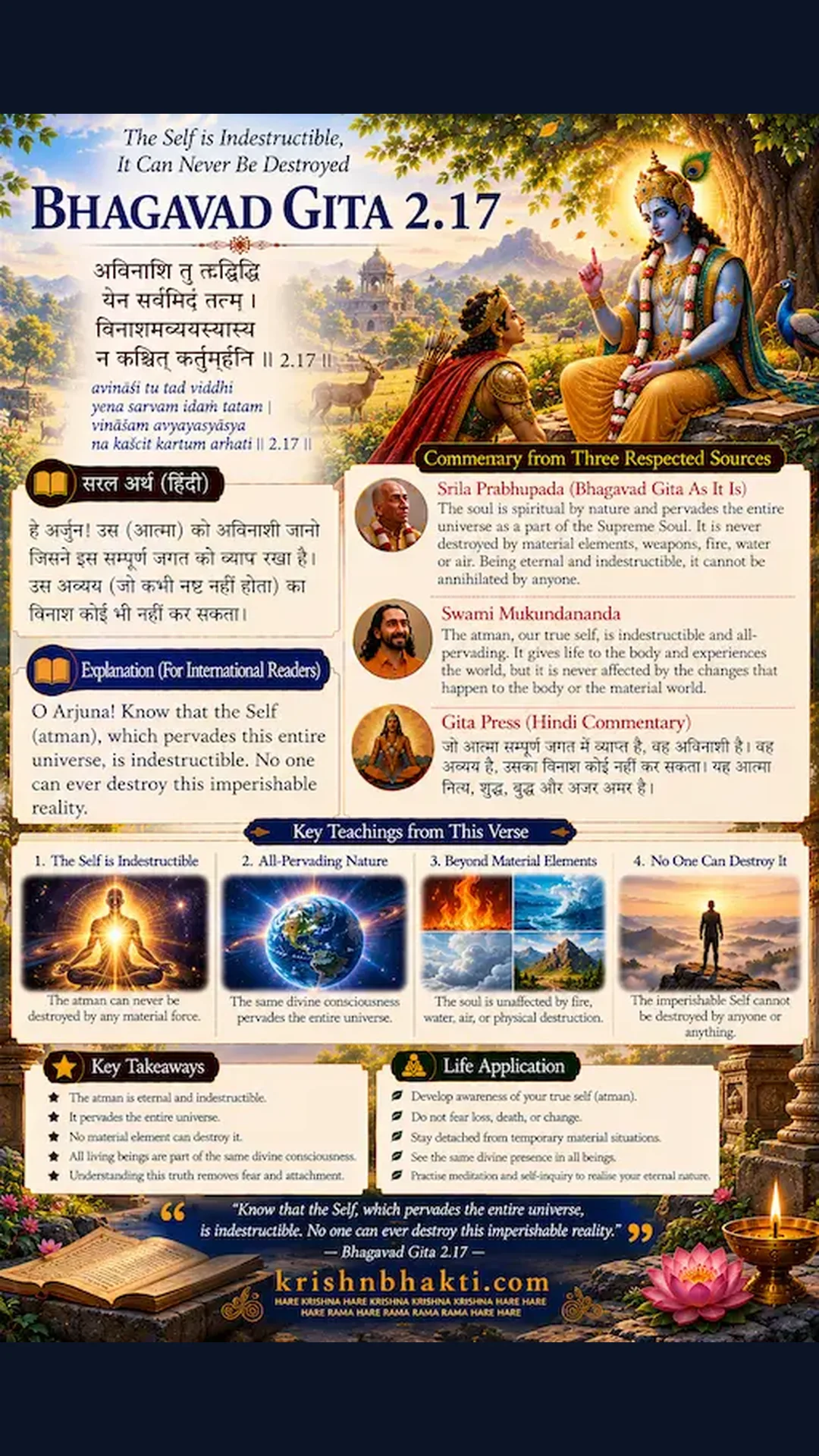
अविनाशि तु तद् विद्धि येन सर्वमिदं ततम्। विनाशमव्ययस्यास्य न कश्चित्कर्तुमर्हति॥ ॥ २.१७ ॥
Simple Meaning and Line-by-Line Breakdown
In simple terms, this verse means: Know that which pervades the entire body and universe to be indestructible. No one is capable of bringing about the destruction of this imperishable soul, which is changeless and eternal. Let us break down key Sanskrit words to absorb their full flavor.
अविनाशि तु तद् विद्धि — 'Avinashi' means indestructible, immortal; 'tu' means but; and 'tat viddhi' means know that. Krishna is urging Arjuna to look past the physical shell and recognize the imperishable reality within. येन सर्वमिदं ततम् — 'Yena' means by whom/which; 'sarvam idam' means this entire universe/creation; 'tatam' is pervaded or spread out. Just as gold pervades every single gold ornament, the same divine consciousness permeates this entire cosmos.
विनाशम् अव्ययस्य अस्य — 'Vinasham' means destruction; 'avyayasya' means of the imperishable, of that which never diminishes or spends away; and 'asya' means of this soul. न कश्चित् कर्तुम् अर्हति — 'Na kashchit' means no one whatsoever; 'kartum' means to do or cause; 'arhati' means is able or capable. Empires have risen and fallen, weapons have clashed, ages have passed, but no power in existence has ever been able to destroy this soul, nor will anyone ever be able to.
From this verse, 3-4 vital takeaways emerge: First, our physical body is just an outfit; we are eternal souls. Second, the fundamental energy running through this cosmos is unified and unbroken. Third, death applies strictly to the physical vehicle, never to the occupant — thus, the fear of death is an illusion. Fourth, as long as we mistake ourselves for the body, suffering remains our constant shadow; once we realize our true spiritual identity, fear dissolves completely.
Deep Insights from Three Great Commentators
1. Swami Ramsukhdas Ji: Sadhana and the Science of Truth
Swami Ramsukhdas Ji Maharaj emphasizes in his commentary that by using the word 'Avinashi' (Indestructible), the Lord aims to shatter humanity's primary delusion of self-identification with mortality. Swami-ji explains that everything in the material world is 'avyayi' (subject to depletion, aging, and decay), but the soul is 'avyaya' (inexhaustible). Highlighting the word 'avyayasya', he compares material wealth to money in a bank account that depletes as you spend it, whereas the soul has no balance sheet that can ever run dry; it is infinite and complete.
Swami-ji offers a beautiful analogy: A stage actor playing the role of a king gets so caught up in his performance that when a fake sword strikes him in the drama, he starts weeping uncontrollably and mistakes the dramatic death for his actual demise. This is precisely our condition. We play roles in the worldly drama and mistake ourselves for those temporary characters. The core message of Swami-ji's sadhana is that a seeker must constantly practice the inner realization: 'I am not the body; I am the silent observer of the body.' When this vision solidifies, worldly disruptions lose their power to disturb peace.
2. Srila Prabhupada: The Lens of Bhakti and Krishna Consciousness
Srila Prabhupada, founder of ISKCON, explains this verse with profound devotional clarity. Prabhupada notes that while modern science can analyze the chemical compounds of a dead body, it remains entirely helpless in detecting the 'consciousness' that animated that body when life was present. Elaborating on 'yena sarvam idam tatam' (that by which all this is pervaded), Prabhupada explains that this consciousness is the unmistakable symptom of the soul's presence. Just as a single lamp illuminates an entire room with its light, the atomic soul situated in the region of the heart illuminates the entire physical body with consciousness.
In his purports, Prabhupada warns that materialistic people waste their entire lifetime caring exclusively for the physical body — a pursuit he often describes as 'dog's race.' Until a person realizes they are spiritual souls distinct from matter, all their endeavors are as futile as decorating a sinking ship. The path of bhakti connects us directly to this eternal soul and its supreme source, Lord Krishna. When someone becomes situated in Krishna consciousness, the fear of death vanishes because they realize their permanent home is in the eternal spiritual realm, not in this temporary material world.
3. Swami Mukundananda: Modern Psychology and Mental Resilience
Swami Mukundananda breaks down this verse using relatable modern terminology tailored for today's youth. Modern youth face intense performance anxiety, clinical depression, and paralyzing fears of failure. Failures in exams or collapsed startups often drive young people to despair. Swami-ji points out that this happens because we tie our entire self-worth to our job titles, academic grades, and social standing.
Swami-ji gives a brilliant modern analogy: Imagine playing an advanced video game where your avatar repeatedly dies or faces 'Game Over'. Do you weep in real life? Do you identify your actual self with the video game character? Of course not! You smile and press the 'Restart' button. Swami-ji explains that Lord Krishna hands us this very spiritual restart button. When you understand that your core self — the soul — is immortal and that worldly situations are merely game levels, daily stress melts away. You work with full sincerity, but the burden of outcomes no longer crushes your spirit.
Real-Life Scenarios: Bringing the Verse to Life
Let us test this wisdom in our daily routine. Suppose you are working in a corporate office, and during a morning review meeting, your manager harshly reprimands you in front of your colleagues. Your ego is bruised, and you feel your dignity has been shattered. You spend the rest of the day fuming with anger, skipping meals, and tossing sleeplessly all night. Ask yourself: Who actually suffered in this entire episode? Did your soul suffer? No power can touch the soul. It was your ego and your physical-social identity that got hurt. If at that exact moment you remember Krishna's teaching — 'This body and job are temporary; my inner consciousness is eternal' — you would simply view your boss's words as a line from a play and let it slide right off your shoulders.
Consider another modern scenario — the widespread youth anxiety surrounding physical aging and fitness culture. Spending hours sweating at the gym, slathering anti-wrinkle creams, and panicking over thinning hair has become the norm. People fear aging so intensely that they hide their birth dates. Why? Because they have confined their identity to skin and muscle. When a person realizes that this body is just an old garment destined to wear out, they still take healthy care of it as a vehicle, but its inevitable physical changes do not trigger psychological panic. Their face carries the grace of maturity rather than the terror of aging.
During meditation or mindfulness practice, this verse is an anchor. When you sit in meditation, physical aches, joint stiffness, and restless impulses arise — these are properties of the physical machine. The mind will wander endlessly. But when you anchor yourself in the realization, 'I am the observer witnessing both body and mind,' you rise above physical discomfort. This is the exact inner liberation Lord Krishna offers Arjuna on the battlefield — an impregnable fortress that no external army can breach.
Self Q&A: Addressing Your Deepest Doubts
1. Does believing 'I am a soul' make me indifferent or irresponsible toward my duties? Won't people call it escapism?
This is a natural question for any thoughtful youth. Arjuna had the exact same dilemma. However, Swami Ramsukhdas Ji clarifies that realizing the soul does not mean running away from duty; rather, it means performing duties with ultimate purity and courage. When you know you are an immortal soul, internal selfishness and fear evaporate. Without fear, you become far more courageous, selfless, and dedicated to righteousness. Arjuna did not abandon the battlefield after hearing this verse; instead, armed with clarity, he fought valiantly for dharma. Immortality makes you a true warrior of life, not a coward.
2. If the soul is immortal and cannot be harmed, how do karma, sins, and merits actually operate?
Srila Prabhupada explains that while weapons cannot cut the soul, the mind and senses through which the soul interacts with matter accumulate the reactions of karma. The soul remains pure in its essence, just as fire remains pure even when covered by smoke, but the subtle mind and physical vehicle accumulate imprints based on actions. Acting under material illusions binds the soul to repeated cycles of physical births in various species. Thus, Krishna's ultimate aim is to liberate us from this cycle, not to grant license for reckless actions.
3. When heavy anxiety or depression strikes, how can I immediately apply this verse to calm down?
Swami Mukundananda suggests a very practical technique. Whenever a major crisis hits — a job loss or a breakup — ask yourself three quick questions: 'Is this pain happening to my physical shell or my inner self?' 'Is this external situation permanent?' and 'Is there something deep within me untouched by this storm?' When you close your eyes and look within, you realize that while surface thoughts rage like waves, an ocean of unshakeable peace lies at your depth. Connecting with that inner calm is what living this verse means. Take a deep breath and remember: this too shall pass, but you remain eternal.
4. Do modern science and this Bhagavad Gita verse point toward the exact same conclusion?
Today's youth deeply respect science. Modern physics states that total energy in the universe is conserved — it can neither be created nor destroyed. Swami Mukundananda often notes that what physics terms 'energy', spirituality terms 'consciousness' or 'soul'. The only distinction is that material science observes energy as inanimate, while the Gita views it as divine, conscious, and blissful. The core principle remains identical: nothing real in this universe ever perishes; it only transforms.
5. What is the easiest way to remember this verse so minor daily irritants stop ruining my mood?
Swami Ramsukhdas Ji recommends a simple daily practice. Spend just five minutes each morning reminding yourself: 'This body and world are a rented house; I am a temporary guest, not the owner.' When someone at work or college tries to put you down or circumstances turn hostile during the day, silently remind yourself of the core message — 'Avinashi tu tat viddhi...' — I am that indestructible reality untouched by this trivial event. Over time, this transforms into a subconscious habit, shielding your mind from petty disturbances.
🙏 Hare Krishna — Jai Shri Krishna 🙏
📖 Also Read: What Never Dies vs What Always Fades: The Ultimate Truth of Gita 2.16 🧠✨