📅 2026-07-01
In the previous verse, Lord Krishna gave Arjuna a profound introduction to the temporary nature of the physical body and the eternal, indestructible nature of the soul. Krishna calmly and firmly explained to Arjuna that these bodies are merely like garments—worn today, discarded tomorrow when they grow old. Yet, Arjuna’s grief, his deep-seated confusion, and his human terror of fighting his own teachers and loved ones had completely paralyzed his intellect. His Gandiva bow was slipping from his hands, his limbs were trembling, and he was suffering from an acute existential crisis right in the middle of the battlefield. Amidst this intense mental turmoil, when Arjuna completely surrendered and begged Krishna to guide him, the Lord began unlocking an ocean of wisdom capable of liberating humanity from the primal terror of life and death.
Today, we find ourselves trapped in the exact same kind of battlefield in our modern lives. The moment the sun rises, an invisible wave of anxiety hits us. The mad rush to catch the morning metro, the gnawing fear of a boss's reprimand at the office, the relentless pressure of performance targets, the subtle inferiority complex triggered by seeing everyone's 'perfect' lives on social media, and the constant dread of an uncertain future—all these combine to make our minds tremble just like Arjuna's did on the plains of Kurukshetra. When a close relationship breaks down, when a job is unexpectedly lost, or when someone we love falls seriously ill, it feels as though our entire universe has collapsed. We wrap ourselves so completely in the physical reality of these transient experiences that we forget who we truly are beneath this fragile skin and bone.
A very common misconception exists in the minds of people today regarding spirituality. Many think that being spiritual means running away from the world, suppressing all natural emotions, or turning oneself into an unfeeling stone. People often assume that reading the Gita means we should never feel sad, that we should always wear a fake smile and casually brush off every major loss in life. But is that really what Krishna is teaching? Absolutely not. Krishna is not asking us to suppress our feelings; rather, He wants to shatter the false identity that makes us believe we are weak, helpless slaves to external circumstances. As long as we identify exclusively with this physical body, every small wound, every insult, and every loss will continue to shatter us from within.
To pull us out of this suffocating illusion and existential crisis, Lord Krishna uttered this extraordinary verse. This shloka is not merely a dry philosophical statement; it is an impenetrable shield for human consciousness. When you deeply internalize the truth of this verse, the greatest storms of life, professional failures, and even the terror of death lose their power to shake you. This verse reminds us that we are not this limited, decaying body, but an infinite, pure, and eternal consciousness. Let us dive deep into the wisdom of this verse and reconnect with that indestructible power within.
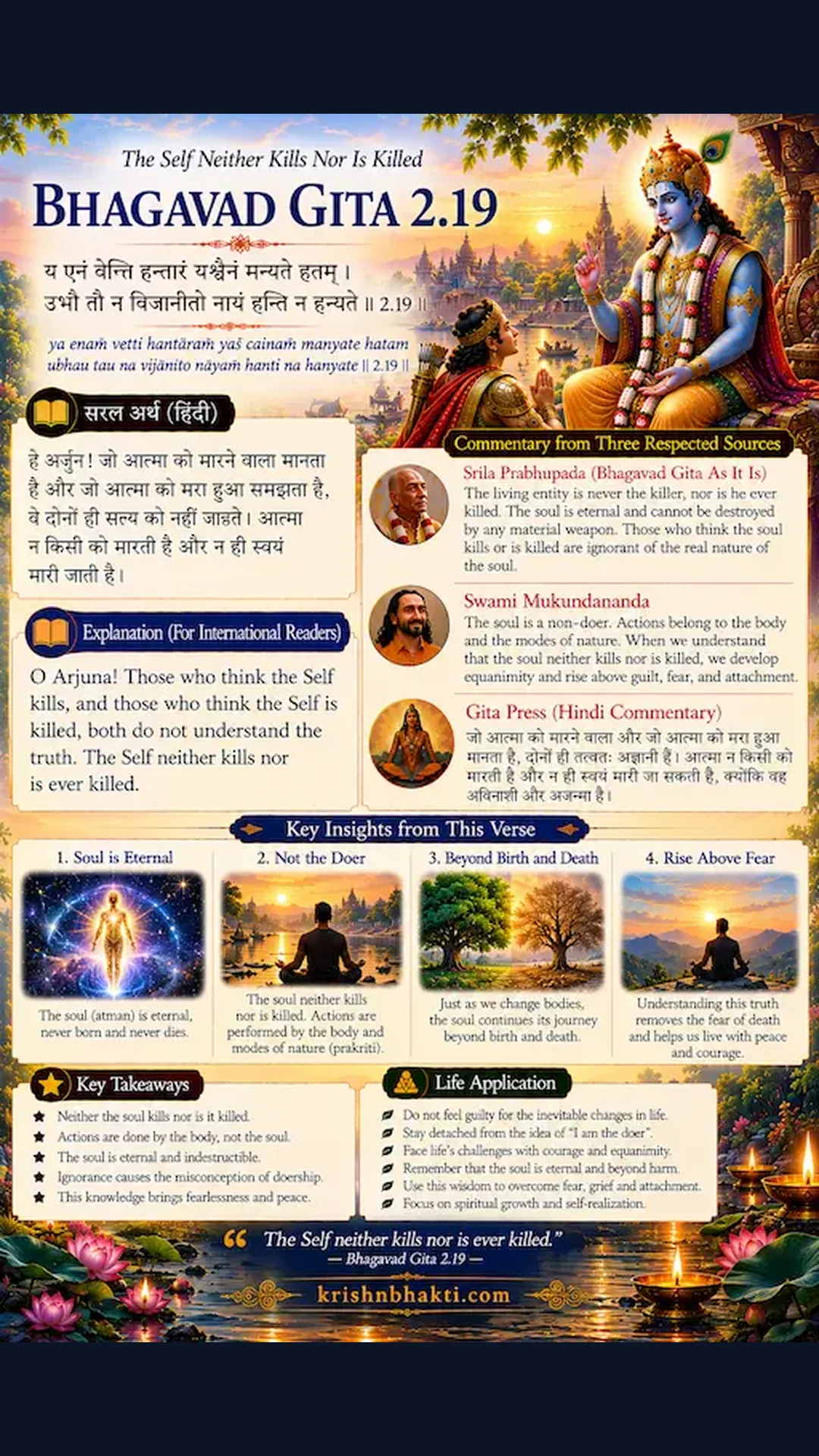
Here is the original Sanskrit verse as spoken by Lord Krishna on the battlefield:
य एनं वेत्ति हन्तारं यश्चैनं मन्यते हतम्।
उभौ तौ न विजानीतो नायं हन्ति न हन्यते॥ (२.१९)
Every single word in this shloka packs an explosive realization capable of wiping away centuries of human ignorance in a single stroke. Let us break down its simple meaning. Lord Krishna states that whoever thinks this soul can kill, and whoever thinks this soul can be killed, both of them are utterly ignorant of the truth. Why? Because the soul neither kills nor is it killed by anyone. It has no birth, and it has no death; it is primeval, eternal, and ever-existing.
The key takeaways we must absorb into our daily lives from this verse are crystal clear. First, the physical body dies, changes, and perishes, but the inner observer—the soul—remains completely untouched. Second, when we face the loss of a loved one or a catastrophic failure and cry out that 'everything is finished,' we are merely displaying our own ignorance of our true nature. Third, the guilt and paralyzing terror that often follow a destructive conflict stem entirely from failing to recognize this spiritual reality. Fourth, Krishna directs us to rise above the dramatic theater of external events and recognize our core divine identity.
Now let us examine the profound layers of this shloka through the lenses of three great spiritual masters. First, let us look at the commentary of Swami Ramsukhdas Ji Maharaj. In his renowned commentary 'Sadhak Sanjivani,' Swami Ji sheds meticulous light on every single phrase of this verse. He points out that 'y enam vetti hantaram' refers to those who mistake bodily death for total annihilation because they are entirely disconnected from the spiritual reality of the soul. Swami Ji explains that man's greatest suffering is his blind attachment to this perishable body. The moment a scratch appears on the skin, a person feels as though their very soul has been wounded. Swami Ji advises that a seeker must constantly practice the inner awareness: 'I am not this body; this body is merely an instrument given to me.' He gives a vivid analogy: when a person discards old, tattered clothes and puts on fresh ones, do they weep over the destruction of the old cloth? Of course not. Similarly, a wise person or a dedicated seeker does not sink into ignorant grief when the body falls ill or passes away, because their vision remains anchored in the indestructible eternal reality.
Next, Srila Prabhupada, the founder of ISKCON, explains this verse through the pure, devotional lens of Krishna consciousness. In his monumental work 'Bhagavad Gita As It Is,' Prabhupada clarifies how modern people get trapped in laboratory experiments and material science, thereby denying the existence of the soul. Prabhupada explains that the presence of the soul can easily be understood simply by observing the transformation of the body. As long as the soul is present, the body is vibrant, conscious, and active. The moment the soul departs, the body becomes a useless lump of lifeless matter. Prabhupada’s perspective teaches us that we are eternal parts and parcels of Krishna, and when we align our consciousness with Him, every trace of fear—especially the fear of death—vanishes permanently. Prabhupada emphasizes that a person who takes complete shelter of the Supreme Lord neither fears this present life nor worries about the future, knowing fully well that their eternal home is at the feet of Krishna and that the soul can never be slain.
Let us now turn to the insights of Swami Mukundananda, a prominent contemporary Vedic scholar. Swami Mukundananda bridges ancient wisdom and modern corporate life with astonishing clarity. He often uses a brilliant modern analogy: when today's youth work in high-pressure corporate environments, they face crushing anxiety regarding project failures, layoffs, or company downsizings. Young professionals often assume that if they lose their job, their entire existence has come to an end. Swami Ji explains through this verse that this job, this designation, this bank balance, and even this physical body are merely like characters in a video game. Your character might get defeated in the game, but do you—the real player sitting behind the screen—actually die? Not at all! Swami Mukundananda explains that when you start viewing life as a grand evolutionary journey where every experience is a lesson, office stress, relationship breakups, and professional setbacks lose their ability to crush your spirit. He advises young people to stop tying their self-worth exclusively to their material achievements or failures.
Let us connect this to concrete, real-life scenarios that young professionals and students face daily. Imagine you are working in a fast-paced corporate office. You spent weeks burning the midnight oil to prepare a high-stakes presentation. During the meeting, your senior openly tears your hard work apart and dismisses your months of effort in front of the entire team. In that exact moment, a burning rage surges in your chest, a bitter taste of humiliation chokes your throat, and you come home, lock your bedroom door, and weep in utter despair, feeling like a complete failure whose worth has dropped to zero. Now, pause right here and recall this verse of the Gita. Can two harsh sentences from a senior touch your eternal soul, which is birthless and deathless? Can your intrinsic divinity ever depend on a corporate job title? Absolutely not! When you view the situation from this higher standpoint, that professional insult shrinks down to a momentary play on a stage, and you bounce back the very next day with renewed enthusiasm and zero internal scarring.
Consider another deeply relatable scenario: romantic breakups and heartbreaks. Among today's youth, this is often the most acute and agonizing pain. When someone you considered your entire universe—the first thought of your morning and the last thought of your night—suddenly walks out of your life, it feels as though a dagger has been driven straight through your chest. For months, sleep abandons you, your appetite vanishes, and your mind spins endlessly with the obsessive question: 'Why did they do this to me?' You begin to feel internally dead. Yet, Lord Krishna is offering you a massive perspective shift through this shloka. He reminds you that no human being has the power to destroy your inner soul, which is a spark of the Divine. Relationships form and dissolve, people enter and exit, but you remain an independent, complete consciousness far above these external fluctuations. The moment this realization even flickers in your heart, that suffocating emptiness begins to quiet down.
Naturally, several practical questions arise in the reader's mind regarding this verse. Let us address them one by one. First, people often ask: 'Does this verse mean that if someone physically harms us, we should feel no pain whatsoever, or should we just quietly endure injustice?' Swami Ramsukhdas Ji offers a beautiful clarification on this. Swami Ji explains that experiencing physical pain or bodily discomfort is completely natural—if it is freezing, you will feel cold, and if you get cut, you will bleed. However, a wise person does not allow that physical pain to penetrate deep into their inner consciousness and destroy their peace. They recognize that bodily changes are governed by material nature, so they remain internally unperturbed by external events. This does not mean one should not stand up against injustice; rather, it means that while fighting injustice, you never lose your inner balance and tranquility.
Another common question is: 'If the soul is eternal and cannot be killed, why should we care about our actions, karma, or moral responsibilities?' Srila Prabhupada answers this decisively. Prabhupada explains that even though the soul itself is indestructible, the actions you perform through this physical body leave deep impressions (sanskars) on your mind and subtle consciousness. If you inflict unjustified suffering on others, you contaminate your own consciousness, forcing yourself to wander endlessly through the painful cycles of material existence. Therefore, the law of karma operates at the level of the mind and body, not the eternal soul. Krishna is urging Arjuna to fight not out of malice or hatred, but as a sacred duty (dharma).
A third question frequently asked by today's youth is: 'When I am gripped by a severe panic attack or depression, how can I practically apply this shloka when my brain refuses to function rationally?' Swami Mukundananda provides a brilliantly simple and actionable technique for this. Swami Ji suggests that when intense stress or depression strikes, immediately anchor your attention on your breath and mentally remind yourself—'This body and mind are going through a difficult storm right now, but I am the observer sitting apart from this mind, watching this pain pass by.' This brief moment of psychological detachment pulls you out of the whirlpool where you were drowning.
Fourth, people often wonder: 'Can truly remembering this verse eradicate the fear of death completely?' The answer is a resounding yes. When you deeply understand that death is merely like stepping out of one room and entering another, the paralyzing dread of mortality that hollows out human existence gradually dissolves. You begin to live life not from a place of chronic anxiety, but as a fearless celebration of conscious existence.
Fifth and finally, readers often ask: 'Will there ever be a Kurukshetra moment in our lives where we are forced to stand against our own loved ones?' The answer is absolute. At various crossroads in life, you will be forced to make difficult moral choices—where you must stand up against toxic family traditions, peer pressure, or societal hypocrisy to walk the path of truth and integrity. At those exact moments, this very shloka will serve as your greatest armor and strength.
So, dear friends, engrave this supreme truth deep within your heart and mind starting today: you are not merely this fragile five-foot physical frame or the temporary label given to you by society. You are an infinitesimal spark of that infinite, immortal cosmic energy which no weapon can cleave, no fire can burn, no water can drench, and no wind can dry. Whenever the storms of life try to knock you off your feet, close your eyes, take a deep, grounding breath, and let the timeless words of Lord Krishna echo in your soul.
🙏 Hare Krishna — Jai Shri Krishna 🙏
📖 Also Read: When Your Whole World Falls Apart, Remember This Verse From the Gita 🌿