📅 2026-07-01
In the previous verse, Lord Krishna explained to Arjuna that the all-pervading reality sustaining the entire universe is indestructible and no one has the power to annihilate that immutable essence. Having established this grand cosmic truth, Krishna now brings the focus directly down to our physical existence and our deepest, most paralyzing fear: the obsession with the physical body. What is our greatest weakness? Excessive attachment to bodily identity, the crushing fear of losing loved ones, the terror of our own mortality, and the constant anxiety of physical decay. We spend our entire lives worrying that if this physical frame perishes, everything we are vanishes into nothingness. In today's hyper-fast modern world, where the younger generation derives its entire self-worth from careers, physical appearances, social media validation, and material success, this verse serves as a profound philosophical anchor and a mental sanctuary.
We often find ourselves comparing our lives to curated social media feeds where everyone appears happy, successful, beautiful, and seemingly immortal. Thus, when life throws a curveball—a sudden job loss, a broken relationship, a health scare, or the passing of someone dear—our mental equilibrium shatters completely. We fall into deep anxiety and depression, feeling as though our entire universe has collapsed. People often think spirituality is just an old-age ritual or something confined to temple walls. But the truth is that the Bhagavad Gita is the greatest life management manual ever given to humanity. It teaches us the stark difference between illusion and reality. As long as we mistake our temporary body for our ultimate identity, suffering and fear will never loosen their grip on us.
Society conditions us to believe that if the body is harmed, ages, or dies, our very existence is extinguished. But the Bhagavad Gita radically shatters this superficial assumption. With logical precision and profound compassion, Krishna explains to Arjuna that the entity you mourn, the entity you fear losing, never actually dies. For modern youth, understanding this truth means realizing that you are infinitely greater than your physical body, your bank account, or your job title. When we tie our entire identity to external, temporary milestones, every minor failure feels like an existential catastrophe. Krishna wants to liberate us from this fragile identity so we can live fearlessly.
Imagine a young corporate professional drowning in deadlines and target pressures. If that individual truly internalized the truth that this body and this job title are merely temporary garments, would the workplace anxiety not dissolve? Absolutely. When we understand that change is the very law of nature, we stop gripping things so desperately. We learn the art of letting go. Krishna's teaching reminds us that what is perishable will inevitably perish, and what is eternal can never be destroyed. Once this realization settles into the heart, all petty fears and paralyzing grief vanish forever.
The youth of today face an unprecedented identity crisis. Everyone is caught in a relentless rat race to prove themselves, sacrificing their inner peace along the way. We live in constant dread of future uncertainties: What if my startup fails? What if my partner leaves me? What if I am not successful enough? The answers to all these existential dreads lie in the timeless wisdom of Krishna. When Krishna establishes that the body is temporary while the soul is eternal, He connects us to an inner core that remains untouched by external storms. Within each of us lies a sanctuary of peace, purity, and eternity. Once we anchor ourselves in that inner reality, the howling winds of the outside world lose their power to disturb us.
This verse is not a morbid philosophical contemplation reserved for the hour of death; it is the raw energy required to fight our daily battles. When someone insults you, when your hard work goes unrecognized, or when a major project falls through, understanding the depth of this verse prevents you from sinking into despair. You realize that all this drama is happening on the surface level; your core soul remains utterly inviolable. The soul is never defeated, never wounded, and never destroyed. This realization builds an inner fortress of resilience that no external circumstance can breach.
Let us now turn our attention to the magnificent verse spoken by Lord Krishna on the battlefield of Kurukshetra. Read these Sanskrit words slowly, allowing their divine resonance to penetrate your consciousness.
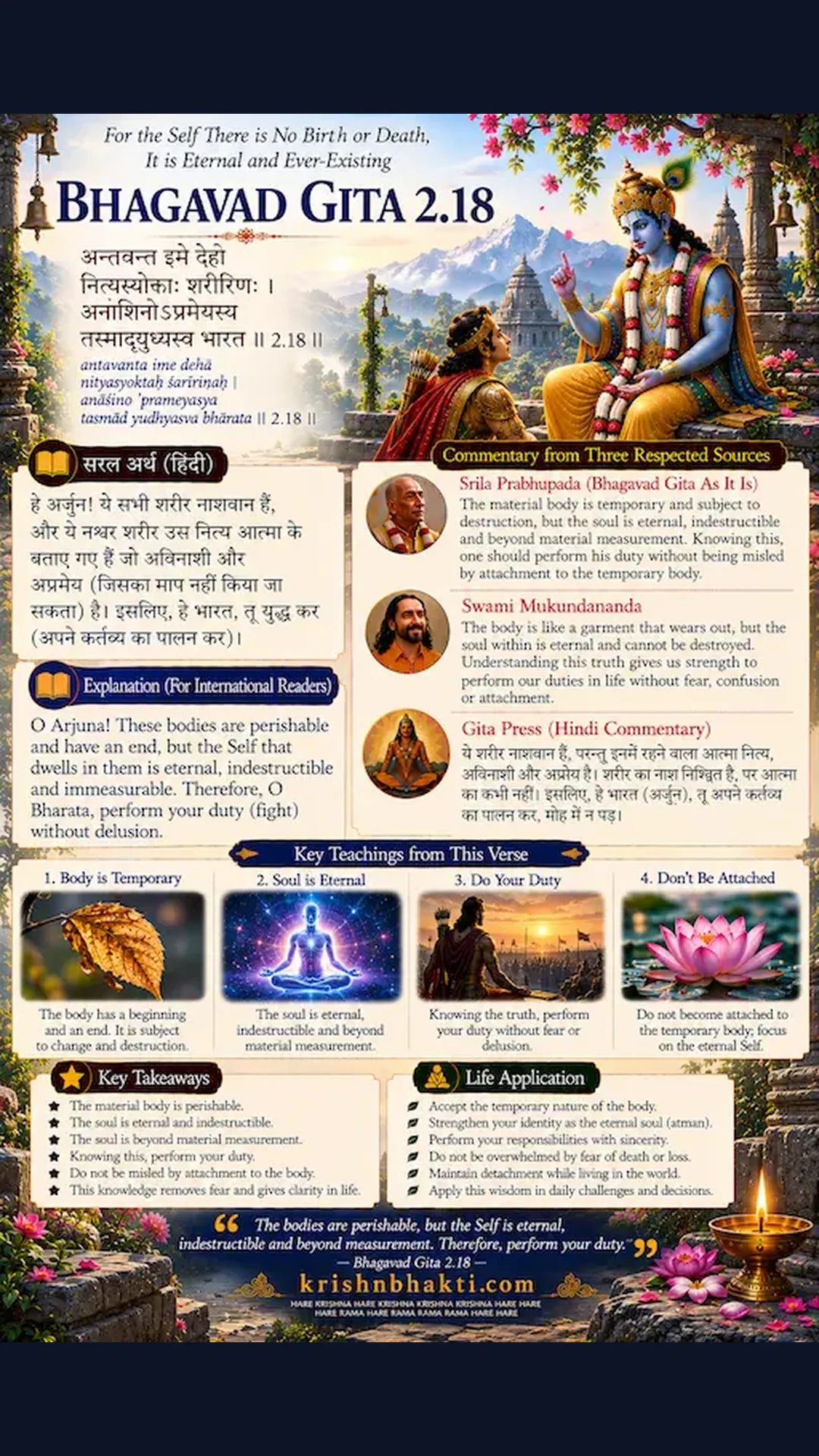
अन्तवन्त इमे देहा नित्यस्योक्ताः शरीरिणः। अनाशिनोऽप्रमेयस्य तस्माद् युध्यस्व भारत॥ ॥ २.१८ ॥
To unpack the simple meaning of this verse, we must examine its Sanskrit components with care. Lord Krishna tells Arjuna, O descendant of Bharata (Arjuna), these material bodies—which are subject to destruction—are declared to be perishable, whereas the embodied soul residing within them is eternal (nitya), indestructible (anashi), and incomprehensible or immeasurable by ordinary senses and intellect (aprameya). Therefore, fight! Here, 'antavantaḥ' means having an end, destined to perish. 'Ime dehāḥ' refers to these physical bodies. All physical forms we see in this world are temporary. Today they exist, tomorrow they decay. No matter how strong or beautiful a body is, its end is guaranteed. Conversely, 'śarīriṇaḥ'—the owner or dweller of this body, the soul—is eternal and indestructible.
Three fundamental takeaways emerge from this verse. First, the body and the soul are two entirely distinct realities. The body is merely clothing, and the soul is the wearer. Just as old garments are discarded for new ones, the soul transitions from one body to another. Second, the destruction of the body does not equal the destruction of the soul; therefore, mourning the death of the physical frame is rooted in ignorance. Third, when a righteous duty or crisis presents itself in life, one must never retreat from duty. 'Tasmād yudhyasva Bhārata' — therefore, O Arjuna, fight your battle, fulfill your duty.
Let us break down the verse flow: 'Antavantaḥ ime dehāḥ' — these bodies have an end. 'Nityasyoktāḥ śarīriṇaḥ' — of the eternal and embodied soul, these bodies are declared to have an end. 'Anāśino aprameyasya' — of that which is indestructible and immeasurable. 'Tasmād yudhyasva Bhārata' — therefore, fight, O Bharata. This verse teaches us to relinquish attachment to the fleeting outer shell and anchor our focus firmly on our righteous duty.
Let us now explore this verse through the profound commentaries of three legendary spiritual masters. First, we examine the viewpoint of the revered saint Swami Ramsukhdas Ji. In his monumental commentary *Sadhak Sanjivani*, Swami Ji offers a deeply moving explanation. He points out that by using the word 'antavantaḥ', the Lord makes it abundantly clear that every single object and body in this material universe has a definitive expiration date. What exists today will not exist tomorrow. Swami Ji places special emphasis on the fact that human delusion lies precisely in mistaking the perishable for the eternal, while completely forgetting the immortal soul.
Swami Ramsukhdas Ji explains that the term 'aprameyasya' is profoundly deep. The soul is so subtle and infinite that our intellects, scientific instruments, and logical frameworks can never fully measure or capture it. We can analyze every biological cell and map DNA in a laboratory, yet we can never capture the conscious spark animating the body. Swami Ji states that until a spiritual seeker understands this fundamental distinction—that the body belongs to material nature while the soul is a spark of the Divine—fear and attachment can never be eradicated. He frequently reminds seekers that bodily attachment is the root cause of all suffering. If an individual integrates the simple truth that this body is merely a rented dwelling, all greed, jealousy, and possessiveness naturally fall away.
Next, let us explore the perspective of His Divine Grace A.C. Bhaktivedanta Swami Prabhupada. In *Bhagavad Gita As It Is*, Prabhupada interprets this verse through the pure lens of devotion and Krishna consciousness. Prabhupada explains with striking clarity that modern civilization has become entirely absorbed in the bodily concept of life. People mistake themselves for bags of flesh and bones, living animalistic lives centered solely on eating, sleeping, mating, and defending. Prabhupada asserts that true peace is impossible until one realizes that they are not the body, but eternal servants of Krishna.
Prabhupada emphasizes that because the soul is indestructible, a person situated in Krishna consciousness never fears death. They understand that when this body expires, their journey does not halt; rather, they progress toward the eternal spiritual realm. In his lectures, Prabhupada constantly reminds us that our relationships in the material world and our physical shells are all temporary. Therefore, lamenting and agonizing over temporary things is sheer foolishness. Just as a person puts on new garments after discarding old ones, a wise person views physical death as a natural transition rather than an absolute end.
Now let us turn to the insights of the modern spiritual luminary, Swami Mukundananda Ji. Swami Ji bridges ancient philosophy with the practical psychological challenges faced by today's youth. In his discourses on mental health and stress management, he frequently highlights this verse. He notes that the greatest challenge for modern youth is perfectionism and the paralyzing fear of failure. People believe that failing an exam or missing a corporate target ruins their entire existence.
Swami Mukundananda Ji gives a wonderful analogy. He says that when we act in a theatrical play, playing the role of a king or a beggar, we know that once the curtain falls, we return to our true selves. Similarly, this material world is a grand stage, and our body is merely a costume assigned to us for this act. When you view life through this perspective, you stop taking office pressures or relationship upheavals too seriously. You give your hundred percent effort, but you remain emotionally detached from the results. Swami Ji emphasizes that this verse teaches us to channel our energy not into crying over spilled milk, but into fighting our righteous battle.
Let us translate this philosophy into a real-life scenario. Imagine a young software engineer named Rahul. Rahul spent sleepless nights building a major tech project. However, on presentation day, a client abruptly rejected the project without valid reason and harshly criticized Rahul in front of the entire team. Rahul was crushed. He felt his hard work was worthless and his reputation destroyed. He locked himself in his room, skipped meals, wept through the night, and even experienced dark suicidal thoughts, convinced his career was over.
Now, what if Rahul remembered Chapter 2, Verse 18 of the Bhagavad Gita in that moment of despair? Krishna reminds us that the body and all external things are 'antavantah'—temporary. Today's project was rejected; tomorrow a new one will be built. This body and this job are fleeting, but the soul seated within Rahul is invincible and immortal. That career setback did not scratch his true spiritual essence by even a fraction. When Rahul internalizes this truth, instead of drowning in tears, he wakes up the next morning ready to rebuild with a fresh perspective. He understands that failure exists only at the level of the physical body and the project, but his core identity remains untouched.
Let us consider another scenario. A young woman named Priya goes through a painful breakup after her long-term partner suddenly walks out of her life. Priya falls into deep depression, stops eating, quits going out, and obsessively ruminates over the person who left her, feeling utterly abandoned and hollow.
If Priya applies the wisdom of this verse, what realization dawns upon her? Krishna reminds us that every relationship and every person in this phenomenal world is temporary. Coming together and drifting apart at the physical and mental levels are laws of nature. But the soul is complete, sovereign, and entirely independent. When Priya understands that her true happiness does not depend on the presence of another human being, but shines from the light of her own soul, she begins to heal. She realizes her life has not ended; a new chapter of self-discovery has simply begun.
In the realm of meditation and spiritual practice, this verse holds immense significance. When a seeker sits for meditation, the mind often rebels initially. Physical pain arises, legs go numb, itching starts, or old traumatic memories resurface. The meditator thinks, "My body is suffering so much; perhaps I am failing at meditation." In that moment, remembering the teaching that "this body is perishable, fatigue and pain are its natural traits, but I am pure consciousness transcending this body" allows the practitioner to detach from physical discomfort. Rising above the bodily platform, the mind anchors securely in the soul. This is the true depth of meditation.
Let us now address several deep questions that frequently arise in the minds of spiritual seekers and modern youth, answered through the wisdom of our revered commentators.
Q1: Does this verse encourage escapism? If the body and everything else are temporary, what is the point of working hard?
Answer: This is a common misconception about the Bhagavad Gita. Swami Ramsukhdas Ji explicitly clarifies that Lord Krishna never endorses escapism. At the very end of the verse, Krishna commands: 'Tasmād yudhyasva Bhārata' — therefore, fight! Running away from duties is sheer cowardice. The Gita does not teach inaction; it teaches action performed without obsessive attachment. The body being temporary does not mean we neglect our health or abandon our responsibilities. It means we work with absolute integrity while remaining free from ego and results-obsession. Swami Mukundananda Ji echoes this, calling it 'active detachment'—staying on the battlefield, fighting, and winning, while keeping the mind liberated from unhealthy bondage.
Q2: When a loved one passes away, the grief is unbearable. Does understanding this verse mean we should stop crying or that feeling grief is wrong?
Answer: His Divine Grace A.C. Bhaktivedanta Swami Prabhupada sheds beautiful light on this. He explains that grief and shedding tears are natural human reactions when separation occurs; experiencing emotional pain is normal. The ignorance lies in making that grief permanent and assuming the person's existence has been entirely wiped out. The verse explicitly states that the body ends, but the soul does not. Therefore, Prabhupada explains that we should not lament the dead body, but rather pray for the auspicious spiritual progression of the eternal soul. Once this truth settles in, grief gradually transforms into a quiet, sacred remembrance rather than a destructive sorrow.
Q3: In a hyper-competitive corporate environment, how does one apply this verse without falling behind? Won't detachment make someone lazy?
Answer: Swami Mukundananda Ji provides a deeply practical answer to this. He states that the wisdom of the Gita does not make you lazy; rather, it turns you into a master strategist. When you realize that office politics, quarterly targets, applause, and criticism are all temporary, you do not stop working out of fear; instead, you deliver your hundred percent performance entirely free from performance anxiety. Anxiety stems only from fearful fixation on outcomes—"What will happen to me if I miss my target?" When you are liberated from that terror, your productivity multiplies. Operating with a calm and centered mind allows you to make wiser decisions, dramatically increasing your chances of success.
Q4: Does this verse mean we should ignore our physical body and mistreat it?
Answer: Absolutely not! Swami Ramsukhdas Ji warns that neglecting or punishing the body is another form of ego and attachment. The human body is revered as a temple of the Divine. As long as this body exists, it serves as the vehicle for the soul. If the vehicle breaks down, how can the journey proceed? Therefore, maintaining physical health, practicing yoga, eating nourishing food, and protecting the body is our sacred duty. The only shift required is stopping the false identification of 'I' and 'mine' with the body. We must view it like a rented vehicle that we care for with utmost responsibility while remaining detached from it.
Q5: How does this verse connect to the preceding verse, and how does it alter Arjuna's mental state?
Answer: In the previous verse (17th), Krishna established the macro-cosmic truth that the all-pervading reality cannot be destroyed. Yet, Arjuna's mind was still shackled by grief and affection for specific individuals (Bhishma, Dronacharya, etc.) whose physical bodies were facing annihilation. Arjuna feared that cutting down those bodies meant destroying everything. Therefore, in this 18th verse, Krishna specifically draws the distinction between 'ime dehāḥ' (these bodies) and 'śarīriṇaḥ' (the embodied soul). Krishna teaches Arjuna that those he fears killing or mourns losing are merely temporary physical forms; the soul is immortal. Hearing this, Arjuna's delusion begins to shatter, awakening him to the realization that fighting this righteous war is an absolute necessity.
At every turning point in life—whether walking through the darkness of failure or navigating the agonizing pain of heartbreak—Chapter 2, Verse 18 of the Bhagavad Gita catches us when we fall. It reminds us that we are infinitely greater, more resilient, and more eternal than this fragile physical shell. When we integrate this profound truth into our daily lives, every struggle transforms into a celebration, fear dissolves, and the radiant light of inner fearlessness takes root.
🙏 Hare Krishna — Jai Shri Krishna 🙏
📖 Also Read: What is Inside You That Fire Cannot Burn and Weapons Cannot Cut? 🧠✨