When Your Whole World Falls Apart, Remember This Verse From Krishna — You Never Die
📅 2026-07-01
In the previous verse, Lord Krishna explained to Arjuna that those who think the soul can kill or can be killed are both ignorant, for the soul neither slays nor is slain. Moving even deeper into this profound dialogue, and seeking to completely eradicate the deep-rooted terror of death and non-existence sitting inside Arjuna's heart, Lord Krishna now delivers one of the most revolutionary and famous verses in the entire second chapter of the Bhagavad Gita. This verse is not merely a philosophical theory; it is the ultimate, unfailing medicine for the greatest existential dread known to humankind.
Just pause for a moment and think about how terrified we all are in this modern life. From the moment we open our eyes in the morning until we fall asleep at night, there is a strange, invisible tension, an unspoken anxiety lingering within us. What is that fear really about? It is the fear of losing our job, losing someone we love, watching our bank account drain out, growing old in loneliness, and above all—the terror of our identity being wiped out. We have become so deeply attached to our jobs, our relationships, our physical bodies, and our social media image that we feel if any of these are taken away from us, we will cease to exist. Our entire self-worth rests on these fragile external props.
In the world of today's youth, this problem has taken on even more monstrous proportions. Corporate office targets, the pressure of startup failures, uncertain futures, and the chronic sickness of comparing oneself with others on social media have completely destroyed our mental peace. We feel that if we don't get that promotion this year, or if this relationship breaks down, our life is completely ruined. We treat every single failure as our final defeat. We begin to believe that we *are* that job, we *are* that broken relationship, we *are* that falling bank balance.
But right here is where we make our most fundamental mistake. Forgetting our true nature, we mistake this perishable body and these temporary circumstances for our entire reality. When a boss scolds us at the office or when someone we love walks out of our life, it feels as though a deep, incurable wound has been inflicted upon our very soul. We allow that pain to dominate our entire being. We completely forget that whatever is changing, whatever is coming and going, consists only of external garments and fleeting situations; the conscious observer sitting deep within is untouched and eternal, far beyond all of this.
People often think that spirituality and the teachings of the Gita are meant only for old age, when the time comes to take sannyasa. Young people think that this is the age to enjoy life, party, build a career, and that there is no room for philosophical discourses. But the reality is quite the opposite. In today's high-stress environment, where depression, anxiety, and suicide rates are continually rising, we need this verse from the Gita more than ever. This verse builds your mental resilience to such an extent that you can stand firm against any storm life throws at you.
When you realize that within you resides an element which no weapon can cut, no fire can burn, no water can wet, and no wind can dry, every single trace of cowardice and fear vanishes from your heart forever. You stop shattering over minor failures. You begin to understand that bodies may change, circumstances may shift, relationships may dissolve, but 'You' never change. Your eternal journey has been going on since infinite time and will continue for eternity.
To explain this wonderful perspective, Lord Krishna has woven words that pierce straight through the heart and settle deep within. Arjuna, who was still trembling with the fear of killing his own relatives and had dropped his bow in despair, is being slowly lifted by Krishna from the delusion of this mortal frame up to the realm of infinite consciousness. This journey is not just for a battlefield; it is the journey of every single person today who is struggling with their own private battles.
Let us now look at that sacred and immortal verse spoken by Lord Krishna to Arjuna and to all of humanity. Every single word of this verse holds the greatest truth of the cosmos. It is not just something to be read, but something to be internalized. When you absorb this verse deeply into your being, the biggest hardships of life will start looking like child's play to you.
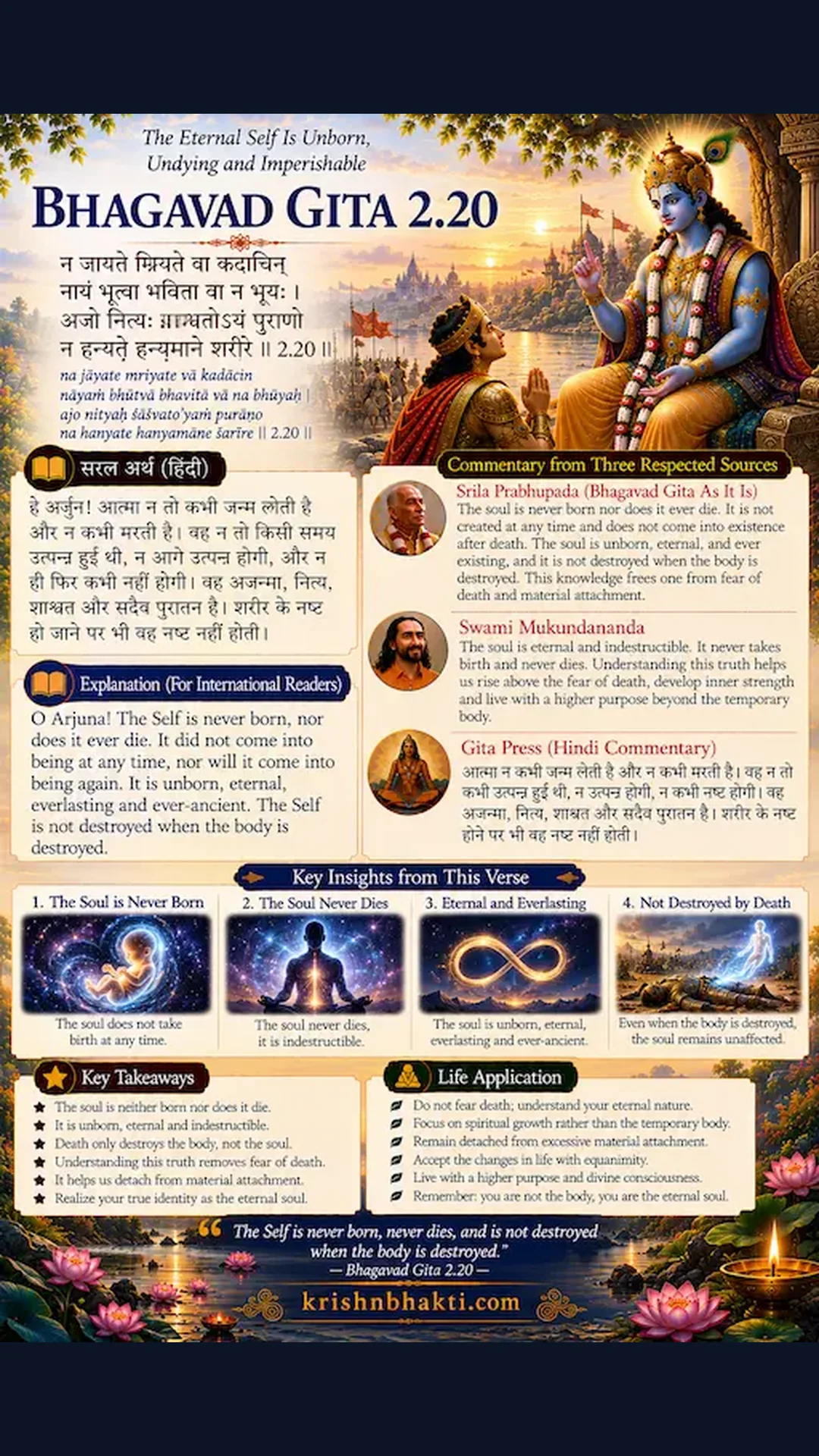
न जायते म्रियते वा कदाचिन्नायं भूत्वा भविता वा न भूयः। अजो नित्यः शाश्वतोऽयं पुराणो न हन्यते हन्यमाने शरीरे॥ ॥ २.२० ॥
Simple Meaning (Saral Arth) — The Eternal Truth of the Soul
The direct and simple meaning of this verse is that the soul is never born, nor does it ever die at any time. It is not that it came into being once and will cease to exist again in the future. The soul is unborn (ajah), eternal (nityah), everlasting (shashvatah), and primeval (puranah) — meaning that even though it is the oldest, it is always fresh and youthful. When this physical body is killed or destroyed, the soul is never killed.
Let us break down the key Sanskrit words one by one so that their essence settles completely within us. The structure of this verse is so scientific and precise that the entire mathematics of the cycle of birth and death is hidden within it.
Na jayate mriyate va kadachit — This soul never, at any time — neither in the past, present, nor future — takes birth, nor does it die. Birth and death are characteristics of the body alone, not of the soul. Just as we change old clothes when they wear out, the soul discards an old body and accepts a new one.
Nayam bhutva bhavita va na bhuyah — It is not that it did not exist before and was created now, nor is it that it will cease to exist hereafter. This stream of existence has always been flowing and always will. The law of physics states that energy can neither be created nor destroyed, it only changes form. Krishna stated this truth on a spiritual level thousands of years before science ever discovered it.
Ajo nityah shashvatoyam puranah — 'Ajah' means unborn, one who is never born. 'Nityah' means constant, remaining the same in every moment, never decaying. 'Shashvatah' means everlasting, permanent, indestructible. And 'Puranah' means ancient, primeval, yet always fresh and youthful. The soul is as old as the cosmos itself, yet it never ages.
Na hanyate hanyamane sharire — When this gross physical body is slashed with weapons, shot with bullets, or destroyed by disease and old age, the soul remains entirely safe and unharmed. No weapon can destroy it. The death of the body is not the death of the soul; it is merely the changing of a residence.
Through the Eyes of Great Masters — Detailed Analysis by Three Commentators
According to Swami Ramsukhdas Ji (Sadhak Sanjivani)
Swami Ramsukhdas Ji Maharaj, in his monumental commentary 'Sadhak Sanjivani', explains this verse with immense emotional depth. He points out that the greatest misery of human life is that man has identified himself completely with this perishable body. When sickness strikes the body, or when a loved one sheds their physical vessel, a human being feels as though everything has come to an end. Swami Ji explains that Lord Krishna uses the word 'kadachit' (at any time) to make it explicitly clear that under no circumstances — past, present, or future — is there ever an absence or non-existence of the soul.
Swami Ji emphasizes that the words 'ajah' (unborn) and 'nityah' (eternal) carry profound philosophical weight. A body originates from the union of parents, and therefore it is born and must die. But the soul is not born from anything or anyone; hence, it can never experience death. Swami Ji gives a beautiful analogy: just as clouds gather in the sky, roar, pour down rain, and eventually dissolve, the sky itself remains untouched, pristine, and unaffected by the coming and going of clouds. In the same way, body-like clouds come and go, but the consciousness-like sky within — the soul — remains eternally untarnished.
What is the utility of this verse in a spiritual seeker's life? Swami Ji explains that when a seeker walks the path of spiritual discipline, they often feel that their mind is restless, their inner tendencies are not dying, and they are facing continuous failures. At such times, they must remember that their true nature is miles away from these mental turbulences. The coming and going of thoughts, the ups and downs of the mind, cannot stain the soul. The soul is forever pure, enlightened, and free. This unwavering conviction gives a seeker the inner fearlessness and stability required to stay the course.
Swami Ji also clarifies why people fear death so intensely: because they mistake the body for the 'I'. If a person's shop catches fire, they grieve deeply because they identify with the shop. Similarly, when the time comes to leave the body, a person weeps because they have made this mortal frame their entire identity. The very day a human being realizes they are not the body but the immortal soul, all their fears and sorrows vanish forever.
According to Srila Prabhupada (Bhagavad Gita As It Is)
Srila Prabhupada, the founder of ISKCON, in his renowned work 'Bhagavad Gita As It Is', explains this verse through the angle of bhakti and pure consciousness. Prabhupada points out that modern science and materialists believe consciousness is merely a byproduct of chemical reactions within the body. They assume that when the body dies, consciousness is chemically extinguished as well. However, Prabhupada refutes this atheistic mindset through this verse.
Prabhupada explains that the soul is an actual spiritual spark residing within the region of the heart. The body is merely a machine, and the driver of this machine is the soul. When a vehicle breaks down or becomes too old, the driver steps out and sits in a new vehicle. Similarly, when this body stops functioning, the soul, according to the will of the Supreme and its own karma, acquires a new body. There is absolutely no cause for grief here, because why weep for something that never died in the first place?
On the path of bhakti, Prabhupada connects this verse directly with Krishna Consciousness. He states that because the soul is immortal, any devotional service we render to Lord Krishna in this lifetime is never lost. Everything done in the material world ends with the death of this body, but a single act of service performed in Krishna consciousness attaches itself to the soul forever. It travels with us into our next life. Therefore, a truly intelligent person is one who does not waste this immortal soul in the temporary sense-gratification of a mortal body, but instead engages it in the service of the Supreme Lord.
Prabhupada firmly explains that Arjuna's grief was born of illusion (moha). Arjuna was thinking that he was killing his own teachers and relatives. But Krishna explained to him that these bodies are destined to die anyway — whether today or tomorrow, they must perish. Yet, wise men do not lament for the living nor for the dead. Prabhupada's perspective teaches us to rise above material attachments and awaken our eternal spiritual identity.
According to Swami Mukundananda Ji (Practical Modern Application)
Swami Mukundananda Ji offers a modern, deeply practical interpretation of this verse. The severe anxiety and depression plaguing today's younger generation stem fundamentally from an identity crisis. Youth tie their self-worth to their careers, physical looks, bank balances, and relationship status. When even one of these pillars shakes, they feel as though their entire existence is under threat.
Swami Mukundananda Ji gives a brilliant analogy: Imagine you are playing a massive video game. Inside the game, you have an avatar. That avatar fights enemies, gets injured many times, and eventually might even experience a 'Game Over'. Do you start weeping uncontrollably when a game is over? Do you slip into clinical depression because your digital avatar died? Of course not! Because you know you are the real player sitting outside the screen; the avatar was just a temporary tool within the game.
Similarly, this material world is a grand game, and our physical body is merely an avatar. When we tether our identity exclusively to this body and this worldly setup, every minor setback feels like the end of our life. But when we adopt Swami Mukundananda Ji's perspective and realize that we are immortal souls transcending this body, our entire outlook transforms. Office failure, business loss, or a broken relationship begin to look like temporary twists and turns in that video game.
Swami Ji also explains that when we realize we are immortal, the fear of death and anxiety about an uncertain future disappear forever. We begin to live in the present moment. We understand that circumstances will come and go, people will enter and exit our lives, but our inner divinity can never be diminished. This realization shields us from the relentless hustle and mental turmoil of modern life.
Real-Life Examples — Applying This Verse in the Hustle of Modern Life
Let us bring these philosophical principles down into our everyday life. Imagine you are a 26-year-old corporate professional working day and night in a multinational firm. For the last six months, you have poured your heart and soul into preparing a major project, expecting a promotion and a handsome bonus. On performance review day, however, your boss dismisses your work without valid reason and promotes someone else instead.
What happens inside you at that exact moment? Your chest tightens, tears prick your eyes, and you feel as though your hard work, your dignity, and your entire existence have been crushed to dust. You begin to feel utterly useless and failed. Insomnia takes over your nights, and a turbulent chaos erupts in your mind, making you feel as though life is no longer worth living.
But wait. If at that very second you remember Lord Krishna's verse — 'Na jayate mriyate va kadachit...' — your perspective instantly shifts. You tell yourself: This job slipped away, my strategy might have fallen short, or office politics played a foul game. But has 'I' — my soul — been destroyed by this job? Did my existence depend on this promotion? Absolutely not! Jobs come and go, the body is exhausted, the mind is sad, but the observer sitting within is untouched and pristine far beyond all of this. This failure is not the final truth of my life; it is merely an experience making me stronger.
Let's consider a second example regarding relationships. Breakups and heartbreaks are painfully common among youth today. When a partner suddenly walks out of a relationship, a person often feels their world has collapsed. They lock themselves in a room for months, slip into deep depression, and lose all will to live, convinced they have no identity without that person.
Yet, this verse from the Bhagavad Gita delivers a powerful wake-up call. Krishna states that bodies change, relationships form and dissolve, people arrive and depart, but the soul remains immovable and immortal. The person whose departure makes you feel your life is ending was merely a physical body and a temporary connection. Your true essence does not depend on that individual. When you anchor your identity in that immortal divine spark within, no one's departure can dim your light. You are as complete and powerful on your own as you were with anyone else.
A third example comes from meditation and the practice of mental stillness. When you sit down to meditate, your mind initially goes haywire. Old traumas, future anxieties, workplace frustrations — everything surfaces at once. You feel frustrated and think, 'I can't meditate, I'm useless, I have no spiritual capability.'
Yet, this is precisely where you must grasp the core of this verse. The wandering of the mind and the rush of thoughts are merely surface ripples on an ocean. But who are you? You are the depth of that ocean upon which these waves rise and fall. When you stop identifying with your thoughts and anchor yourself in that witness consciousness, the comings and goings of thoughts no longer bother you. You simply become a tranquil observer. This is true meditation and the practical application of this verse.
Self Q&A — Resolving Doubts
1. Does this verse make us pessimistic or inactive? If everything is immortal, what is the need to work hard?
This is a common doubt that arises in the minds of youth: if the soul is immortal and never dies, why fight or hustle so hard? Swami Ramsukhdas Ji sheds beautiful light on this. He explains that Krishna is not asking Arjuna to run away from battle, but rather to perform his duty (dharma) with total dedication. The soul being immortal does not mean the physical body should become inactive.
Swami Ji explains that when you realize your true self is immortal, the fear of failure is stripped away from you. Free from fear, you can perform your duties with your full capacity and zero anxiety. A person who fears death or defeat always makes cowardly decisions. But someone who knows their true nature can never be destroyed faces every major challenge in life like a warrior. Therefore, this verse does not make you indifferent; it makes you the ultimate karmayogi.
2. When a loved one leaves this world, it causes deep grief. Does the Gita say we shouldn't cry or feel sad?
Srila Prabhupada answers this very clearly in his commentary. He notes that a moderate amount of grief or emotional pain at the separation of near and dear ones is natural at the physical level because we have spent a long time together. However, when that grief turns into blind attachment and crushing sorrow that shatters a person entirely, it becomes ignorance.
Prabhupada explains that wise individuals do not lament at the passing of a body because they know the soul is immortal and has embarked on its next journey. When we wail excessively over a death, we forget that the person was a soul, not a body. Our grief is directed toward the departing garment, not the soul. Krishna teaches us to step out of the swamp of illusion and anchor ourselves in our eternal spiritual connection and Krishna consciousness.
3. In a modern environment filled with cut-throat competition and insecurity, how do we practically apply this principle of immortality?
Swami Mukundananda Ji offers a highly practical solution here. He says that while avoiding competition in modern life may not be entirely possible, transforming our perspective is entirely in our hands. When you work in your profession or office, give it your absolute hundred percent, but do not shackle your identity to the final outcome.
Swami Ji explains that when your self-worth is restricted to your resume and bank balance, even a minor setback throws you into depression. But when you practice the realization that 'I am a divine soul transcending body and designation', you treat your work like a play, like an act of service. Winning or losing does not disturb your inner joy. This is the only foolproof formula for mental peace in modern life.
4. In the previous verse, Krishna said the soul neither kills nor is killed, and in this verse He says it is never born and never dies — how are these two connected?
Swami Ramsukhdas Ji explains this connection with profound depth. In the previous verse (2.19), Krishna addressed the realm of action and consequence, establishing that weapons can only cut the body, not the soul. In this verse (2.20), Krishna establishes the ontological reality of the soul — its absolute unborn and undying nature.
The first verse targets action and consequence, while this verse establishes foundational existence. Krishna is dismantling every single illusion Arjuna carried in his mind. Arjuna thought he was destroying the existence of his elders and incurring terrible sin. Krishna responds: My dear friend, you are not destroying any existence; bodies change, you are merely an instrument.
5. Is believing that 'I am an immortal soul' merely a psychological coping mechanism, or does it have a genuine spiritual basis?
Srila Prabhupada and all great acharyas agree unanimously that this is not a concocted psychological placebo, but the supreme truth of the cosmos. Psychology can offer temporary soothing agents, but it can never uproot the real fear of death.
Only self-realization is the key that liberates a human being from the fear of death once and for all. When a seeker directly experiences this truth through meditation and devotion, this drama of life and death transforms into a divine play. They no longer panic at life's blows, knowing their real home is far beyond this mortal realm.
🙏 Hare Krishna — Jai Shri Krishna 🙏
📖 Also Read: When the Soul Can Never Be Cut, Why Fear Anything? 🧠 Gita 2.19