What Do You Do When Your Entire Life Changes Overnight?
In the previous verse, Lord Krishna explained to Arjuna that the soul is unborn, eternal, everlasting, and primeval. It is not slain when the body is slain. While this sounds profoundly philosophical and spiritual, what does it actually mean when applied to our chaotic, modern lives? When a young corporate professional in Delhi or Bangalore is suddenly laid off on a random Tuesday morning, what comfort does the immortality of the soul bring? When a relationship you poured five years of your life into ends with a casual text message, how does this ancient verse mend a shattered heart?
Imagine a 26-year-old software engineer who has been pulling all-nighters for months to build a startup. One fine morning, an email arrives stating that due to downsizing, his position has been terminated. In that single moment, his entire identity, his future plans, his self-worth, and his bank balance feel utterly meaningless. He asks himself, 'If I am not this job, who am I?' This crisis of identity is something millions of young people face today. We tie our worth so tightly to our titles, our Instagram follower counts, our academic degrees, and our romantic validation that when these external pillars shake, we feel like we are dying.
Or consider the deep agony of modern heartbreak. In an age of rapid swiping and instant connections, we invest our emotions quickly, and the pain of detachment is equally excruciating. When someone you thought was your forever says, 'I need space' or 'We are moving in different directions,' the hollow feeling in your chest is suffocating. You spend sleepless nights scrolling through old chats, replaying memories, wondering where it all went wrong. Your mind screams, 'My life is over! How will I ever be happy again?'
Right in the middle of this existential dread and emotional turbulence, Lord Krishna offers a perspective that can wipe away every tear. We constantly confuse ourselves with our temporary roles—we think we are our job title, our relationship status, our anxious minds, or our physical bodies. When these circumstances shift or vanish, we panic because we think *we* are vanishing. But Krishna's message cuts through this illusion with razor-sharp clarity, reminding us of a dimension of our existence that time, loss, and death can never touch.
Change is the undeniable law of this material universe. Every single relationship, every job, every phase of life, and every physical body has a fixed expiration date. Yet, the greatest source of human suffering is our stubborn resistance to this flow. We try to grasp water tightly in our fists, and when it slips through, we weep. We treat temporary pit-stops as our permanent home.
Many people make the mistake of assuming that spirituality is an escape from reality—a tool for people who want to run away to the Himalayas. But the Bhagavad Gita was spoken on a roaring battlefield, not in a quiet, isolated cave. It is a manual for warriors standing right in the middle of life's chaotic conflicts—where relationships break, careers collapse, and uncertainty surrounds us on every side. It is precisely in this messy, high-pressure environment that Krishna delivers a verse that can anchor our drifting minds.
Let us dive deep into this magnificent verse and explore how its profound spiritual science can heal our modern anxieties, quiet our racing thoughts, and help us navigate the inevitable storms of life with grace and unshakeable inner peace.
वेदाविनाशिनं नित्यं य एनमजमव्ययम्।
कथं स पुरुषः पार्थ कं घातयति हन्ति कम्॥ २.२१ ॥
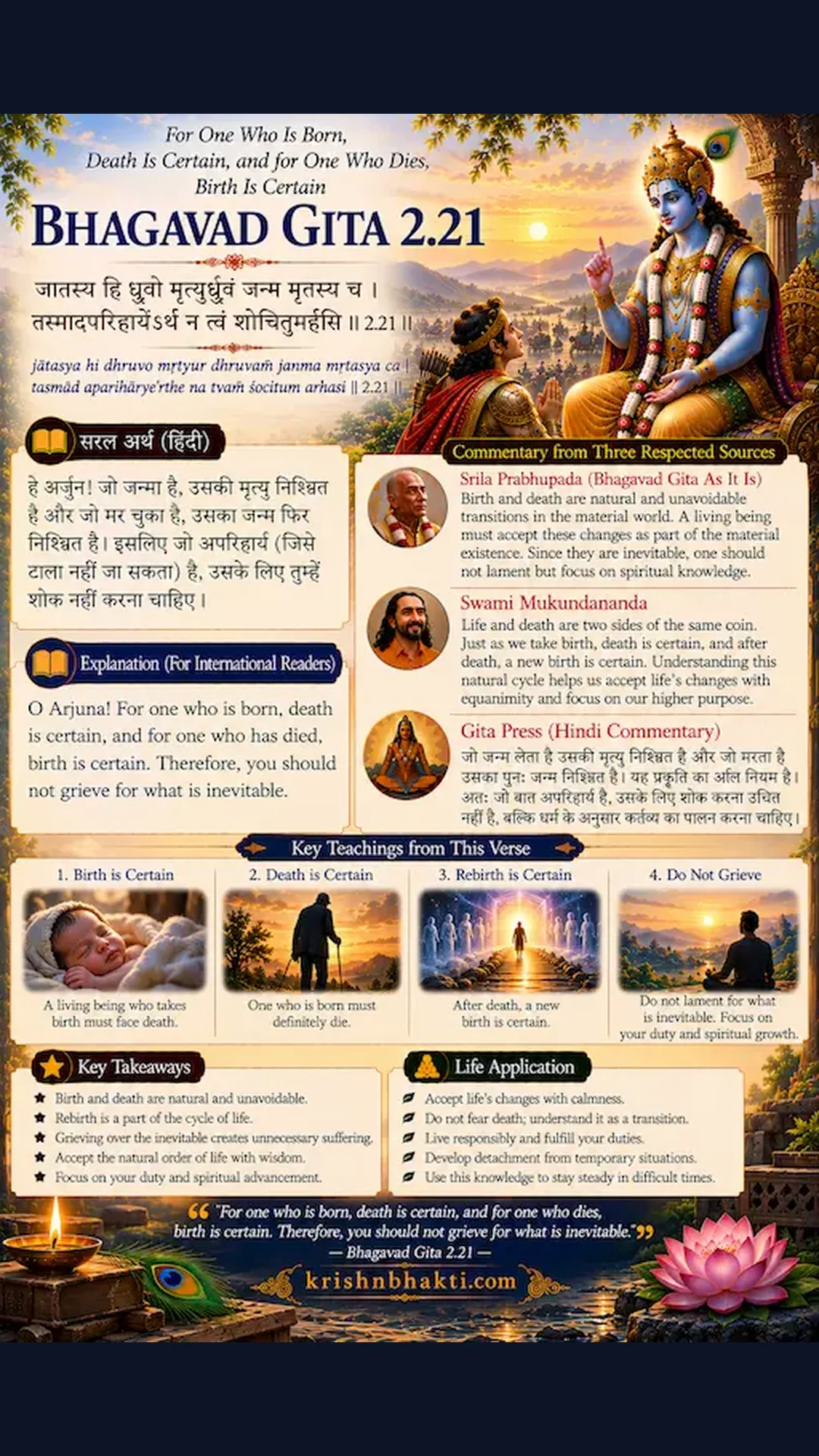
Simple Meaning and Line-by-Line Breakdown
Every single word in this verse carries an ocean of wisdom. Lord Krishna asks Arjuna a logical yet deeply piercing question: 'O Partha, how can a person who knows that the soul is indestructible, eternal, unborn, and immutable kill anyone or cause anyone to be killed?' Let us break down the Sanskrit terms to understand the exact anatomy of this profound statement.
Line-by-line breakdown: वेदाविनाशिनं नित्यम् — *Veda avinaashinam nityam* — One who knows the soul as indestructible (*avinaashi*) and eternal (*nityam*). य एनमजमव्ययम् — *Ya enam ajam avyayam* — Who knows it to be unborn (*ajam*) and unchanging/immutable (*avyayam*). कथं स पुरुषः पार्थ — *Katham sa purushaH paartha* — O Partha, how can such a wise person? कं घातयति हन्ति कम् — *Kam ghaatayati hanti kam* — Kill anyone or cause anyone to be killed? In essence, when a person realizes the immortal nature of the true self, all motives for malicious violence, paralyzing fear, and blinding grief naturally dissolve.
From this verse, 3-4 vital takeaways emerge for our daily lives. First, our identification with the physical body and external roles is an illusion. Second, when we understand that everything in the material world is constantly changing and perishing, our frantic clinging to people and situations begins to relax. Third, any loss or failure that feels like the end of the world today is merely a transition in a grander, eternal journey.
When a student fails an exam or gets rejected from their dream university, they feel their future is destroyed. But the light of this verse reminds us: You are not your exam score, you are not your college admission status, and you are not your temporary failure. Your true essence is far higher, purer, and beyond the reach of material setbacks. When we view our daily struggles through this lens, our problems shrink in magnitude, and our inner resilience multiplies manifold.
The Perspective of Three Great Acharyas
To truly digest the beauty of Bhagavad Gita 2.21, we must look at it through the commentaries of three legendary spiritual masters: Swami Ramsukhdas Ji, A. C. Bhaktivedanta Swami Prabhupada, and Swami Mukundananda. Each of them brings a unique, transformative lens to the same eternal verse.
1. Swami Ramsukhdas Ji: The Heartfelt, Practical Wisdom of 'Sadhak Sanjivani'
Swami Ramsukhdas Ji touches the core of the seeker's heart with his remarkably simple and intimate explanations. When commenting on this verse, he places special emphasis on the words *'avinaashi'* (indestructible) and *'avyay'* (immutable). Swami Ji points out that human misery stems from one fundamental error: seeking permanent happiness in a temporary, perishable world. We are trying to plant permanent roots in shifting sands.
Swami Ji explains that when we weep over the death of a loved one or a catastrophic financial loss, our attachment is invariably tied to the perishable body or the transient material form, not to the eternal soul. If we could develop even a glimpse of clear vision to see that the body is merely a garment changed by the soul, half of our worldly grief would vanish instantly. In his practical teachings, he encourages seekers to remind themselves every single morning: 'I am not this changing body.' This is not mere intellectual philosophy; it is a mental shield against life's brutal blows.
For modern youth struggling with anxiety and depression, Swami Ji’s approach is a lifeline. When a young person breaks down because of peer pressure or professional rejection, Swami Ji would say they are anchoring their identity to their performance review or social standing. Circumstances change, people walk away, and partnerships dissolve—these are the fixed laws of material nature. But the witness behind all these changes never alters or decays.
2. A. C. Bhaktivedanta Swami Prabhupada: The Devotional Angle of 'Bhagavad Gita As It Is'
Srila Prabhupada approaches this verse through the pure, loving lens of Bhakti yoga and surrender to Lord Krishna. Prabhupada insists that as long as a human being remains shackled to bodily identification, true peace is impossible. He explains that the soul is an eternal fragment of the Supreme Lord, and its ultimate home is not this temporary material plane, but the spiritual world in loving association with Krishna.
Prabhupada emphasizes that those who anchor their lives in devotional service become completely undisturbed by the dualities of happiness and distress, victory and defeat. When Arjuna was paralyzed by grief and cowardice on the battlefield, Krishna was rebuking his ignorance. The people Arjuna was afraid of killing were eternal souls, and the bodies he was trying to protect were destined to perish anyway. True compassion lies in spiritual awakening, not in sentimental bodily attachment.
Prabhupada’s commentary teaches us to view every crisis as an arrangement of divine providence. This is not fatalism; rather, it is supreme spiritual surrender that frees us from chronic anxiety. When every action is dedicated to Krishna, winning brings no arrogance, and losing brings no despair.
3. Swami Mukundananda Ji: The Bridge Between Modern Psychology and Ancient Wisdom
Swami Mukundananda Ji bridges the gap between ancient Vedic wisdom, modern neuroscience, and practical self-development. He frequently explains that the chronic stress, burnout, and existential emptiness plaguing today's generation stem from misplaced attachments. We attach our happiness to outcomes, people, and objects that are entirely outside our control.
Swami Ji uses a wonderful analogy: Think of an actor playing the role of a beggar or a king in a dramatic play. During the play, the actor weeps if his character suffers and rejoices if his character wins a crown. But deep down, the actor never forgets his true identity—he knows that when the curtain falls, he is neither a king nor a beggar. Similarly, we must play our assigned roles in the grand theater of life with utmost sincerity, but we must never fall under the delusion that the drama is our ultimate reality.
Swami Ji compares spiritual practice to a 'mental rep' in the gym. Just as physical muscles grow through repeated weightlifting, our mental resilience grows each time we consciously pull our minds back from grief and remind ourselves: 'I am the eternal soul; this situation is temporary.' This continuous mental conditioning creates an unshakeable psychological immunity against modern stressors.
Real-Life Scenarios: Applying Gita 2.21 Today
How do we translate these profound insights into our chaotic, screen-addicted, fast-paced modern lives? Let us look at concrete daily scenarios. Imagine a Monday morning at a high-pressure tech startup. You walk in, and your project manager openly berates you in front of your peers for a minor bug in the code. Your months of hard work are dismissed in thirty seconds. A hot wave of humiliation and rage floods your chest. You feel worthless, small, and deeply insulted.
This is precisely where Bhagavad Gita 2.21 steps in. That office chair, that project deadline, that aggressive manager, and your temporary job title—all of these belong strictly to the realm of the perishable body and material designations. Stepping back mentally and viewing yourself as the indestructible soul (*avinaashi*) creates an invisible shield. The manager's words sting the ego, but they cannot touch your core. You fix the bug professionally, but you are no longer enslaved by the opinions of temporary mortals.
Consider another common scenario: modern dating and relationship breakups. In the era of social media 'ghosting,' getting blocked overnight by someone you deeply cared about can trigger weeks of insomnia and obsessive overthinking. You stalk their profiles, questioning your worth. But anchoring yourself in Krishna’s wisdom reminds you that relationships in this world are transient meetings at a railway station. People board and deboard according to their destiny. The pain of separation is real, but it is not the end of your existence. You will heal, grow, and move forward because your true identity is immortal and complete in itself.
Even during meditation or mindfulness practice, this verse acts as an anchor. When you sit down to quiet your mind, distracting thoughts, past regrets, and future worries swarm your consciousness. You feel like a failure at meditation. But realizing that you are the *observer* of the thoughts, not the chaotic thoughts themselves, shifts everything. The mind may race, but you remain the calm, eternal witness.
Reader Doubts and Self Q&A
Q1: Does realizing that 'everything is temporary' make us cold, uncaring, or detached from our loved ones?
Answer: This is one of the most common doubts spiritual seekers face. Swami Ramsukhdas Ji addresses this beautifully by clarifying that true spiritual detachment (*vairagya*) does not mean cold indifference; rather, it purifies love. When our love is bound by worldly attachment (*moh*), it is always laced with fear, expectations, and possessiveness ('You must belong only to me'). Once you understand the eternal nature of the soul, your love becomes unconditional. You appreciate your loved ones deeply without trying to possess or control them. It is love without fear—the highest form of human connection.
Q2: When a major tragedy strikes—like the sudden loss of a parent—why doesn't this philosophical knowledge stop the immediate grief and crying?
Answer: Srila Prabhupada explains that our multi-lifetime conditioning of identifying with the physical body is profoundly deep. Reading a verse does not instantly erase lifetimes of bodily attachment. Crying and feeling grief are natural human emotional responses—even Arjuna wept and laid down his bow on the battlefield. Krishna does not criticize Arjuna for feeling grief; rather, He gently corrects the illusion behind that grief. Over time, through steady practice and remembrance of Krishna, the spiritual realization deepens, and even in moments of profound loss, an inner anchor of peace remains intact.
Q3: Does this verse mean we should stop striving for career success, wealth, or ambition?
Answer: Swami Mukundananda Ji clears this up by emphasizing that the Gita teaches the art of right action (*Karma Yoga*), not inaction. Understanding that your body and material success are temporary does not mean you quit your job or drop out of college. It means you are liberated from outcome anxiety. You work with 100% excellence, but your self-worth is no longer tied to whether you get the promotion or not. When the fear of failure is removed through spiritual wisdom, your actual productivity and creativity skyrocket.
Q4: If the soul is immortal and everything is part of a grand cosmic order, why bother struggling so hard in life?
Answer: Swami Ramsukhdas Ji points out that this human birth is a rare, precious golden opportunity. While the soul is eternal, this specific physical life is the workshop where we elevate our consciousness and break free from the material cycle. Struggling to do our duty righteously is the very means by which our inner character is purified. Giving up effort is laziness, not spirituality. Action is our duty; detachment from the frantic results is our wisdom.
Q5: Can this verse help with minor daily stresses, like getting stuck in traffic or receiving a harsh email?
Answer: Absolutely! Swami Mukundananda Ji emphasizes that spirituality must be practiced in the arena of daily life. When a harsh email ruins your morning or a traffic jam triggers road rage, pause for five seconds and ask yourself: 'Will this matter five years from now?' Connecting with the eternal perspective instantly shrinks petty annoyances. It prevents trivial daily irritations from hijacking your mental peace.
🙏 Hare Krishna — Jai Shri Krishna 🙏
📖 Also Read: When Your Whole World Falls Apart, Remember This Verse From Krishna — You Never Die