When Loved Ones Leave and the World Feels Empty
In the previous verse, Lord Sri Krishna introduced Arjuna to the immortal, untouched, and eternal nature of the soul. He explained that the soul is never born, never dies, cannot be pierced by weapons, nor burned by fire. Yet, even after knowing this profound truth, when we lose someone very dear to us, our hearts refuse to accept it. A strange, aching void fills our chest. Waking up in the morning, we expect to hear their voice; as evening falls, we expect them to knock on the door, but instead, a heavy, deafening silence surrounds us. This is the bitter truth of our material existence, and running away from it is simply not an option.
All of us go through this phase at some point in our lives. A childhood friend moves far away, a parent or grandparent bids a final farewell to this world, and all we are left with are a few old photographs, lingering memories, and a chilling quietness. At that very moment, a haunting question echoes in our minds — "Where did that person go with whom I shared every single thought? Are they gone forever? Will I ever see them again?" These questions break us from within. In the stillness of the night, pacing on the terrace or gazing out of a hostel window, tears spill from our eyes without warning.
In the rush of modern life, we try hard to bury this grief. We throw ourselves into our work, sit through back-to-back office meetings, or endlessly scroll through social media reels just to distract our minds from that aching emptiness for a few moments. But as soon as night falls, that loneliness creeps right back in. Do you know why this happens? It happens because we mistake the physical body for the entirety of existence. We forget that the body is merely a garment, while the true player resides within. For today's young generation, plagued by epidemics of depression, anxiety, and isolation, the fear of death and separation hollows them out from the inside.
People often think that mourning is a sign of weakness, or they are terrified that even thinking about mortality will plunge their minds into despair. Many seek comfort in religious rituals and prayers, but until the inner doubt is cleared, true peace remains elusive. In this flashy, filtered world of social media where everyone is pressured to project a smiling face, dealing with the loss of a loved one or the inevitable passage of time leaves a person feeling utterly isolated. They cannot speak their heart out for fear of being labeled weak or overly emotional by peers.
This is precisely where Lord Sri Krishna steps in as our ultimate friend and guide. He shakes us awake and asks: What you are weeping for — was it ever truly yours to begin with? Does everything end just because a physical form perishes? Krishna pulls us out of this ocean of sorrow by offering a perspective that completely transforms our outlook on life. He teaches us that death is not destruction; rather, it is a graceful and necessary transition, much like stepping into a new chapter after a long journey concludes.
The analogy Krishna uses in this verse is so simple yet so striking that grasping it immediately lightens the heaviest of hearts. He directly attacks that primal human fear which has haunted civilization since time immemorial — the fear of death. For modern youth entangled in career uncertainties, broken relationships, and anxious futures, this verse acts as a spiritual balm. It teaches that change is the law of nature, and learning to accept every transition with grace is the key to inner freedom.
So let us dive deep into this supreme message of Lord Krishna without any preconceived notions, and explore how this ancient wisdom can heal our modern, chaotic lives and render us truly fearless from within.
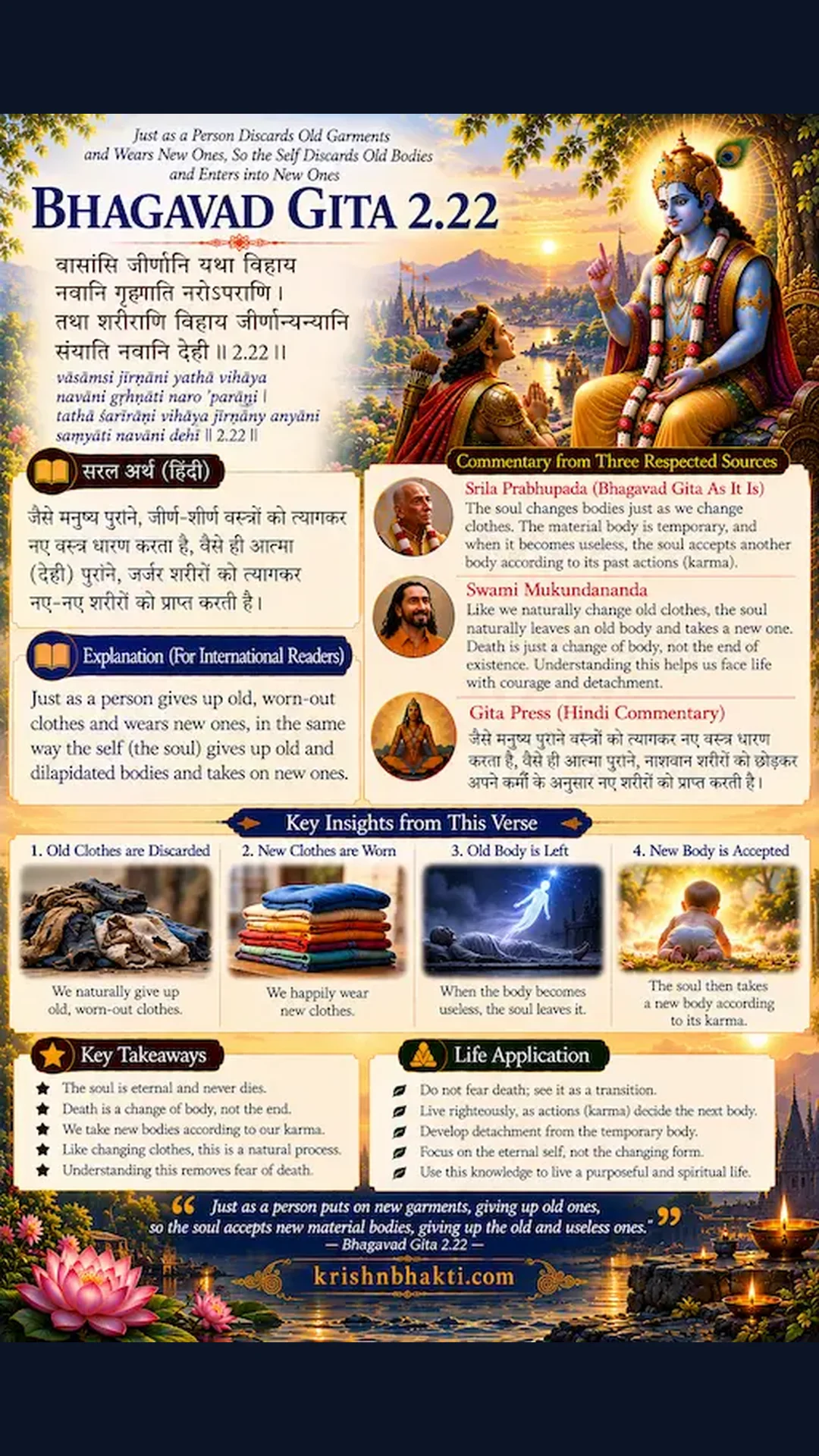
वासांसि जीर्णानि यथा विहाय नवानि गृह्णाति नरोऽपराणि।
तथा शरीराणि विहाय जीर्णान्यन्यानि संयाति नवानि देही॥ २.२२ ॥
Simple Meaning and Profound Word-by-Word Breakdown
Every single word in this verse holds an ocean of wisdom. Let us break it down into conversational language so its essence sinks straight into our hearts and minds. Lord Sri Krishna says — 'वासांसि जीर्णानि यथा विहाय' meaning just as a person casts off worn-out, tattered garments and puts on new ones, similarly 'तथा शरीराणि विहाय जीर्णान्यन्यानि संयाति नवानि देही' — this embodied soul casts off worn-out, old bodies and enters into new ones. Here, 'Dehi' refers to the owner of the body, which is none other than the eternal soul.
We can summarize the core takeaways of this verse as follows:
1. The Metaphor of Clothes and Body: Just as we discard an old, torn, or soiled shirt and put on a fresh, clean one without feeling any grief — rather feeling a sense of renewal — similarly, when this body becomes old, diseased, or incapable of functioning, the soul leaves this old vehicle behind and acquires a brand-new form.
2. The Wearer Remains Unchanged: Does changing your shirt change who you are as a person? Absolutely not! The person remains the same; only their outfit changes. Similarly, changing bodies does not alter the soul's core identity, consciousness, or intrinsic nature. It remains eternal and unchanging.
3. No Reason to Mourn: When we see someone put on new clothes, we don't cry; we smile and appreciate it. Crying at the time of death merely reflects our ignorance, because only the soul's attire has changed, not its existence.
4. The Natural Law of Nature: Just like changing seasons, day following night, and spring following autumn, the shedding of bodies is an entirely normal and beautiful mechanism of creation.
Let us look at the line-by-line Sanskrit breakdown:
वासांसि जीर्णानि यथा विहाय — Just as a person discards old, worn-out garments.
नवानि गृह्णाति नरोऽपराणि — And puts on new ones.
तथा शरीराणि विहाय जीर्णानि — Similarly, casting off worn-out bodies.
अन्यानि संयाति नवानि देही — The embodied soul (Dehi) enters into new ones.
This verse jolts us out of our greatest illusion. We often mistake our physical body for our absolute identity. We hit the gym, apply anti-aging creams, and wear designer clothes to keep the outer shell looking attractive. There is nothing inherently wrong with this; the body is indeed a temple. But when the temple becomes dilapidated, the deity residing within must move on. Once we deeply understand this reality, the unbearable pain of losing someone slowly transforms into a peaceful and sacred acceptance.
🙏 Hare Krishna — Jai Shri Krishna 🙏
📖 Also Read: When Everything Falls Apart, Remember This One Truth from the Gita 💔 2.21