📅 2026-07-01 | krishnbhakti.com
In the previous verse, Lord Krishna explained to Arjuna that just as a person discards old garments and puts on new ones, the soul similarly casts aside old bodies and enters new ones. That single verse took away a huge chunk of the primal fear of death that we all carry deep within our hearts. But let's be honest with ourselves — does that grand philosophical understanding completely wipe away our sorrow, anxiety, and the pain of losing loved ones? Absolutely not! No matter how beautiful a theory sounds, when someone close to us walks away, when our bank balance drops to zero, when our career hits rock bottom, or when heartbreak shatters our chest, all that philosophy vanishes into thin air, and the tears start flowing all over again.
Today, in this hyper-paced modern life where everyone walks around wearing a smiling mask on social media, we are actually drowning in deep anxiety and helplessness inside. That weird twitch of anxiety the moment we wake up and check our phone notifications, the heavy chest pain after getting scolded by the boss at office, and staring into the dark ceiling at night worrying about an uncertain future — this has become the everyday story of today's youth. We have convinced ourselves that our entire identity begins and ends with this body, this job title, this bank balance, and these fragile relationships. The moment even one of these pillars shakes, our entire world feels like it is collapsing.
People often think spirituality means running away to the mountains, leaving the world behind, or chanting beads all day just to shield themselves from sorrow. But the reality is quite the opposite. Lord Krishna is giving this profound knowledge right in the middle of a battlefield, where Arjuna is facing his own revered teachers, brothers, and near-and-dear ones. Krishna isn’t telling him to run away from the war or pretend he doesn't feel pain; He is telling him to realize who he truly is. As long as you identify purely with this fragile body, every little scratch will shatter you from the inside out.
The biggest trap for today's generation is that we tie our every single failure directly to our inner soul. If we get rejected in a job interview, we feel like we are complete failures as human beings. If a relationship ends in a breakup, we feel like our life has lost all meaning. We commit the grave mistake of weighing our eternal, invincible soul on the tiny, shifting scales of a temporary setback, a failed exam, or a physical flaw.
Piercing straight through this mental turmoil and the crushing stress of modern life, Lord Krishna drops an eternal absolute truth in the 23rd verse of the second chapter of the Bhagavad Gita — a truth that can instantly incinerate all our fears, sorrows, and anxieties. Let us gaze upon this divine shloka and understand what Krishna is whispering to our restless souls.
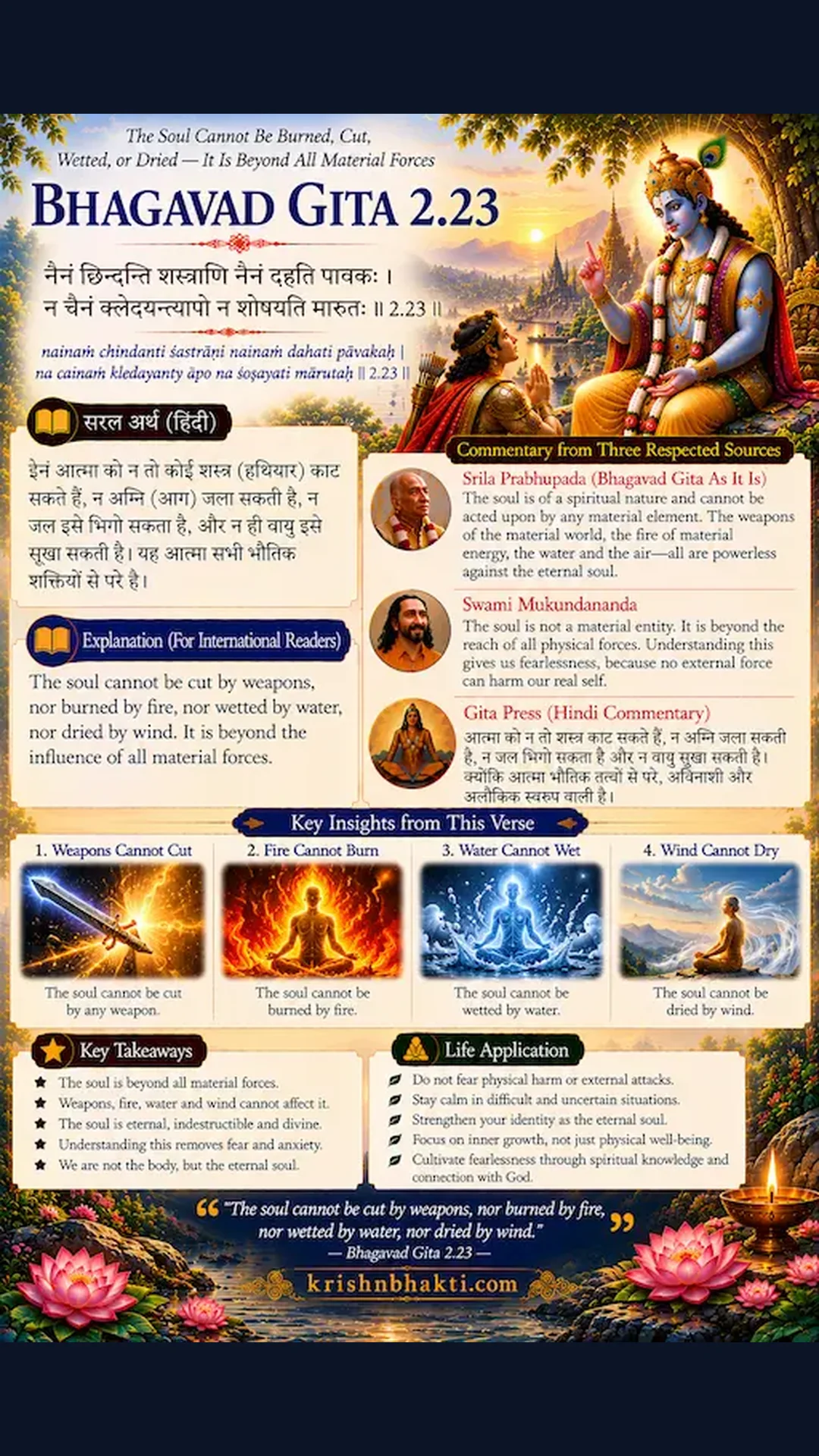
नैनं छिन्दन्ति शस्त्राणि नैनं दहति पावकः। न चैनं क्लेदयन्त्यापो न शोषयति मारुतः ॥ २.२३ ॥
Simple Meaning and Deeper Breakdown
Every single word of this shloka acts like an impenetrable armor that no power in the universe can pierce. Let us break down the Sanskrit words one by one so their profound essence sinks deep into our hearts.
नैनं छिन्दन्ति शस्त्राणि — Na (not) enam (this soul) chhindanti (can cut) shastrani (weapons). No weapon in existence can slice this soul into pieces. Whether you use a sword, a bullet, or any advanced machinery, not a single scratch can be made upon the soul.
नैनं दहति पावकः — Na (not) enam (this soul) dahati (can burn) pavakah (fire). The most ferocious, blazing fire cannot incinerate it. The soul remains entirely untouched and beyond the reach of flames.
न चैनं क्लेदयन्त्यापो — Na cha (and neither) enam (this soul) kledayanti (can moisten or dissolve) apah (water). Whether it is the deep ocean or torrential rain, water cannot wet, dampen, or dissolve this soul.
न शोषयति मारुतः — Na (not) shoshayati (can dry up) marutah (wind). Be it a howling storm or the dry, scorching desert wind, wind cannot dry up the soul.
Through this verse, Lord Krishna teaches us three monumental truths. First, your true identity is light-years away from this perishable body. Second, whatever can be cut, burned, soaked, or dried is merely the temporary garment (the body), never your eternal soul. And third, once you become firmly established in this consciousness of eternity, no worldly sorrow can ever shake you from within.
Analysis Through the Eyes of Revered Masters
1. The Perspective of Swami Ramsukhdas Ji (Sadhak Sanjivani)
Swami Ramsukhdas Ji Maharaj explains in his characteristically simple yet profound style that Lord Krishna is here highlighting the absolute limitations of the five primary material elements (fire, water, air, ether, and earth). Swami Ji points out that everything in this material creation made of these five elements is temporary, subject to constant change, and bound to perish sooner or later. The physical body is nothing more than a product of these five elements, so its destruction is guaranteed.
However, Swami Ji places tremendous emphasis on why we tie our identity so tightly to this body. He states, "The greatest foolishness of human beings is that we mistake a rented house for our permanent palace, and when the landlord asks us to vacate it, we beat our chest and weep bitterly." Swami Ji clarifies that the soul is un-cuttable, un-burnable, un-moistenable, and un-drying — meaning it is completely immune to any natural laws that govern the material universe.
From the perspective of spiritual practice (sadhana), Swami Ramsukhdas Ji insists that until a seeker gains this intellectual and experiential realization that they are not the body but the immortal soul, the terror of death and the grief of worldly losses can never truly leave them. The very first step of true sadhana is to stop identifying with the flesh and begin resting in our conscious spiritual identity.
2. The Perspective of A.C. Bhaktivedanta Swami Prabhupada (Bhagavad Gita As It Is)
Founder-Acharya of ISKCON, Srila Prabhupada views this verse entirely through the lens of pure devotion and Krishna consciousness. Prabhupada notes that modern scientists and materialists firmly believe consciousness is merely a byproduct of chemical reactions, and when the body dies, consciousness is reduced to absolute zero. However, Lord Krishna completely shatters this materialistic illusion through this verse.
Prabhupada clearly explains that the soul is an eternal spiritual spark, an inseparable fragment of the Supreme Lord (Krishna). Since the Supreme Lord is eternal, His fragment must also be eternal. In his commentary, Prabhupada stresses that when a devotee realizes they are not the material body but an eternal servant of Krishna, all artificial fears naturally drop away from their lives.
Applying this verse to the path of bhakti, Prabhupada points out that materialists go to absurd lengths to hide their mortality — using cosmetics, undergoing surgeries, trying desperately to stop the aging process. But a Krishna conscious person knows the body is bound to change, so instead of wasting their energy decorating a temporary cage, they invest every ounce of their being into awakening their eternal dormant love for Krishna. That is the ultimate spiritual secret of this verse.
3. The Perspective of Swami Mukundananda Ji
Swami Mukundananda Ji bridges this verse with modern psychology and practical life challenges in a remarkably relatable manner. Swami Ji often shares a wonderful analogy. He says that when we sit inside a movie theater watching a horror film or a tragic emotional drama, and a terrifying monster or heartbreaking scene appears on the screen, our hair stands on end and we start shivering. But does that fire on the screen burn down the walls of the theater? Does that water on the screen make us wet in our seats? Absolutely not! Because we deeply know that it is just a projection playing on a screen, and the real truth is us sitting safely in our chair.
Swami Ji explains that our entire life acts very much like this film projection. Joys, sorrows, insults, honors, victories, defeats — all these keep coming and going on the screen of this world. But due to our ignorance, we mistake ourselves for the characters on that screen and genuinely suffer. Swami Mukundananda Ji gives a powerful message to today's youth: Whenever work pressure mounts in your corporate office, whenever someone tries to put you down, or whenever a relationship falls apart, remind yourself — 'Nainam chhindanti shastrani'. All of this is happening at the external level; your core existence is untouchable.
Real-Life Application in Daily Modern Life
Let us bring this profound truth down into the messy realities of our everyday life. Imagine you are working in a corporate office. You have spent the last three months pouring day and night into building a massive project. On the day of the presentation, your senior unnecessarily tears your hard work to shreds and humiliates you in front of the entire team. The instant fire that erupts in your chest, the bitter pill of insult you are forced to swallow — it hollows you out from the inside. You come home and stare blankly at the ceiling all night, unable to sleep.
Now, bring this shloka of the Bhagavad Gita right into that situation. What is Krishna saying? Did those words of your senior chop your soul into pieces? Did his scolding burn your consciousness? No! He only bruised your ego, your fragile identity that you built by attaching yourself to this job title and corporate rank. The moment you strip away the employee label and view yourself as that eternal, unbroken soul, that thorn of insult automatically pulls itself out. You realize jobs come and go, titles shift, but 'You' remain eternal.
Let's take another example — relationships. Breakups and heartbreaks are the deepest mental wounds of the current generation. Someone walked out on you, someone betrayed your trust. You feel like life is no longer worth living, like your whole world has ended. Wait, stop for a second! Did that person walking away chop off a piece of your soul? Did fire scorch your consciousness? The relationship existed only at the level of the body and mind; at the soul level, two souls are never truly bound by mortal ties, and the ultimate truth is that every soul's true companion is the Supreme Lord Himself. When you view life from this vantage point, all that desperate crying starts to look like a silly misunderstanding.
Self Q&A: Your Deepest Doubts Addressed
Q1: If the soul is immortal and untouched by anything, why do we experience such intense emotional pain over worldly things?
Answer: Swami Ramsukhdas Ji provides a gorgeous resolution to this. He explains that pain arises because of a massive gap between our conditioning (belief) and absolute reality. The reality is that we are the soul, but our conditioning tells us we are the body. As long as our identity remains glued to the physical body, every blow directed at the body will cause us suffering. It's like having a nightmare where a tiger is chasing you and you wake up sweating, even though you were completely safe in your bed all along. Similarly, all worldly sorrow is an illusion born out of bodily identification (dehadhyas).
Q2: Does this verse mean we should completely stop crying or feeling grief when a loved one passes away?
Answer: Srila Prabhupada clarifies that feeling a temporary wave of grief or emptiness upon the departure of a companion is a natural human reaction because of long association. However, plunging into prolonged, destructive mourning — ruining your life for months — is proof that we mistook the body for the whole person. Prabhupada says a wise devotee knows the soul is untouched, so rather than lamenting the dead body, they pray to Krishna for the soul's higher destination.
Q3: How do I practically remember this shloka in the middle of severe office stress or a financial crisis?
Answer: Swami Mukundananda Ji offers a practical technique for this. He advises taking an immediate 'pause' whenever a crisis hits your life. Take a deep breath and tell yourself — 'This circumstance is shifting, but I am the eternal constant.' Bank accounts can drain, jobs can vanish, but your inner capacity, your divine resilience, and your spiritual core can never be snatched away. This mental detachment is what keeps you anchored amidst storms.
Q4: Will reading this shloka once permanently cure my anxiety and fear of the future?
Answer: Swami Ramsukhdas Ji reminds us that reading a verse once won't magically banish fear; it requires continuous practice. Just like building muscles in a gym requires daily lifting, training your mind to see yourself as a soul separate from the body requires daily practice. Whenever fear grips your heart, chant this verse and feel that eternal spark within you that is entirely immune to weapons, fire, or water. Slowly, the roots of anxiety will wither away.
Q5: How does this verse connect with the previous one about changing garments?
Answer: Both verses are two sides of the same coin. The previous verse (2.22) explained that changing bodies is a natural, seamless process like changing clothes. And this verse (2.23) clarifies that the wearer inside that changing body — the soul — is completely indestructible and immortal. One explains the casual nature of the outer garment, and the other guarantees the absolute immortality of the inner wearer. Combined together, they make a person utterly fearless.
🙏 Hare Krishna — Jai Shri Krishna 🙏
📖 Also Read: You Change Clothes, Not Who You Are — What the Gita Teaches When Loss Shakes Your World 🕊️