The Soul is Immortal, Weapons Cannot Cut It — This Gita Verse Will Erase Your Fear of Death 🕊️
📅 2026-07-01
In the previous verse, Lord Krishna explained to Arjuna that this physical body is merely like a garment worn and discarded by the soul. Krishna clearly stated that weapons can cut this body, fire can burn it, water can moisten it, and wind can dry it up, but the soul can never be cut, burned, moistened, or dried by any element or weapon. Taking this profound teaching forward, in this current verse, Krishna offers an even deeper and more scientific analysis of the indestructible, unburnable, unwettable, and un-drying nature of the soul.
In today's modern world, where every individual is battling deep depression, insecurity, and anxiety, the fear of death has become the ultimate underlying terror. We live in constant fear of losing our careers, our relationships falling apart, our physical health deteriorating, and above all, the ultimate terrifying thought of the end of life itself. In this glitzy era of social media where everyone is desperately projecting how happy they are, a deep, hollow void and a quiet terror of losing everything gnaws at the heart of every young person.
When a young professional loses their job, or when a deeply cherished relationship shatters overnight, they feel as though their entire world has come to an end. They feel as though their very existence has been erased. People slip into severe depression, experience panic attacks, and far too often, suicidal thoughts begin to plague their minds. This happens because we have restricted our identity entirely to this perishable physical body and our temporary social status. We have completely forgotten who we truly are at our core.
We assume that whatever is visible to our eyes—our bank balance, our physical appearance, our family, our friends—is the absolute totality of our existence, and if these things are snatched away, we too will be obliterated forever. This fundamental ignorance is the root cause of all our miseries and mental stress. Human beings constantly live in dread that tomorrow their happiness might vanish, their youth might fade, or their body might age and die. This deep-seated insecurity hollows a person out from within.
However, people often fall victim to a massive misconception. They think spirituality means running away to a secluded forest, hiding behind religious rituals out of the fear of death, or shutting one's eyes to the harsh realities of the world. People assume that sacred texts like the Bhagavad Gita are meant exclusively for the elderly who are nearing the end of their lives. They assume that concepts like the soul have no practical application in daily corporate life and are mere philosophical abstractions or blind superstitions.
Yet, Lord Krishna through Arjuna is teaching us that the science of the soul is not meant for an old person sitting in retirement; it is meant for a warrior standing fully armed in the middle of a battlefield. Arjuna stood on the battlefield paralyzed by the impending death of his loved ones, the fear of defeat, and the dread of losing his identity. Today's youth feel precisely the same way in the arena of modern life. Corporate politics, intense peer pressure, relationship betrayals, and the sheer unpredictability of the future have turned every young person into a hesitant, frightened Arjuna.
In such times, Krishna teaches us that as long as you identify yourself exclusively with this physical body, you will remain gripped by terror every single second. But the moment you realize that you are an eternal, invincible, and limitless spark of consciousness far beyond this body, not a single power in this universe will be able to frighten you. Death will lose its sting because you never truly die. Bodies change, circumstances shift, but your core essence remains completely untouched.
So let us dive deep into the profound depths of the 24th verse of the second chapter of the Bhagavad Gita and understand how Krishna can permanently dissolve every ounce of fear, insecurity, and death anxiety residing within our hearts. This verse is not merely a religious chant; it is a revolutionary perspective that can completely transform the way you experience existence.
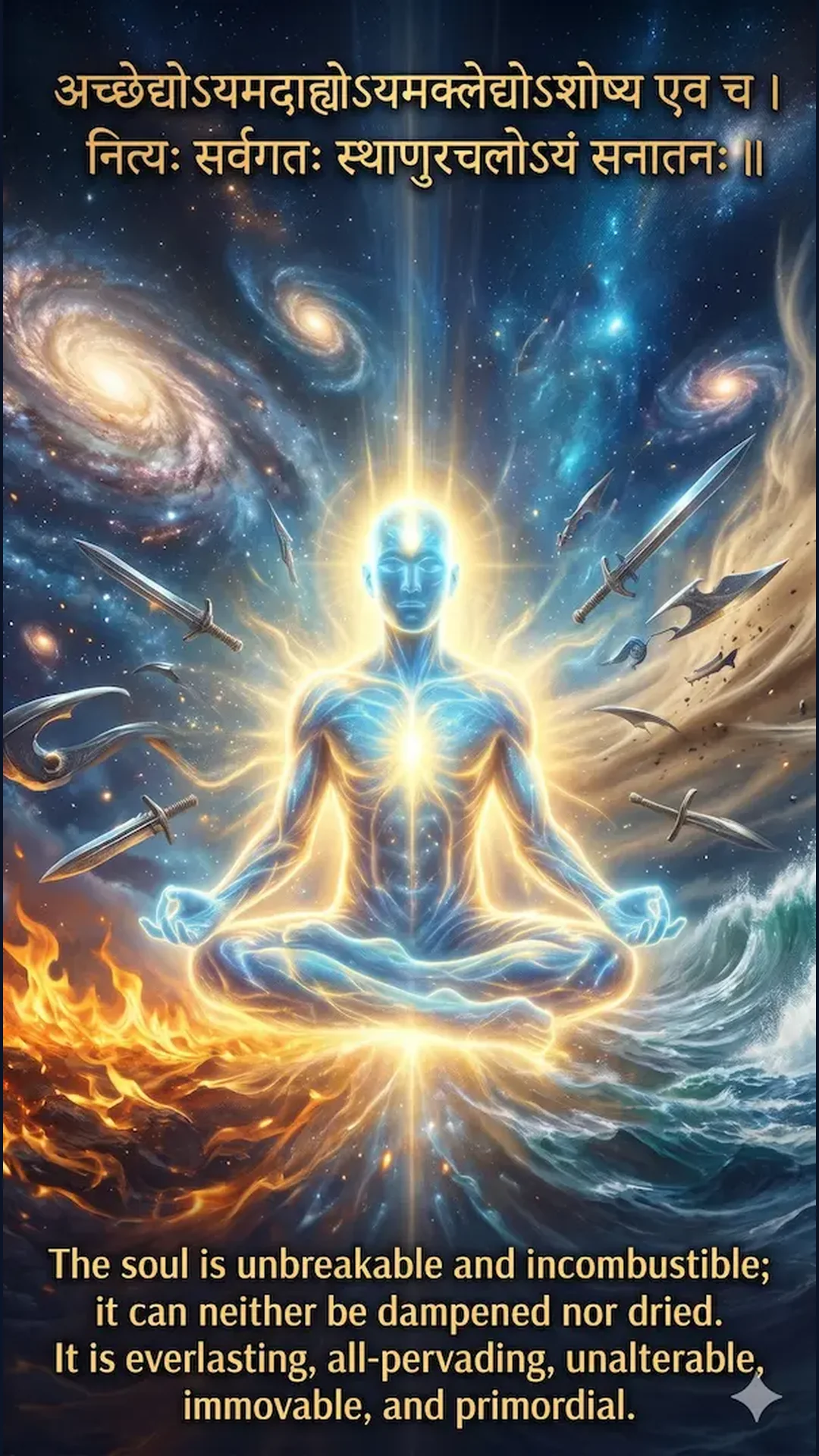
अच्छेद्योऽयम् अदाह्योऽयम् अक्लेद्योऽशोष्य एव च。
नित्यः सर्वगतः स्थाणुरचलोऽयं सनातनः ॥ २.२४ ॥
The simple meaning of this magnificent verse is both profound and direct. Here, Lord Krishna describes the intrinsic attributes of the soul that render it entirely immune to every destructive force in the material universe. Let us break down the exact meaning of each term in this verse so that its truth sinks deep into our hearts and minds.
First, Krishna says—अच्छेद्यः अयम् (Achhedyo'yam) — this soul cannot be cut. This means that no weapon, sword, dagger, or bullet in existence can slice this soul into pieces. It is totally impervious to any physical instrument of destruction. Following this, Krishna declares—अदाह्यः अयम् (Adahyo'yam) — this soul cannot be burned. No matter how blazing or intense the flames of a fire may be, they can never burn this soul into ashes. Fire exerts its influence exclusively over physical matter, leaving the spiritual soul completely untouched.
Going further, Krishna states—अक्लेद्यः अशोष्यः एव च (Akledyo 'shoshyeva cha) — this soul cannot be moistened or dissolved by water or any liquid substance (Akledya), nor can it be dried up by the wind or the scorching heat of the sun (Ashoshya). Thus, the four primary elements of the material realm—earth (represented by weapons), fire, water, and air—are completely powerless to inflict any damage upon the soul.
Next, Krishna describes the eternal nature of the soul by saying—नित्यः सर्वगतः स्थाणुः (Nityah Sarvagatah Sthanuh) — the soul is eternal (Nitya), present everywhere or all-pervading (Sarvagata), and immovable or fixed (Sthanu). It is not bound to a single localized spot; rather, it is all-pervading in consciousness and remains eternally steady in its intrinsic nature. Finally, Krishna concludes with—अचलः अयम् सनातनः (Achalo'yam Sanatanah) — the soul is immovable, meaning it is devoid of any modification or decay, and it is eternal (Sanatana), meaning it has no beginning and no end. It has always existed, exists right now, and will continue to exist forever.
The three or four most critical takeaways we derive from this verse have the power to entirely reshape our daily existence. First, whatever is perishable in our lives should not become a source of profound grief, because the soul—which is our true identity—never dies. Second, our real existence is not rooted in this temporary physical shell, but in that infinite consciousness. Third, when we internalize this profound truth, the terror of death and every form of material loss vanishes permanently from our minds. And fourth, hardships and crises strike only at the level of the body and mind; our real spiritual core remains perpetually safe and pristine.
Swami Ramsukhdas Ji's Perspective on the Verse
The revered saint Swami Ramsukhdas Ji Maharaj, in his monumental commentary 'Sadhak Sanjivani', presents a wondrous and highly practical viewpoint on this verse. Swami Ji emphasizes that the attributes of the soul described by Lord Krishna here are not meant for dry philosophical debate; rather, they serve as a foolproof remedy to eradicate fear from a seeker's life. Swami Ji stresses that human beings suffer primarily because of the deep-seated illusion that they are the body, mistakenly identifying their own self with the physical joys and sorrows of the flesh.
Swami Ramsukhdas Ji explains that whenever we weep over the death of a loved one or tremble in terror at our own approaching illness, we are essentially weeping out of ignorance—the illusion that the physical body is everything. In his discourses, Swami Ji shares a beautiful analogy: just as a person discards torn old clothes and puts on fresh new garments, they do not grieve over the destruction of the old clothes; rather, they feel glad to receive new ones. In the exact same way, enlightened souls do not mourn when a body changes or drops dead, because they recognize clearly that the soul never perishes.
Elaborating on the term 'Sanatanah' (eternal), Swami Ji explains that whatever is born at a certain point in time must inevitably perish at another. However, that which was never born—that which had no origin—how can it ever die? The soul is 'Sanatana'—it has existed eternally. It never had a beginning, nor will it ever have an end. Swami Ji notes that when a spiritual seeker allows this truth to sink into their consciousness, all worldly fears automatically dissolve. They lose all fear of humiliation, public criticism, or material loss.
Swami Ramsukhdas Ji also clarifies that the word 'Sarvagatah' (all-pervading) implies that the soul is not imprisoned in one tiny corner of the body. People often imagine that the soul is confined like a tiny point inside the physical heart, but in reality, consciousness permeates the entire body and beyond. Swami Ji advises seekers that whenever feelings of insecurity, inferiority, or panic arise within, they should immediately recall this verse and remind themselves: 'I am not this fragile body; I am this immortal soul.' This mindful remembrance instantly liberates a person from all forms of mental tension and fear.
Srila Prabhupada's Perspective on the Verse
His Divine Grace A.C. Bhaktivedanta Swami Prabhupada, the founder of ISKCON, presents this verse in his renowned commentary 'Bhagavad Gita As It Is' strictly from the angle of pure devotion and Krishna consciousness. Prabhupada strongly asserts that as long as an individual considers themselves to be a product of this material body and temporary world, they can never experience genuine, lasting peace. Prabhupada emphasizes that the science of the soul is not meant merely for mental pacification; rather, it is the pathway to re-establishing the eternal relationship between the individual living entity and Lord Krishna.
Analyzing the terms 'Achhedyo'yam' and 'Adahyo'yam', Prabhupada writes that material scientists and secular philosophers endlessly debate the nature of life and the origin of consciousness. They examine molecules and cellular structures in laboratories under microscopes, yet they can never isolate or capture the soul that animates the biological frame. Prabhupada points out that modern science will never comprehend the soul because scientific instruments are exclusively designed to measure material elements (earth, water, fire, air, and ether), whereas the soul completely transcends all material components.
In his lectures, Prabhupada explains with immense warmth and devotional love that because the soul is 'Sanatana' (eternal), its ultimate home cannot possibly be this temporary material world. In this material realm, everything is fleeting—whatever arrives must eventually depart. However, the soul's true home is in the spiritual sky, in the eternal abodes of Lord Krishna known as Vaikuntha or Goloka Vrindavana, where there is no disease, no old age, no death, and no lamentation. As long as the living entity wanders in this material creation, they remain trapped in the grueling cycle of repeated birth and death (samsara), suffering needlessly.
Prabhupada states that the true benefit of studying this verse is unlocked only when a person becomes firmly established in Krishna Consciousness. When a devotee realizes they are not this body but an eternal servant of Krishna, the fear of death vanishes permanently from their heart. They understand that even after the annihilation of this physical body, their loving relationship with Krishna remains completely intact and eternal. Prabhupada repeatedly urges that loving devotion unto Lord Krishna is the only absolute shelter that can ferry a living entity safely across the terrifying ocean of material miseries and the fear of death.
Swami Mukundananda's Perspective on the Verse
Swami Mukundananda is widely celebrated for his highly logical, relatable, and contemporary approach to the Bhagavad Gita. He analyzes this verse using crisp logic tailored specifically for the mindset of today's young generation. Swami Ji notes that the most prominent psychological issues plaguing modern youth are the 'fear of failure' and 'death anxiety.' Young people constantly fret over what will become of them if their careers crash, if their romantic partners walk away, or if they fail to make a mark in society.
Swami Mukundananda uses a brilliant modern analogy to make this crystal clear. He explains that when a person plays a high-end video game and their digital character gets shot, crushed, or killed on the screen, does the real human being sitting behind the console start weeping? Do they slip into clinical depression? Absolutely not! Because they know quite well that whatever is dying on the screen is merely a virtual avatar, while the actual player sitting outside the screen remains completely safe and untouched.
In the exact same manner, Swami Ji explains that this entire material universe operates like a massive virtual stage or video game. Our physical body is merely an avatar or costume we have put on to play our part in this earthly realm. The true player is the soul within. When corporate layoffs happen or a business incurs massive losses, we feel as though our entire existence has collapsed. But Swami Mukundananda points out that this is a colossal delusion. Your job is gone, your body is exhausted, your bank balance has shrunk—yet your soul has not suffered even a single microscopic scratch!
Swami Ji advises young people that whenever a massive crisis strikes in life, whenever it feels like everything has turned to dust, take a deep breath and ask yourself right then: "Has my soul been harmed in any way?" The answer echoing from within will be an emphatic — "Not at all!" Swami Ji emphasizes that anchoring oneself in this inner spiritual awareness provides unshakable mental fortitude and resilience during life's most brutal storms. This is the ultimate practical wisdom of the Gita that serves as a lifeline for every competitive young professional today.
Real-Life Scenarios: Applying Gita's Wisdom to Modern Challenges
Let us connect these profound philosophical insights directly to our daily life scenarios and see how this verse provides concrete solutions to real-world problems. Imagine a 26-year-old young professional named Rahul working in a high-pressure multinational corporation. Sleepless nights, crushing deadlines, and relentless quarterly targets consume his life. One afternoon, sudden layoffs sweep through the company, and Rahul's name is right at the top of the termination list.
The ground beneath Rahul's feet gives way. He feels as though his entire future has been obliterated. He locks himself in his room, cuts off all communication, and dark suicidal thoughts begin to cloud his mind. He feels he has lost his identity because his entire self-worth was tied to his corporate designation. He stays awake all night weeping, gripped by a paralyzing terror of the uncertain future.
However, if Rahul were equipped with the wisdom of the 24th verse of the Gita, his perspective would undergo a revolutionary shift. Rahul would realize that losing a job is merely the end of one chapter in his life script, not the end of his existence. He would remind himself that his title has changed, his income has temporarily dropped, but his core essence—his immortal soul—remains just as complete, radiant, and indestructible as it always was. This realization alone would pull him back from the brink of despair and grant him the fresh psychological strength to stand back up.
Let us consider a second scenario involving a young woman whose long-term relationship abruptly ends when her partner walks away. She feels that life has lost all color, that there is no reason left to breathe, and that she will never recover from this devastating heartbreak. She sinks into deep clinical depression, deaf to well-meaning friends who tell her that 'time heals everything.'
Here, this verse acts as a miraculous healing balm. The Gita teaches us that human relationships are formed and broken solely at the level of the physical mind and body. People come and go, circumstances shift, but the soul seated within you is entirely complete and self-contained, dependent on no external human being for its wholeness. When a person realizes that they are spiritually complete in themselves, they do not lose their dignity, self-respect, or mental equilibrium even when relationships shatter.
A third scenario involves our physical health. In today's fast-paced life, people panic at the slightest sign of physical illness. Hearing the diagnosis of a major disease sends individuals into an absolute tailspin of panic, convincing them that death is staring them in the face. Yet Krishna reminds us that this physical body is naturally destined to return to dust—that is its inherent design. The body may fall ill, age, and eventually perish—but you are that immortal soul which no disease can ever touch. This realization infuses a patient with extraordinary mental courage to fight back against illness with supreme poise.
1. Does this verse speak exclusively about life after death, or does it apply to our active, breathing life right now?
Many people harbor the misconception that teachings about the soul and reincarnation are relevant only after one dies. However, Swami Ramsukhdas Ji clarifies that this verse directly impacts your active, living state right now. When you realize while still alive that you are the soul and not the body, your entire living paradigm changes. Petty frustrations fade away, office stress loses its power to drive you into depression, and you learn to remain calm amidst turbulent circumstances.
2. If the soul cannot be cut or harmed by anything, why should we care about physical health and self-care?
This is a very natural question for any rational seeker: if the soul is immortal, should we stop caring for our physical body altogether? Srila Prabhupada answers this by explaining that the physical body is the temple of the soul. God has gifted us this rare human birth precisely so we can utilize it to elevate our consciousness and realize the Supreme. Therefore, maintaining the health and fitness of the body is a spiritual duty, not mere vanity.
3. When a massive crisis strikes my life, how can I practically apply the wisdom of this verse?
Swami Mukundananda offers a wonderful practical technique. Whenever a severe crisis or failure hits you, immediately pause, close your eyes, and take three deep breaths. Tell your mind: "This storm is hitting my career or my external circumstances, not me—not my soul." Separating your true identity from temporary external crises instantly relieves half your mental anxiety and allows you to perceive a clear path forward.
4. Does constantly contemplating this verse genuinely reduce the fear of death over time?
Yes, absolutely. Swami Ramsukhdas Ji states that fear arises from ignorance. We fear what we do not know. Because we have spent our entire lives identifying exclusively with the body, the destruction of the body terrifies us. But when you contemplate this verse daily and remind yourself — 'Nityah Sarvagatah Sthanuh...', this truth embeds itself deeply into your subconscious mind. Once this conviction matures, the fear of death permanently exits your life.
5. Was this knowledge of the soul as urgent for a mighty warrior like Arjuna as it is for an ordinary person today?
Without a doubt. Arjuna was no ordinary individual; he was the greatest archer and warrior of his era. Yet standing on the battlefield, his Gandiva bow slipped from his trembling hands, and he wept out of sheer despair. He was consumed by the dread of committing sins and losing his loved ones. Lord Krishna imparted this exact science of the soul to him, helping him realize that what he thought he was killing or saving was merely the physical form. Once Arjuna grasped this truth, all his hesitation and fear vanished, and he courageously fulfilled his duty. Today's youth stand on that exact same battlefield of life, desperately needing this eternal wisdom from the Gita.
🙏 Hare Krishna — Jai Shri Krishna 🙏
📖 Also Read: When the Soul Is Immortal, Why Are You Breaking Over This Small Pain? The Gita Will Shift Your Perspective 💔✨