The Hidden Anxiety of Modern Life and Our Deepest Fears
With the very first ray of dawn, the endless flood of notifications on our smartphone screens doesn't just bring news; it triggers a quiet, invisible anxiety deep within us. We rush to catch our morning commutes, stand in crowded subway trains worrying about career uncertainties, or lie awake at night calculating our future relationship prospects and bank balances. This modern lifestyle has not only kept us physically exhausted but has completely drained us mentally. Every young person carries a silent, underlying fear — What if I fall behind? What if this project fails? What if something happens to my health or the people I love?
In the previous verse, Lord Krishna explained to Arjuna that bodies change, age alters, but the conscious entity residing within never changes. Taking that profound thought a step further, in today's magnificent verse, Krishna unveils a timeless truth that shatters the very limits of human comprehension. People often assume that whatever is visible to our eyes is the ultimate reality. We mistakenly identify ourselves as this physical body, and whenever there is the slightest pain in the body, or whenever we face the prospect of losing someone dear, our entire world shakes. We tremble with grief.
But have you ever paused to think about the true nature of that entity you call 'I'? We attach our identity to our name, our job title, our clothes, or our social media follower count. The moment any of these gets disrupted, we feel as though our entire existence is coming to an end. This is the greatest illusion of the modern age. We spend all our energy trying to preserve things that were never meant to last forever. Krishna cuts through this web of illusion in a single stroke. Through Arjuna, He wants to tell today's generation — 'O innocent soul! Why do you weep for that which was never born and can never be destroyed?'
When we flip through the pages of the Bhagavad Gita, we often mistakenly assume it is an ancient religious text meant only for rituals or post-death ceremonies. But the truth is, there is no psychology on earth more practical and grounded than the Gita. When a young professional goes through depression, when someone experiences a painful breakup, or when a sudden career setback hits, their ego and temporary identity shatter completely. They feel like their life has ended. At such moments, Krishna's voice acts as an ultimate elixir of life.
In this shloka, Krishna describes an aspect of the soul that completely transcends our imagination, our intellect, and all our logical reasoning. We try to grasp that infinite reality with our limited minds, and that is where we stumble. Krishna states that the soul cannot be cut, burned, or moistened. Hearing this might make our minds spin — how can there be something untouched by any physical law of the universe? In this detailed blog, we will unpack this profound mystery and understand how internalizing this single verse can forever banish every fear from our lives.
Let us first behold this divine shloka and then dive deep into its every word to resolve the inner turmoil of our hearts.
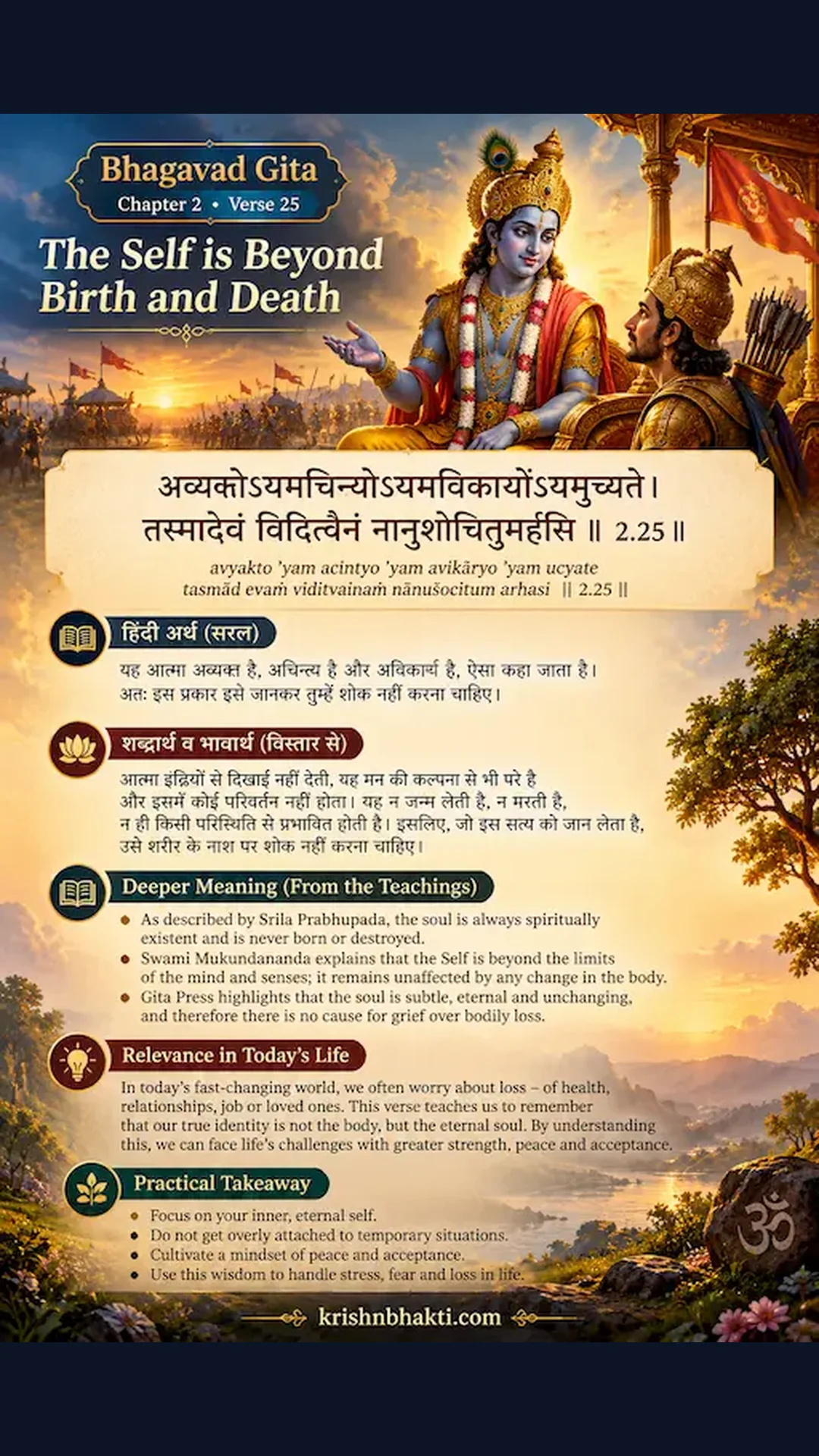
अव्यक्तोऽयमचिन्त्योऽयमविकार्योऽयमुच्यते।
तस्मादेवं विदित्वैनं नाऽनुशोचितुमर्हसि॥ २.२५ ॥
Simple Meaning and Word-by-Word Breakdown
Every single word in this shloka holds an ocean of wisdom. Let us understand the Sanskrit terms with utmost clarity and simplicity. Krishna tells Arjuna — Avyakto'yam (This soul is unmanifest, meaning it is beyond the grasp of our senses and physical eyes), Achintyo'yam (This is unthinkable, meaning it cannot be comprehended or imagined by our limited intellect), Avikaryo'yam ucyate (And it is spoken of as immutable, meaning it is free from all changes and transformations). Therefore, O Arjuna! Tasmad evam viditvainam (Knowing the soul thus, having this deep realization), na anusocitum arhasi (you have no reason to grieve, you should not lament).
It is vital to pay close attention to these three core adjectives: Avyakta (Unmanifest), Achintya (Unthinkable), and Avikarya (Immutable). First, 'Avyakta' means that which is outside the reach of our five sense organs (eyes, ears, nose, tongue, skin). We can go into laboratories, examine biological tissues, map DNA sequences, but we can never capture the consciousness that animates this body. When a doctor examines a dead body, all the physical organs are present, but the 'person' who was speaking moments ago is gone. What was that? That is the unmanifest soul.
The second term is 'Achintya'. Our intellect has a strict boundary. We can only understand something if we can compare it to something else or build a mental model of it. But the soul resembles no physical object. Therefore, even our greatest scientists and philosophers cannot trap it entirely within the grip of intellect. It towers far above our thought capacity. When we assume everything in existence must fit neatly inside our logical box, frustration is born.
The third term is 'Avikarya'. Everything in the material world undergoes decay, modification, and wear and tear. Buy a new phone today, and it becomes outdated tomorrow. The body is youthful today, old tomorrow. But the soul experiences no aging or modification. It remains eternal and unchanged. We can draw three key takeaways from this for our daily lives: first, what is visible to the eyes is not the whole truth; second, drop the ego of your limited intellect; and third, while change is the law of the material world, your core essence remains untouched and immortal.
The Profound Insights of Great Commentators
1. Swami Ramsukhdas Ji's Sadhana Perspective
Swami Ramsukhdas Ji Maharaj is renowned for his direct, deeply relatable, and simple commentary style. Discussing this shloka, he points out that man's greatest blunder is identifying with the perishable body and grieving over its destruction. Explaining the word 'Avyakta', Swami Ji gives a lovely example. He states that whatever can be seen with the eyes is the material creation (Drishya). The very definition of the world is that which flows away and perishes. But the one who witnesses this world is the knower, the seer (Drasta).
Swami Ramsukhdas Ji emphasizes that calling the soul 'Achintya' means we should stop trying to capture it through mental imagination and intellectual acrobatics. The mind always visualizes forms, colors, and shapes. The soul has no material form, so the mind can never reach there. When a spiritual seeker understands that their true identity is far beyond this perishable physical garment and is an eternal spark of the Divine, attachment and fear naturally drop away. Swami Ji notes that only those grieve who forget their true divine nature and mistake the body for the ultimate reality.
2. Srila Prabhupada's Devotional Standpoint
Srila Prabhupada, the founder-acharya of ISKCON, views this shloka through the intimate and eternal relationship between the individual soul and Lord Krishna. Prabhupada repeatedly underscores in his purports that modern civilization has become entirely absorbed in the 'bodily concept of life'. People consider themselves mere biological machines, and that is why they shatter completely at every minor career setback or personal failure, sometimes even resorting to suicide.
Prabhupada explains that because the soul is unmanifest and unthinkable, materialist scientists will never be able to discover the soul inside a laboratory. No matter how hard they try, they can only study dead matter, never the spirit. Prabhupada lovingly states that the only way to discover this immortal soul is through devotional service and Krishna consciousness. When a person surrenders to Krishna, they begin to tangibly experience that they are a spiritual spark far beyond this temporary physical framework, whose ultimate home is at the feet of the Lord.
3. Swami Mukundananda's Modern Psychological Lens
Swami Mukundananda translates this shloka into the language of today's youth with exquisite skill. He notes that today's generation suffers most acutely from overthinking and anxiety. We drag every issue so heavily through our minds that we become mentally exhausted. Swami Ji offers a beautiful modern analogy — just like an operating system runs silently in the backend of a computer, enabling all apps to function on screen while the user only sees the apps and never the underlying code.
Similarly, this physical body is the screen, and the consciousness behind it is that ultimate software or energy. When a crisis hits our lives, we panic over the 'errors' appearing on the screen, forgetting that our core existence towers far above those errors. Swami Mukundananda advises young seekers that whenever heavy stress strikes, remind yourself: 'I am greater than this situation.' This single thought instantly infuses a fresh wave of mental strength into a person.
From Real Life Pages — Stories of Modern Youth
Let us picture Rahul, a 26-year-old software engineer working at a major MNC in Bangalore. Day-and-night coding, dealing with harsh client demands, and surviving quarterly performance reviews had turned Rahul's life into a running treadmill. One day, his manager casually called him in to announce that layoffs were underway, and his name would likely be on next week's list. In that single moment, the ground slipped beneath Rahul's feet. He felt as though his entire identity, his self-respect, and his future had vanished in a second. That night, sitting in a dark room with the lights off, his chest felt heavy, breathing rapid, feeling unworthy of facing the world.
Late that night, an old friend called him and, discussing the second chapter of the Bhagavad Gita, shared this exact shloka — 'Avyakto'yam achintyo'yam avikaryo'yam ucyate.' The friend gently reminded him over the phone, 'Brother, you lost a job, not your breath or your consciousness. You are far greater than that corporate designation.' Rahul put the phone down and sat quietly, turning his gaze inward. He thought — if this body itself didn't exist tomorrow, what use would this job be? And if the body remains, another job will certainly come. That night, Rahul realized for the first time why he had chained his entire happiness to a corporate tag. Over the next few weeks, he interviewed again and secured a better position, but this profound experience permanently transformed his outlook on life.
Another example is from a college student, Priya, studying at Delhi University, who had recently gone through a painful breakup from a long-term relationship. When the relationship abruptly ended, Priya felt the sun had set forever on her life. She wept uncontrollably, lost her appetite, and felt a suffocating emptiness everywhere. Her mother came into her room, stroked her hair gently, and said, 'My child, what you are mourning with such deep grief was only a chapter in this temporary world. Your soul is complete; no one can ever rob you of your true self.' Those maternal words acted as healing balm on Priya's wounds. Gradually, she redirected her energy toward books, art, and her inner spiritual practices. She realized that love is not something to be hunted for outside, but the very nature of the soul.
This principle applies not just to massive life events, but to our everyday mundane experiences as well. When we scroll through social media and compare ourselves unfavorably to someone else's curated luxury lifestyle, we are essentially weighing our immortal soul on the flaky scales of temporary material comparison. Krishna's verse reminds us daily that your worth is not dictated by your bank balance or follower count; your worth lies in the fact that you are an eternal fragment of the supreme divine consciousness.
Your Personal Questions Answered (Self Q&A)
1. Does this shloka only talk about post-death liberation, or is there a practical use for it in daily life today?
It is a massive misconception that the Gita only speaks of post-death salvation or the afterlife. Swami Ramsukhdas Ji explicitly clarifies that this shloka relates directly to our living, breathing daily reality. When we realize while still alive that our physical body and mental thoughts are constantly shifting, but we are the eternal witness of them all, all our daily fears and stress vanish instantly. When you know you are not the body, whether an office boss shouts at you or family drama unfolds, it fails to shake your inner peace. Thus, this shloka is the ultimate practical tool for liberation while living (Jivanmukti).
2. If the soul is completely unmanifest and invisible, how can we believe in it or experience it?
Srila Prabhupada provides a wonderful explanation for this doubt. He points out that electric current is invisible to the eyes, but when it flows through a fan, the fan begins to spin. We cannot see the wind itself, but we can feel its cooling touch. Similarly, the consciousness or life force operating within this physical body is the ultimate proof of the soul's presence. As long as that consciousness is present, limbs move and eyes see; the moment it departs, the body turns to dust. Thus, through our daily conscious awareness, we directly experience the reality of the spirit.
3. When a major life crisis or trauma hits, it becomes extremely difficult to remember this knowledge. What should we do?
Swami Mukundananda offers a brilliant practical solution for this challenge. He explains that when a storm is raging fiercely, it is extremely difficult to steer a boat. That is why we must strengthen our practice before the storm arrives. Daily 10-15 minutes of meditation, sitting quietly and practicing the witnessing attitude (separating oneself from bodily identifications), builds a strong mental armor so that when a major life crisis strikes, our mind doesn't panic instantly. Taking deep slow breaths during a crisis and repeating mentally that 'this situation will pass, but my true essence is immortal' pulls us safely through the turbulence.
4. Does 'Achintya' (unthinkable) mean we should not use our intellect in matters of spirituality?
No, not at all. Swami Ramsukhdas Ji clarifies that the intellect is meant to discern between truth and untruth (Viveka). 'Achintya' means you cannot completely measure or capture that infinite Supreme Divine or soul with your limited logical intellect. Just as a small bucket cannot contain the entire ocean inside it, our limited mind cannot fully calculate infinite consciousness. This simply means we must drop intellectual arrogance and embrace that supreme reality with humble reverence and genuine inquisitiveness.
5. How does this verse connect directly with the previous one?
In the preceding verse (2.24), the Lord described the physical invulnerability of the soul — weapons cannot pierce it, fire cannot burn it, water cannot wet it, and wind cannot dry it. Following that, a natural question arises in Arjuna's mind: what kind of entity is this upon which no material law applies? To resolve that exact inquiry, Krishna states in verse 2.25 that the soul is unmanifest, unthinkable, and immutable. While the previous verse established its indestructible properties against elements, this verse highlights its transcendence beyond material senses and human intellect.
🙏 Hare Krishna — Jai Shri Krishna 🙏
📖 Also Read: The Soul is Immortal, Weapons Cannot Cut It — This Gita Verse Will Erase Your Fear of Death 🕊️