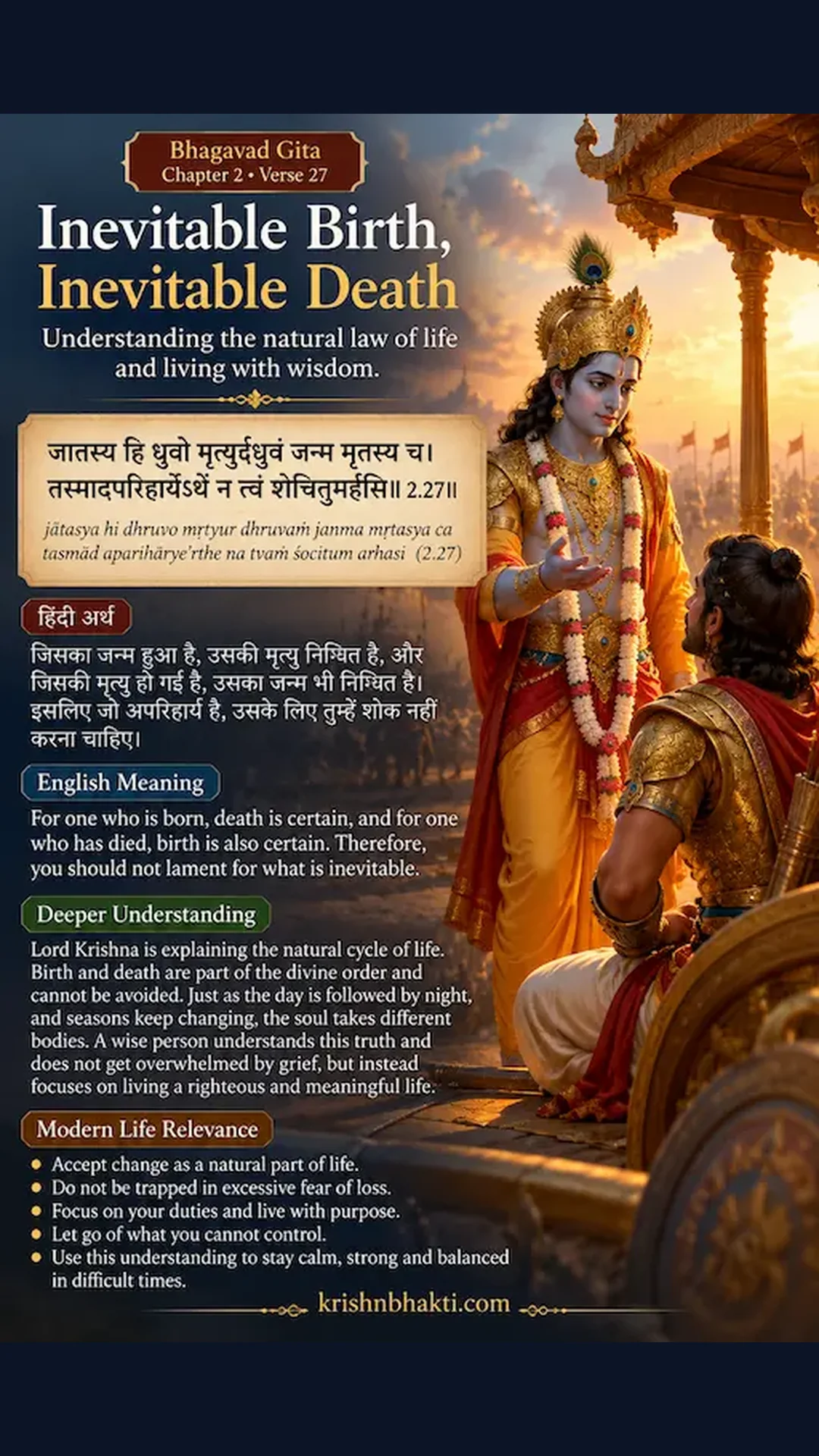
In the previous verse, Lord Sri Krishna explained the distinction between the body and the soul to Arjuna, making it clear that even if you consider the body to be constantly born and constantly dying, O mighty-armed one, you still have no cause to grieve like this. The ocean of delusion and grief that was surging within Arjuna's heart needed to be calmed by bringing him to a very practical and philosophical plane. Whenever a crisis arises in our lives where we face the fear of losing our loved ones or encounter a major failure, our minds become agitated in the very same way Arjuna's did.
In today's fast-paced modern lifestyle, surrounded by relentless competition, insecurity, and uncertainty, we live in constant fear of losing something or the other. Sometimes it is the fear of losing a job, sometimes cracks appearing in relationships, sometimes uncertainty about the future, and sometimes anxiety regarding the health of a loved one. In this glittery world of social media where everyone is showcasing their victories and happiness, every young person is fighting an undeclared war deep inside. When a major tragedy strikes or a loved one departs forever, our entire world shatters. We feel as though nothing is left in life, and we sink into the darkness of profound sorrow.
People often think that the teachings Lord Krishna gave in the second chapter of the Gita were exclusively for the battlefield of Kurukshetra or that they are too philosophical and complex to be applied in today's frantic life. A common misconception in the minds of people is that spirituality means abandoning the world, running off to the forests, and closing one's eyes to worldly sorrows. But Krishna never says that. Krishna stands right on the battlefield with Arjuna and gives him the vision to pierce through his inner fear and delusion. They teach us that life and death, joy and sorrow, gain and loss are eternal rules of this universe that cannot be changed, only understood.
Whenever a heavy calamity befalls our lives, our immediate reaction is — "Why did this happen only to me?" We begin to complain to God, curse our destiny, and slip into the abyss of depression. We fail to understand that this entire cosmos runs under a definitive cosmic order where every single event has a purpose. Whatever has arrived must depart, and whatever is born must die. Accepting this very truth is the greatest endeavor. Lord Krishna reveals this bitter and ultimate truth with profound simplicity and depth in this 27th verse, so that Arjuna's and our own delusions may be eradicated forever.
Let us now contemplate that supreme, life-transforming verse spoken by Lord Krishna to guide Arjuna. This verse is not merely a collection of words, but a mirror of life in which we can see our true existential state. When we dive into the depth of this verse, we begin to realize how small our petty sorrows and fear of death are compared to this vast cosmic cycle. This verse provides us with an inner peace and stability that never shakes, no matter how much external circumstances change.
जातस्य हि ध्रुवो मृत्युर्ध्रुवं जन्म मृतस्य च।
तस्मादपरिहार्येऽर्थे न त्वं शोचितुमर्हसि ॥ २.२७ ॥
The simple meaning of this wondrous verse is straightforward and clear, yet its depth is deeper than the ocean. Lord Krishna says that for one who has taken birth, death is certain, and for one who has died, birth is certain once again. In this world, whatever object or body is generated, its destruction is inevitable. Therefore, regarding what is unavoidable — what cannot be bypassed or prevented — you should not grieve. Every single word of this verse contains such profound life wisdom that it dispels all our illusions in a single stroke.
Let us understand the key words of this verse in detail: जातस्य हि ध्रुवो मृत्युः — surely, for one who is born, death is certain. ध्रुवं जन्म मृतस्य च — and for one who is dead, birth is equally certain. तस्मादपरिहार्येऽर्थे — therefore, regarding this unavoidable (inevitable) subject. न त्वं शोचितुमर्हसि — you do not deserve to grieve, O Arjuna! Krishna is speaking with absolute logic here. He is saying that a rule which no power in the world can change, and over which neither you nor anyone else has any control, crying or lamenting over it is sheer foolishness.
The main 3-4 takeaways we get from this verse can transform the direction of our daily lives. First, change is the only permanent rule of this universe. Second, death or loss is not an accident or injustice, but a natural cycle of nature. Third, wisdom lies in accepting what cannot be changed, rather than wasting energy fighting against it. And fourth, when we rise above this physical body and think at the level of the soul, all our grief and fear vanish naturally.
In-Depth Perspective by Swami Ramsukhdas Ji
Revered Swami Ramsukhdas Ji Maharaj, while explaining this verse, presents a very beautiful and practical perspective. He says that Lord Krishna used the word "Dhruva" here with great deliberation. "Dhruva" means that truth which never changes, which is absolute and permanent. Everything in this world is transient; only one thing is eternal, and that is change and the divine order. Swami Ji explains that the greatest illusion of human beings is that they consider the transient world to be permanent. They forget that the very body they are so attached to will one day turn to dust.
In his discourses, Swami Ji repeatedly emphasizes the phrase "Apariharye 'arthe" — regarding that which cannot be averted, man should never worry or grieve. He says that people suffer most over things that are not in their control. Changing weather, aging, falling ill, and ultimately facing death — these are all realities that no emperor or scientist on earth can stop. Yet, human beings remain the most disturbed by these very things. Swami Ji explains with immense love that mourning cannot bring back the dead nor avert an impending sorrow, which is why grieving is utterly futile.
From the perspective of spiritual practice (sadhana), Swami Ramsukhdas Ji adds something very profound: when a seeker internalizes this truth, the fear of death disappears from within them forever. They remain joyful in every circumstance because they know that this body is merely a garment being changed by the soul. Swami Ji notes that Krishna did not scold Arjuna out of anger, but guided him as a true friend and teacher, saying, "O Arjuna, your scholarship and heroism do not befit you when you weep over what is simply nature's law."
Explaining the philosophical dimension of this verse, Swami Ji also clarifies that birth and death take place only at the level of this gross physical body. The soul is never born nor does it ever die. Therefore, those who consider the body to be everything suffer the most. Swami Ji's message serves like an elixir for today's youth, who resort to extreme steps like ending their lives over minor failures and broken relationships. If they understand this perspective of Swami Ji, every form of inferiority complex and depression will vanish from their lives.
A.C. Bhaktivedanta Swami Prabhupada (ISKCON) Perspective
Srila Prabhupada presents the pure devotional angle and Krishna consciousness while explaining this verse. He explains that in the material world, this cycle of birth and death is endless, known as "Samsara." Prabhupada states that until a living entity takes shelter of Lord Krishna, they continue to revolve repeatedly in this cycle of repeated birth and death. Prabhupada explains with touching words that while everyone knows they must die one day, no one wants to contemplate it. People live as if they are going to stay here forever.
In his books and lectures, Prabhupada repeatedly stresses that understanding the temporary nature of the material body should prompt human beings to engage their time in the devotional service of the Lord. Explaining "Jatasya hi dhruvo mrityuh," he says that since death is certain, it is supreme intelligence to utilize our rare human life in attaining love for Krishna. If we fail to attain God-realization in this life, our birth goes in vain. Prabhupada's perspective teaches us that instead of wasting time in grief, we should focus on the actual goal of our existence.
As the founder-acharya of ISKCON, Prabhupada also explains why one should not grieve when a devotee departs from this world. The death of a devotee means their soul is now liberated from material bondage and returning to Krishna's abode. Therefore, according to the Bhagavad Gita, wise people do not lament for the living nor for the dead. Prabhupada's viewpoint offers a tender and reassuring experience, where death is seen not as an end, but as a fresh beginning.
According to Prabhupada, Krishna consciousness is the only remedy that can completely liberate a human being from this fear of birth and death. When a person chants the "Hare Krishna Mahamantra" and dedicates every action to the Lord, the fear of death is eradicated from their heart forever. They gain the firm conviction that their protector is the Supreme Lord Himself, and even after the destruction of this body, their soul rests in safe hands. This is why millions of youth worldwide connect with Prabhupada's message and find freedom from depression and fear.
Modern Interpretation by Swami Mukundananda Ji
Swami Mukundananda Ji connects this verse to modern life and psychology in a very graceful manner. He frequently uses a wonderful analogy — just as an actor plays different roles in a play, and when the play ends, takes off his makeup and returns to his real home, similarly, this body is like a costume. Swami Ji says it is crucial for today's generation to understand that we are far greater than this body, this job, or this relationship. When something is snatched away from us in life, we begin to weep like an actor crying because a single scene of a drama has ended.
Addressing the problems of modern youth, Swami Mukundananda Ji points out that today's youth are plunging into severe depression due to performance pressure, career uncertainty, and broken relationships. Citing this verse, he explains that Krishna is teaching us the lesson of "Radical Acceptance." Wisdom lies in accepting what is inevitable — what cannot be changed. If you are fighting a circumstance that is not in your control, you are merely draining your mental energy.
Swami Ji gives a very practical example. Suppose a young software professional suddenly loses his job at a startup. His immediate reaction is — "My career is over!" He slips into depression. But according to Swami Ji, if he adopts this verse of the Gita, he will think — "This was a change that had to happen. Now, what is the new opportunity for me in this situation?" This exact mental shift is the key to success.
Swami Mukundananda Ji also explains that mindfulness and the wisdom of the Bhagavad Gita work hand in hand. When we realize that everything in this world is temporary, our attachment diminishes. With reduced attachment comes reduced suffering. According to Swami Ji, Krishna is not giving impractical advice to Arjuna, but inspiring him to think like a great warrior who knows that both victory and defeat are possible in war, and therefore remains equipoised in both.
Real-Life Examples and Inspiration
Let us now bring this verse into our daily lives and see how it works. Imagine Rahul, a 24-year-old software engineer. He prepared day and night for an interview at a company, fully confident he would get selected. However, he got rejected in the final round. Rahul was completely shattered. He felt his life was ruined and all his dreams were crushed. He locked himself in his room and refused to speak to anyone, slipping into dark, negative thoughts.
Let us apply the 27th verse of the second chapter of the Bhagavad Gita to Rahul's situation. Krishna says — "Jatasya hi dhruvo mrityuh" — that which is created must dissolve. Similarly, the opportunity that arrived was destined to depart as well. Not getting the job does not mean Rahul's capability has vanished. It was merely a change of circumstances. When Rahul spoke to his senior, who taught him the Gita's lesson not to grieve over what is beyond his control, that heavy burden lifted from Rahul's mind. He told himself — "Alright, this attempt has ended, now a new door is open." And within a few weeks, he secured an even better job.
Let us take a second example from a family scenario. Priya's grandmother was quite old and had been ill for a long time. One night, she passed away. The entire family plunged into grief, and Priya, in particular, was extremely attached to her grandmother. She kept weeping continuously and blaming God for letting it happen. Her world felt shattered, and she could not figure out how to come out of this pain.
Then Priya's mother came over, hugged her, and whispered softly in her ear — "My child, what did Krishna say in the Gita? 'Jatasya hi dhruvo mrityuh' — for one who is born, departure is certain one day. This is the immutable law of this world. Grandmother had lived a long life and was suffering greatly. Her passing away in this manner is nature's law. We certainly feel the pain of her absence, but we must accept this unavoidable truth." These words of her mother acted as a healing balm on Priya's heart. She understood that crying would not bring her grandmother back; rather, her soul would find peace only when we accept this truth and move forward.
Thus, whether it is a career setback, a broken relationship, or the departure of a loved one — this 27th verse of the Bhagavad Gita stands tall like a sturdy pillar to support us through every difficult hour. It teaches us that sorrow is natural in life, but getting stuck in that sorrow is our own foolishness.
Self Q&A
Q1: Is it my special personal problem that I grieve so much or get scared over every little thing?
Answer: Absolutely not! This is a common human vulnerability for all of us. Swami Ramsukhdas Ji says that as long as man remains in ignorance, he considers the body and the world to be everything. Therefore, whenever a cherished object or person moves away from us, our grief is natural. But the difference arises when we listen to divine wisdom and understand that this world is inherently changeable. Even Arjuna was a great hero, yet delusion caused his heart to sink as well. Hence, instead of cursing yourself, absorb this knowledge within and gradually transform your perspective.
Q2: Does this verse mean we should not love anyone so that we don't feel pain?
Answer: This is a major misconception, which Swami Mukundananda Ji beautifully clears up. He explains that Krishna is not telling you to become stone-hearted and refrain from affection. Krishna means that you should love, fulfill your duties, but always remember that every relationship and every object in this world is temporary. When you have the awareness that this thing or person is not going to stay with you forever, your attachment decreases, and when they part ways, you do not experience the unbearable agony that uninformed people do.
Q3: According to Srila Prabhupada, since death is so certain, how should we incorporate Krishna consciousness into our daily lives?
Answer: Prabhupada repeatedly explains that because this human body is extremely rare and there is no guarantee how long it will last, we must spend every single moment with great mindfulness. This does not mean you abandon your studies or job. It means whatever work you do, perform it as an offering to the Supreme Lord. Start your day with the Lord's holy name and experience His grace in every action. When you anchor your consciousness in Krishna, this entire fear of birth and death automatically dissolves.
Q4: According to Swami Mukundananda Ji, how do we become mentally strong when a major crisis strikes in life?
Answer: Swami Mukundananda Ji says that in times of crisis, our mind first runs toward negativity. At such moments, we must practice "Radical Acceptance." That is, fully accept the circumstance that has arisen by thinking — "Now this has happened, what needs to be done next?" Crying or complaining over it wastes time. This 27th verse of the Gita teaches us that instead of cowering before the inevitable, we should develop the vision to look beyond it. This is true mental fortitude.
Q5: How does this 27th verse connect with what Krishna said in the previous verse?
Answer: Swami Ramsukhdas Ji clarifies this connection very precisely. In the previous verse (2.26), Krishna stated that even if you consider the body to be constantly born and dying, you still have no cause to grieve. In this 27th verse, He expands upon that exact point, stating that this is the immutable law of nature — "Jatasya hi dhruvo mrityuh." In other words, the birth and death of the body are undeniable truths, making grief completely futile. Krishna is repeatedly guiding Arjuna toward that single ultimate truth from different angles so that his delusion is completely shattered.
🙏 Hare Krishna — Jai Shri Krishna 🙏
📖 Also Read: Is Death Really the End? What the Bhagavad Gita 2.26 Reveals