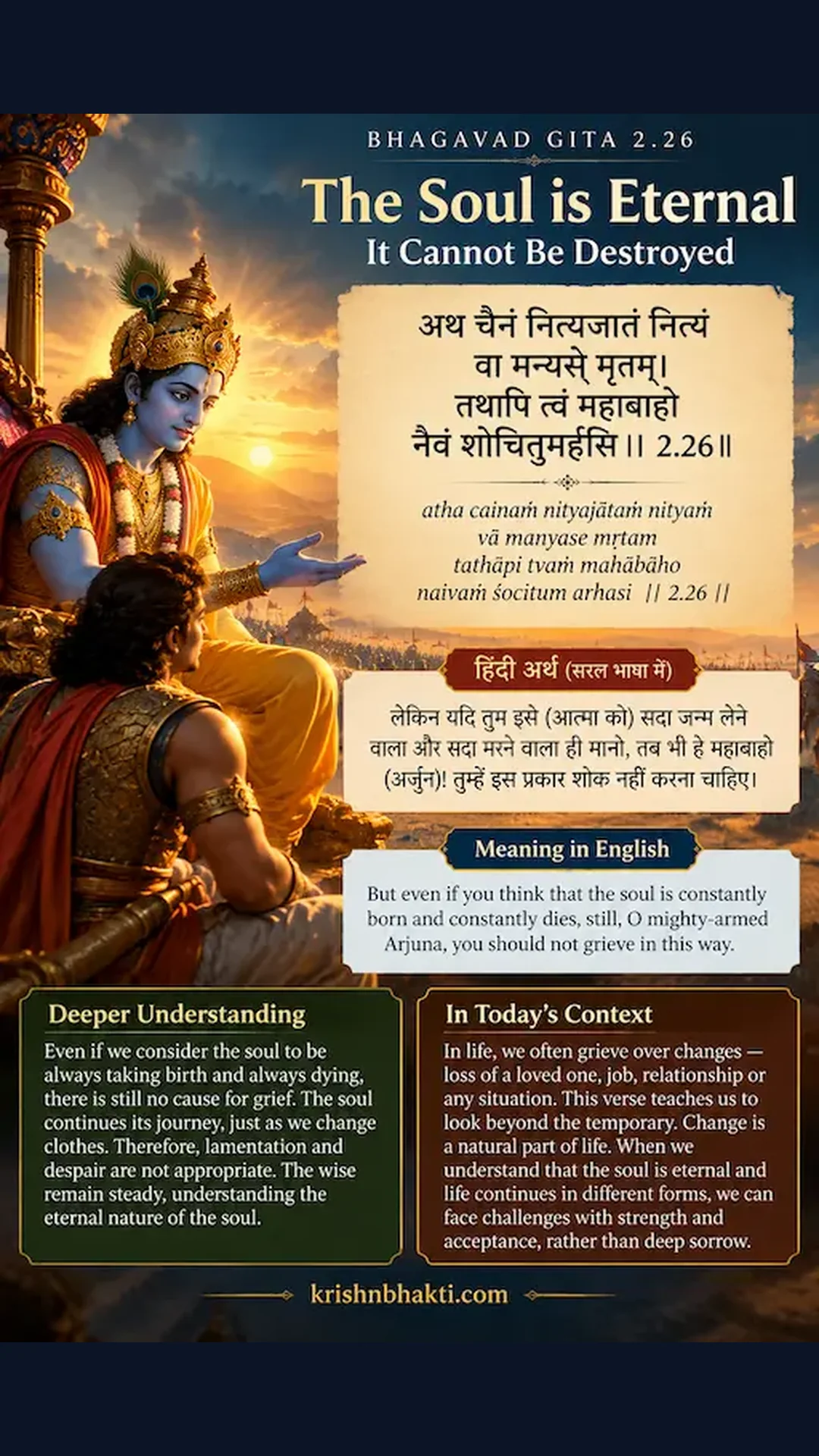
The Ultimate Fear of Life and Our Hidden Anxiety
In the previous verse, Lord Krishna explained to Arjuna the inconceivable, immutable, and eternal nature of the soul. He clarified that this soul can never be cut by any weapon, burned by fire, moistened by water, or withered by wind. It is completely eternal and indestructible. Taking this profound teaching forward, in this 26th verse, Sri Krishna addresses yet another very subtle and deep illusion lingering in Arjuna's mind — the natural attachment and fear that human beings hold regarding birth and death.
Imagine sitting at your office desk today, coding on your laptop or fixing an Excel spreadsheet, when suddenly your phone buzzes with news that knocks the ground right out from under your feet. A distant relative or someone you knew has suddenly passed away. Instantly, a strange silence descends upon your mind — amidst the office chatter, the commute home in the metro, or while walking down the street. You catch yourself thinking — 'Just yesterday that person was talking, and today they are gone! Is this all that life is?' Whenever this thought crosses our mind, a chill runs down our spine. Deep down, we are all terrified of the day everything we know will vanish, our bodies will turn to dust, and we will cease to exist forever.
On social media, we see filtered faces, vacation reels, and smiling young people every single day. Everyone acts as though this life will never end. We run in this blind race as if this world belongs to us and we are going to stay here eternally. But as night falls, the room's lights go off, and we lie down on our beds, a strange emptiness and an unknown fear suddenly sit heavily on our chests. 'What if I don't wake up tomorrow morning?' 'Does anything really remain after this body is destroyed?' This is the very question that has troubled the human mind for centuries.
Many people think that the Gita is merely about swords clashing and winning a religious war on a battlefield. But wait. If you look closely, the battlefield of the Gita is actually our own mind. Arjuna represents each one of us today — a modern youth tangled in the web of professional life, relationship stress, career crossroads, and future uncertainty. Arjuna's Gandiva bow is nothing more than our modern laptops, mobile phones, and responsibilities under whose crushing weight we suffer every moment. When Arjuna trembles at the sight of his own loved ones on the battlefield, he is actually mirroring our own inner trembling, terrified of losing our families, dreams, and careers.
This is where Lord Krishna appears like an infallible physician. He does not feed Arjuna long religious stories; instead, He strikes directly at the core of human consciousness where the seed of fear is planted — the fear of death. The Lord says that O Arjuna, the body you think is dead and whose destruction is causing you so much grief was never truly alive in the eternal sense to begin with, and the soul never dies. This statement sounds simple to say, but living it is immensely difficult. In the rush of modern life, we have mistaken our bodies for our true identity. Making biceps in the gym, following skincare routines, keeping hair styled — this has become our entire world. Naturally, when someone tells you that you are not this body, it comes as a profound shock.
Yet, Lord Krishna insists that this illusion must be shattered. If you remain trapped in the belief that the body is everything, you will die a thousand deaths every day. Every time your bank account drops, you will feel like you are perishing. Every time a relationship breaks, you will feel your world has collapsed. Every time your promotion gets delayed at the office, you will feel your very existence is being wiped out. This is why today's youth fall prey to depression, anxiety, and panic attacks. We have anchored our identity to something utterly perishable.
Against this backdrop, let us examine the sacred verse spoken by Sri Krishna to permanently dispel Arjuna's deep delusion. This verse is not merely a Sanskrit shloka; it is the very oxygen your soul needs to experience immortality amidst the turbulent storms of this mortal world. Let us absorb every single word of this verse into our hearts and feel the radiant light hidden within it that can pierce through the darkest shadows of your life.
Srimad Bhagavad Gita Verse 2.26
अथ चैनं नित्यजातं नित्यं वा मन्यसे मृतम्।
तथापि त्वं महाबाहो नैवं शोचितुमर्हसि॥ २.२६ ॥
Simple Meaning and Inner Analysis
Before diving into the literal and simple meaning of this verse, we must plumb the depths of its individual Sanskrit words. Addressing Arjuna, Lord Krishna says: 'O mighty-armed Arjuna! Even if you think of the soul (or body) as perpetually born and perpetually dying, still, O mighty-armed one, you have no reason to lament like this.' Here, the Lord adopts an extremely fascinating and logical approach. He says: suppose, just for a moment, we accept the viewpoint of those who believe there is no eternal soul, and that with every passing second bodies are newly born and destroyed along with consciousness — even then, there is no justification for such grief.
Let us break this down word by word:
अथ चैनम् (Atha cha enam) — And if this (soul or body).
नित्यजातम् (Nitya-jatam) — Constantly born (taking birth at every moment).
नित्यम् वा (Nityam va) — Or perpetually.
मन्यसे मृतम् (Manyase mritam) — You consider it constantly dying (perishable).
तथा अपि (Tatha api) — Still, nevertheless.
त्वम् महाबाहो (Tvam mahabaho) — O mighty-armed Arjuna! You.
न एवम् (Na evam) — Not thus (in this manner).
शोचितुम् अर्हसि (Shochitum arhasi) — Deserving to lament (fit to grieve).
The three or four core takeaways from this verse for our daily lives are revolutionary. First, Lord Krishna speaks from the absolute peak of logic. He tells Arjuna that even if you side with materialist philosophy, which claims there is no soul and only physical bodies taking continuous birth and perishing, there is still no reason to weep. Because the very rule of nature is that whatever is born must die, and whatever dies must be reborn. So why lament over an inevitable mechanism?
Second, the Lord addresses Arjuna as 'Mahabaho' (mighty-armed). This is no ordinary address. 'Mahabaho' refers to one whose arms are strong, who is not a coward, and who does not shrink from life's battles. Krishna is reminding Arjuna of his innate strength. When we are shattered by the death of a loved one or a massive professional setback, we forget our inner fortitude. We sit in a corner weeping like helpless children. The Lord shakes us awake and says — rise, you are not weak, your arms are strong; recognize the wheel of this mortal world and perform your duty.
Third, lamentation is the greatest waste of human energy. The Lord states 'na evam shochitum arhasi' — you should not grieve in this manner. Grieving will not bring back the dead, reverse the past, or mend broken relationships. On the contrary, mourning destroys whatever remaining energy you possess, robbing you of your capacity to perform present actions. Therefore, a wise person is one who accepts this eternal law of life and stands firm on the path of duty without unnecessary attachment.
Swami Ramsukhdas Ji Maharaj offers a unique and practical perspective while commenting on this verse. Swamiji explains that here Lord Krishna addresses that exact psychological state of Arjuna where one feels, 'If the body is everything and the soul has no independent reality, then life is terrifying.' Materialistic thinkers believe everything ends with the body. Swami Ramsukhdas Ji explains that the Lord is saying: even if you become completely atheist or materialist and believe the physical body is all there is, there is still no rational ground to mourn.
In his discourses, Swamiji explains in simple words that the inherent rule of the world is 'change'. Why cry over something that changes every single second? Swamiji places great emphasis on the words 'nityajatam' and 'nityam mritam'. He says that millions of creatures are born and millions die every second in this world. It operates like a massive factory where products are manufactured and shipped out continuously. If one item gets destroyed in this ongoing assembly line, does any sensible merchant burn down the entire factory? No! He understands it is part of the business.
Swami Ramsukhdas Ji connects this directly to the practice of spiritual sadhana. He states that a sadhak's greatest disease is claiming ownership over things that are foreign and impermanent. The body, family, wealth, and status are like rented apartments. When the landlord asks you to vacate a rented house, do you weep inconsolably? No, because you always knew it had to be vacated sooner or later. Swamiji emphasizes that human ignorance is the root cause of all suffering. Man mistakes the perishable for the imperishable and forgets the true eternal soul.
This insight from Swami Ramsukhdas Ji serves as a wake-up call for modern youth who slip into depression over trivial matters. A breakup happens, and life feels over. A job is lost, and the world seems shattered. Swamiji says — oh foolish one! This world is another name for change. Nothing here is permanent. Once you understand this law of change, half of your problems vanish instantly. Swamiji firmly declares that lamentation is not human nature; it is the byproduct of ignorance. When the lamp of illumination is lit, the fog of grief clears automatically, and one returns to the field of duty with renewed vigor.
When we look at this verse through the eyes of Srila Prabhupada, the founder of ISKCON, we witness an extraordinary illumination of devotion and Krishna consciousness. Prabhupada explains in his translations and purports that Lord Krishna is also addressing those who deny the existence of the soul (whom he terms atheists or agnostics). Prabhupada notes that material scientists and philosophers consider life to be merely a combination of chemical elements, believing that consciousness becomes permanently extinct at death.
Prabhupada writes that even if someone harbors a thoroughly foolish materialistic outlook, considering the physical body to be everything, there is still no scientific or spiritual justification to lament the birth and death cycles of this temporary frame. In his books, Prabhupada repeatedly emphasizes that Krishna Consciousness is the sole means to elevate humanity beyond this endless and painful cycle of samsara.
Prabhupada's perspective is deeply compassionate and loving. He explains that Lord Krishna is not chastising Arjuna angrily, but guiding him like a mother. When a young child cries over a broken toy, a mother does not beat the child; she gently explains, 'My dear child, I will get you a better toy; do not cry over this.' Similarly, Krishna is counseling Arjuna: why grieve over the breaking of this temporary body? If you anchor yourself in Me and practice My devotional service, you will attain that eternal abode where there is no birth, no death, and no grief.
According to Prabhupada, modern society's greatest tragedy is the banishment of God from our daily lives. We have reduced spirituality to a weekend ritual. When a major crisis strikes — such as the death of a loved one or a severe illness — we flounder, not knowing where to turn. Prabhupada teaches that for one who takes shelter of Krishna, death is not an end, but a doorway to return home, back to Godhead. Such a person does not lament the dropping of the physical garment; instead, they relish the soul's eternal journey toward the lotus feet of the Supreme Lord.
Swami Mukundananda Ji is renowned for his modern and psychological analysis. When he explains this 26th verse of the Bhagavad Gita, he speaks the language of contemporary youth — corporate offices, startup cultures, relationships, anxiety, and mental health. Swami Mukundanand Ji notes that modern youth live in constant fear of losing things, a phenomenon commonly known as 'FOMO' (Fear of Missing Out). We fear falling behind, losing money, being abandoned by partners, or losing aging parents.
Swami Mukundanand Ji offers a brilliant analogy. Suppose you are working out in a gym, lifting heavy dumbbells, and your muscles experience intense burning pain. Do you quit the gym in terror of that pain? No! You know that very pain is building your muscle strength. Similarly, the ups and downs of life, the pain of separation, and career setbacks are nothing more than the process of strengthening your spiritual and mental muscles.
Swami Ji points out that through this verse, Lord Krishna is teaching us 'Emotional Resilience'. Modern psychology concurs that anyone who cannot accept change can never remain mentally healthy. Swami Mukundanand Ji explains that when we remain submerged in grief for weeks and months after losing a loved one or facing a massive loss, we are essentially waging war against the immutable laws of nature. And whoever fights nature's laws is destined to lose.
Swami Ji advises youth to adopt the principle of 'Detached Attachment' in life. Love everyone, care for your family, perform your work with utmost honesty, but inwardly realize that none of these things are permanent. This office, this company, this home, these friends, and even this body will change one day. Living with this mental framework ensures that no shock in life can shatter you. You may experience sorrow and shed tears because you are human, but you do not drown in that sorrow and ruin your life. You rise, wipe your tears, and march forward on your path of duty.
Let us bring these philosophical principles down into the practical pages of everyday life. Imagine Rahul, a 26-year-old software engineer working at a major MNC in Bangalore. Rahul's world revolved around his grandfather. Whenever Rahul felt overwhelmed by office pressure or his project got rejected, he would sit beside his grandfather, who would stroke his head and say — 'My boy, do not worry; every sun sets only to rise again the next morning.'
Yet one day, a sudden phone call arrives. His grandfather has suffered a massive heart attack and passed away. Rahul is devastated. He catches the first flight home, and upon seeing his grandfather lying still, he lets out a cry of pure anguish. It feels as though his entire world has collapsed. His legs refuse to support him. Office emails start pinging about project deadlines and client calls, but Rahul's mind is completely numb. He sits in a corner of the room, weeping uncontrollably, thinking — 'Why did God do this? Why did He take away my greatest pillar of support?'
At that very moment, fragments of the Bhagavad Gita that Rahul had once read echo in his mind. He remembers what Krishna told Arjuna. Rahul thinks — 'Was my grandfather's physical body everything? Are his love, his teachings, and his energy gone forever?' Rahul takes a deep breath. He realizes that while his grandfather's body has dissolved into the five elements, his soul is immortal, and his teachings remain vibrantly alive within Rahul.
Rahul wipes his tears and stands tall. He fulfills all funeral rituals with complete responsibility. Afterward, he returns to his work. When his boss asks if he is okay, Rahul smiles and replies — 'Yes sir, I am fine. Life and death are the laws of nature, and my duty is to perform my work with absolute sincerity.' This is Rahul's inner transformation. This is the practical application of the Gita's verse. Rahul no longer fears losing his loved ones; instead, he transforms the memories spent with them into his fuel to move forward.
The second scene features Priya, an HR manager at a startup. She shared a deep bond with a close friend who had stood by her through the initial five years of her career. Suddenly one day, that friend announced he was moving abroad permanently and their relationship could no longer continue. Priya was shattered from within. She felt as though a vital part of her life had been ripped away. She stayed awake all night reading old chats and blaming herself. She stopped eating properly, and her performance at the office began to plummet.
One day, an insightful colleague approaches Priya and gently advises — 'Priya, why are you destroying your entire life over something beyond your control? Everything in this world has an expiration date. People come, teach their lessons, and leave. Are you going to destroy yourself over the departure of this relationship?' These words hit Priya's heart like an arrow. She recalls the Gita's 26th verse — 'na evam shochitum arhasi'. Priya realizes that the breaking of a relationship or the departure of someone is not the end of life. She wipes her tears, resumes her fitness routine, learns new skills, and propels her career forward. This is the true power of the Gita's wisdom — preventing us from breaking and transforming us into stronger beings.
Self Q&A
Q1: Is crying or feeling grief upon the death of a loved one considered a sin or against the Gita?
Answer: Absolutely not! Swami Ramsukhdas Ji beautifully explains that shedding tears or experiencing emotional pain is a natural human response. When a loved one departs, the heart aches, and tears flow naturally. Lord Krishna is not demanding that we become unfeeling stones devoid of emotion. What the Lord cautions against is drowning in that grief, abandoning one's duties, sinking into months of depression, and freezing one's life. Tears may flow from the eyes, but deep within the heart must reside the unshakable conviction that the soul is eternal and the body is temporary. Once you grasp this truth, your grief lightens, and you smoothly return to the mainstream of life.
Q2: How do we apply this verse in modern life when losing a job or facing a major business loss?
Answer: Swami Mukundanand Ji offers profound practical guidance on this. When a job is lost or a business collapses, we often feel as though our entire identity has been wiped out. Applying this verse means untethering your self-worth from your job title or bank balance. A job is a tool, not your ultimate purpose. Just as seasons change — transitioning from sunshine to rain — success and failure ebb and flow in life. When you recognize that this loss is also a temporary, changing event, you bounce back from the shock much faster and gather the energy to make a fresh start.
Q3: Is Lord Krishna endorsing materialist philosophies like Carvaka in this verse?
Answer: According to Srila Prabhupada (Bhagavad Gita As It Is), the Lord is not endorsing Carvaka philosophy here; rather, He is employing an academic and logical debate style known in Sanskrit discourse. The Lord is essentially saying: 'O Arjuna, even if you assume the perspective of those who deny the soul and view the physical body as everything, there is still no rational ground to lament the destruction of this temporary shell.' This highlights Krishna's genius in addressing thinkers and philosophers at every level to guide them back to the path of duty.
Q4: What is the connection between this verse and modern youth anxiety and depression?
Answer: Today's youth suffer immense anxiety driven by future uncertainties — 'What will happen to me?', 'Will my job remain secure?', 'Will my partner leave me?' All such fears stem from the anticipation of some future 'death' or 'loss'. Swami Mukundanand Ji explains that this Gita verse anchors you firmly in the present moment. Once you accept that nothing in this material world is permanent, you stop obsessing over future anxieties and begin living each moment with complete integrity and joy. This is the ultimate cure for anxiety.
Q5: How does this verse connect with the previous verse (2.25)?
Answer: In the preceding verse (2.25), the Lord described the unmanifest, immutable, and eternal nature of the soul — 'achyoyam achintyoyam...'. He established that the soul never dies. Yet, Arjuna's lingering doubt likely whispered: 'Alright, grant that the soul doesn't die, but the body certainly dies, and watching the bodies of loved ones burn causes undeniable pain!' To dispel this very doubt, Lord Krishna states in this 26th verse: 'O foolish one! Even if you view the body as everything and believe in continuous birth and death every second, there is still no cause for grief because change is the sole eternal reality of this world.' Thus, the previous verse provides the spiritual truth, while this verse translates that truth into practical application for human existence.
🙏 Hare Krishna — Jai Shri Krishna 🙏
📖 Also Read: When Fear and Anxiety Hit Hard, the Gita Reveals the Ultimate Truth About Who You Really Are 📜