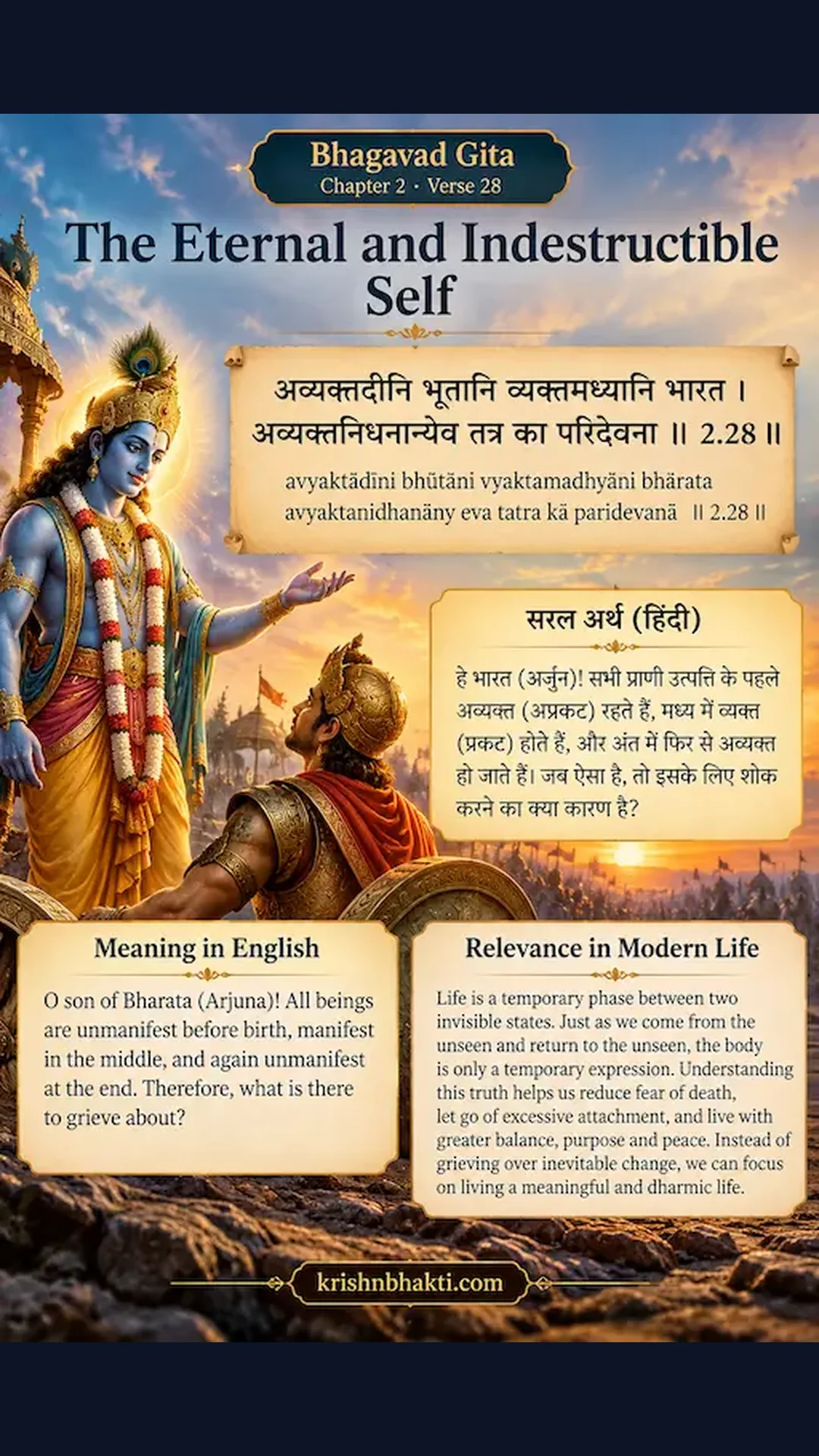
In the previous verse, Lord Krishna explained to Arjuna the unbroken and inevitable cycle of birth and death to shake off his grief. He made it crystal clear that whatever has taken birth must die, and whatever has died must take birth again. Knowing this absolute law of nature, mourning is utterly pointless. Yet, the human mind is such that while it intellectually accepts this reality, whenever real-life tragedies strike — the loss of a loved one, the shattering of a career, or a sudden crisis of existence — it completely shatters. Arjuna was also drowning in this very whirlpool of human weakness and delusion, and Krishna was steering him out step by step through timeless spiritual truths.
If we look at our modern lifestyle today, we are constantly living in a whirlwind of uncertainty and rat race. From the moment our eyes open in the morning until we collapse into sleep at night, our minds spin with thousands of worries — career pressures, the fear of losing a job, toxic relationships, social media comparison where everyone else seems to be living a perfect life, and above all, an unknown terror about the future. We are trapped in a relentless marathon where stopping feels like falling behind. This continuous stress and anxiety pull our minds away from the present moment, dragging us either into the bitter regrets of yesterday or the terrifying imaginations of tomorrow. We desperately want to cling to things, people, and circumstances forever, completely ignoring the fundamental nature of this universe.
When a sudden crisis hits our lives — like the abrupt departure of a loved one, a massive financial crash, or a sudden health scare — our entire world crumbles. It feels as though our universe has been blasted into a million pieces and nothing is left. At that very moment, we forget where everything came from before it appeared and where it vanishes when it's gone. We become so deeply entangled in the outer layer of manifest reality that we completely lose sight of the infinite, unmanifest reality hidden right behind it. This precise delusion is the root cause of all our agonizing suffering.
People often harbor a massive misconception that spirituality means running away from the world, escaping to the mountains, and suppressing all human emotions. Many young people think that ancient texts like the Bhagavad Gita or the Upanishads are meant only for the elderly, having zero connection with the fast-paced life of the younger generation, startups, AI eras, and corporate hustle. They believe that applying Gita's wisdom in practical life is impossible because modern life is a daily battle for survival. However, through Arjuna, Lord Krishna is teaching us that spirituality is not escapism; it is the ultimate clarity of vision to see life in its absolute wholeness.
This profound principle of the unmanifest (avyakta) and the manifest (vyakta) is not just a description of post-death states; it is a reality unfolding right before our eyes every single second. Think about it: where were the thoughts running through your mind right this second before they arose? They emerged suddenly from that infinite, unmanifest reservoir of consciousness. And as you read this very paragraph, those old thoughts dissolve to make way for new ones. In the exact same manner, our relationships, our successes, our joys, and our sorrows all emerge from that same great void or unmanifest state and one day dissolve right back into it. Once we grasp this cosmic truth, our entire perspective toward life transforms dramatically.
Through this verse, Krishna wants to bestow upon us a mental resilience that never breaks, no matter the storm. For the youth of today, this verse serves as the greatest mental tonic. When you realize that everything is temporary, the gripping fear of loss slowly loses its chokehold over you. You work, you love, you strive forward, but you become completely liberated from the unhealthy attachments that breed clinical depression and anxiety. This is precisely why verse 2.28 of the Bhagavad Gita has become exponentially more relevant today in a world where inner peace is the rarest commodity on earth.
Let us now witness this deeply profound and revolutionary verse of Lord Krishna in its pristine original Sanskrit script, which has illuminated human consciousness for millennia:
अव्यक्तादीनि भूतानि व्यक्तमध्यानि भारत।
अव्यक्तनिधनान्येव तत्र का परिदेवना ॥ २.२८ ॥
The simple yet profound meaning of this verse is: O Arjuna, descendant of Bharata, all created beings are unmanifest in their beginning, manifest in their interim state of life, and unmanifest again when they are annihilated. What need is there for lamentation? Here, Lord Krishna scientifically and philosophically categorizes the three stages of existence — adi (beginning), madhya (present state), and nidhana (conclusion). In the beginning, there was nothing visible; at the end, nothing will remain visible; so why foster ego, arrogance, or obsessive grief over what is merely visible in the middle?
To understand this verse in its absolute depth, we must dissect every single Sanskrit word. The first key word is 'avyaktadeeni' — meaning those whose origin or beginning is unmanifest, invisible, or subtle. Before any living entity or physical object takes form in this material world, it rests in the subtle, unmanifest womb of nature or Brahman. The second key word is 'bhootaani' — meaning all created beings or physical elements. The third crucial term is 'vyaktamadhyaani' — meaning that in their interim period, during their active lifetime, they are explicitly manifest to our senses.
Next, the Lord addresses Arjuna as 'Bharata' — O best of the Bharata lineage. And in the final phase, He explains 'avyaktaneedhanaanyeva' — meaning that at the end, they revert right back into that very same unmanifest state (nidhana here does not mean destruction in the sense of absolute annihilation, but rather returning to one's original source). Finally, He asks the rhetorical question: 'tatra kaa paridevana' — why on earth should anyone mourn or weep over this natural cycle? When appearance and disappearance are natural laws, shedding tears over them is sheer ignorance.
We must extract three life-altering takeaways from this verse. First, whatever is standing right in front of your eyes today was not always there and will not remain there forever — therefore, do not form toxic, blinding attachments to present circumstances. Second, death or loss is never an end; it is merely a transition of form, a passage from one state of being to another. Third, ignorance is the root cause of all misery; when the light of wisdom dawns, grief naturally evaporates.
In-Depth Perspective by Swami Ramsukhdas Ji
Let us now explore the commentary on this verse through the eyes of some of India's greatest saints and thinkers. First, let us look at the perspective of Swami Ramsukhdas Ji. In 'Sadhak Sanjivani', Swami Ji analyzes this verse with immense warmth and piercing insight. He places special emphasis on the particle 'eva' in the phrase 'avyaktaneedhanaanyeva'. Swami Ji explains that the word 'eva' places an absolute, unbreakable seal of certainty that there are zero exceptions to this rule. Whatever is visible in this material realm — whether it is the human body, wealth, social status, or relationships — is destined to merge back into the unmanifest. Nobody holds a permanent residential address in this mortal world.
Swami Ramsukhdas Ji gives a vivid, relatable analogy of a dream. He explains that just as we see a magnificent palace in a dream, live like a king inside it, and the moment we wake up, the entire palace vanishes into thin air, this waking world operates on the exact same principle. Where was the palace before you slept? Where did the palace go when you woke up? It only appeared in the middle! So how utterly foolish is it to cry over a dream object after waking up? Swami Ji points out that man's greatest misery is treating something meant only for the 'middle' phase as if it were eternal. When it parts ways, he feels his entire existence has been looted. Swami Ji advises seekers to treat the body and world as a temporary assignment, never as personal property.
A.C. Bhaktivedanta Swami Prabhupada (ISKCON) Perspective
Moving forward, let us examine the perspective of Srila Prabhupada, the founder-acharya of ISKCON. In 'Bhagavad Gita As It Is', Prabhupada views this verse through the pure lens of Bhakti yoga and Krishna consciousness. Prabhupada maintains that because the manifestation and unmanifestation of bodies and the material world are entirely under the control of nature's laws, a wise person never wastes precious time and human energy chasing ephemeral material illusions. Instead, they invest their energy in the service of the Supreme Lord, who transcends both the manifest and the unmanifest.
Prabhupada explains with immense gentleness and paternal affection that Lord Krishna is not scolding Arjuna harshly; rather, He is stroking his head like a compassionate father, guiding him out of delusion. Prabhupada notes that modern man seeks solutions to every life problem in secular physical science, completely forgetting that science can only study 'manifest' objects, while the ultimate source of life remains 'unmanifest'. Unless a person is situated in Krishna consciousness, every death and every loss will feel like a catastrophic apocalypse. But for a devotee who understands that every living entity is an eternal spirit soul and part of Krishna, death is nothing more than moving from one room to another. Prabhupada's perspective provides youth with unshakeable inner stability, empowering them to execute their duties without panic.
Modern Interpretation by Swami Mukundananda Ji
Let us now look at the insights of Swami Mukundananda Ji, a prominent contemporary spiritual master known for his scientific and logical presentation of Vedic wisdom. Swami Mukundananda connects this verse directly to modern psychological struggles such as depression, overthinking, and perfectionism. Swami Ji introduces a brilliant analogy of a gym workout. He explains that just as lifting weights creates stress and muscle micro-tears, and that very resistance builds physical strength, the ups and downs of life — where things manifest and then suddenly vanish — are designed precisely to build our mental muscle and resilience.
Swami Ji points out that today's youth tends to equate any single failure with their entire identity. If they score low on an exam, if their startup tanks, or if a romantic partner walks away, they feel their entire life is over. Using this verse as an anchor, Swami Ji explains: my friend, this is merely the 'interim' or 'middle' stage! The failure visible today will soon become unmanifest, and out of your persistent effort, a brand-new, superior phase will emerge. Just like mental reps in meditation, whenever the mind gets stuck in grief over an old loss or a past wound, gently pull it back and remind yourself that these are merely passing seasonal winds. Swami Mukundananda's practical wisdom acts as a life-saver for modern corporate professionals and students alike.
Real-Life Examples and Inspiration
Let us connect this to concrete, real-life scenarios that young people face daily. Imagine you are a software engineer working at a high-pressure IT firm. For the last six months, you have poured your heart and soul, sleepless nights included, into building a groundbreaking software project. You dream of getting promoted, getting a massive salary bump, and cementing your reputation in the office. But suddenly, upper management shifts priorities and axes the project entirely overnight. In that single second, the ground slips from beneath your feet. You feel all your grueling labor was wasted, your dreams shattered, and you plunge headfirst into a dark spiral of depression.
Now look at this exact situation through the lens of this verse. Lord Krishna states that that project and that anticipated success were merely 'vyaktamadhyaani' — they manifested for a brief window in the middle. The original source (the unmanifest reservoir of your skills, intelligence, and creativity) remains entirely intact within you. When you adopt this worldview, you do not weep over the canceled project; instead, you recognize that this chapter has naturally closed and another unmanifest chapter is waiting to be born. This exact realization pulls you instantly out of mental darkness.
Take another extremely common scenario: romantic relationships and heartbreaks. In today's youth culture, getting dumped or going through a painful breakup is an overwhelming emotional trauma. When someone you loved unconditionally walks out of your life, it feels as though the universe has ended. Months are spent locked in a room, insomnia takes over, and staring at old photographs on a smartphone eats away at the soul. At that moment, telling someone 'everything happens for a reason' feels like a cruel joke. Yet, verse 2.28 of the Bhagavad Gita walks softly to your side, places a gentle hand on your shoulder, and whispers that the person who is no longer manifest in your life has simply dissolved back into that infinite consciousness from which they came. You existed before they arrived, and your existence does not cease because they departed. Embracing this truth initiates the core healing process no worldly doctor or counselor can ever manufacture.
Even inside meditation and mindfulness practices, this verse plays a monumental role. When you sit down in the morning to meditate, closing your eyes and trying to anchor your awareness on your breath, your mind inevitably wanders within seconds. Sometimes a stressful meeting pops up, sometimes an old grievance flares up, and sometimes anxiety about the future manifests. You grow frustrated, thinking, 'My mind refuses to stay still!' That is when this verse hits you like a flash of lightning. You realize that these thoughts also operate on the exact law of 'avyaktadeeni vyaktamadhyaani avyaktaneedhanaanyeva'. Thoughts emerge from nowhere, dance on the stage of the mind for a few moments, and then dissolve back into the unmanifest void. You do not need to wrestle with them; you simply observe them as a detached witness coming and going. That is the ultimate secret of deep meditation.
Self Q&A
Let us now address some profound questions that naturally stir in the hearts of genuine seekers. Through these queries, we will cement the practical application of this verse.
Question 1: Is the Lord saying we should never love anyone because everything is perishable?
Swami Ramsukhdas Ji offers a crystal-clear distinction here. He explains that Krishna never discourages love; rather, He commands us to abandon 'attachment' (moha). Love and attachment are poles apart. Love means wishing the absolute well-being of the other person, granting them freedom, and connecting with their soul. Attachment means claiming ownership over someone, trying to cage them, and believing they exist solely for your emotional validation. When you love, you enjoy their presence; when you are attached, you die a thousand deaths fearing their loss. Krishna is urging us: do not treat worldly things and human bodies as your permanent property; love them as trustees of God's creation. When they depart, bid them farewell with a smile because their true home is the unmanifest.
Question 2: When a loved one passes away, is crying or grieving a violation of spiritual principles?
Srila Prabhupada maintains a deeply compassionate and human-centric perspective on this. Prabhupada notes that as human beings, shedding tears and experiencing grief is entirely natural. Even a mighty warrior like Arjuna had tears streaming down his face. However, the critical difference is this: an ordinary, deluded person drowns completely in that grief, abandons their duties, and acts as though life is finished; whereas a wise, God-conscious person maintains unwavering faith in the cosmic order even through their tears. They know the body perished, but the soul is eternal. Avoiding the excess of grief is the true intent of this verse, not the suppression of human emotion.
Question 3: How can this verse help combat the modern plague of 'anxious future' and chronic overthinking?
Swami Mukundananda Ji answers this brilliantly. He points out that the future is entirely unknown because it currently resides in the 'unmanifest' womb of time. We burn our present-day vital energy to ashes worrying about what hasn't even happened yet. Swami Ji emphasizes that the Bhagavad Gita trains us in the supreme art of living in the present moment. Since both the beginning and the end are beyond our control (being unmanifest), the only domain given to our agency is the 'middle' — our present karma. Worrying about the future is like expecting a harvest without ever planting a seed. When you invest 100% honest effort in the present moment, the future naturally manifests in a magnificent and fulfilling way.
Question 4: Does this verse directly point to the law of reincarnation? Are we talking about past and future lives?
Yes, absolutely. Swami Ramsukhdas Ji clarifies that 'avyaktadeeni' does not simply mean the physical body did not exist before birth; it signifies that the living soul is on an infinite journey which began in a subtle unmanifest state long before this current visible body, and which will continue in subtle unmanifest states long after this body dissolves. This verse scientifically defines the immortality of the soul and its eternal cycle of manifestation and withdrawal. Once this conviction settles in your heart, the terror of physical death vanishes permanently.
Question 5: Can this verse be applied to office politics, career setbacks, and corporate competition?
Undoubtedly! Swami Mukundananda frequently states in his discourses that the Bhagavad Gita is the greatest management manual ever written. Today you got promoted; tomorrow someone else will take the chair. Today your boss praises you; tomorrow you might face harsh criticism. This is all 'vyaktamadhyaani' — the fluctuating colors of the middle phase. If getting praised swells your head with arrogance, or getting criticized plunges you into clinical depression, you lack emotional maturity. A wise professional views these external shifts like changing weather — when it's sunny you wear shades, when it rains you use an umbrella, but your internal temperature remains steady and undisturbed.
Question 6: How does this verse connect to the previous verse? Is it repeating the same concept or offering something entirely new?
Swami Ramsukhdas Ji provides a gorgeous analytical bridge here. In the previous verse (2.27), Krishna established the inevitability of birth and death on an individual, personal level — that whatever has a birth must face death. But in this verse (2.28), Krishna scales that exact truth up to a grand, universal cosmic perspective — the movement from the unmanifest into manifestation, and back into the unmanifest. This applies not just to humans, but to entire galaxies, objects, thoughts, and life situations. This wisdom expands Arjuna's narrow, localized grief into a vast, universal vision of existence.
The time has arrived to anchor this monumental truth deep within your consciousness. The next time a storm hits your life, when things slip out of your control, when a loved one walks away, or when your hard work does not yield immediate results, close your eyes and let Lord Krishna's timeless words echo in your soul: 'Avyaktadeeni bhootaani vyaktamadhyaani bharata, avyaktaneedhanaanyeva tatra kaa paridevana.' This singular mantra will generate an unshakeable stillness and peace inside you that no storm can ever rattle.
Let us rise above our petty egos, our trivial anxieties, and our blind attachments, connecting directly with that infinite, eternal consciousness that serves as the foundation of the entire cosmos. Every single moment of life becomes a divine celebration once we understand its fundamental laws.
🙏 Hare Krishna — Jai Shri Krishna 🙏
📖 Also Read: When Death or Defeat Stares You in the Face, Lord Krishna's Words Give Real Courage 😔🙏