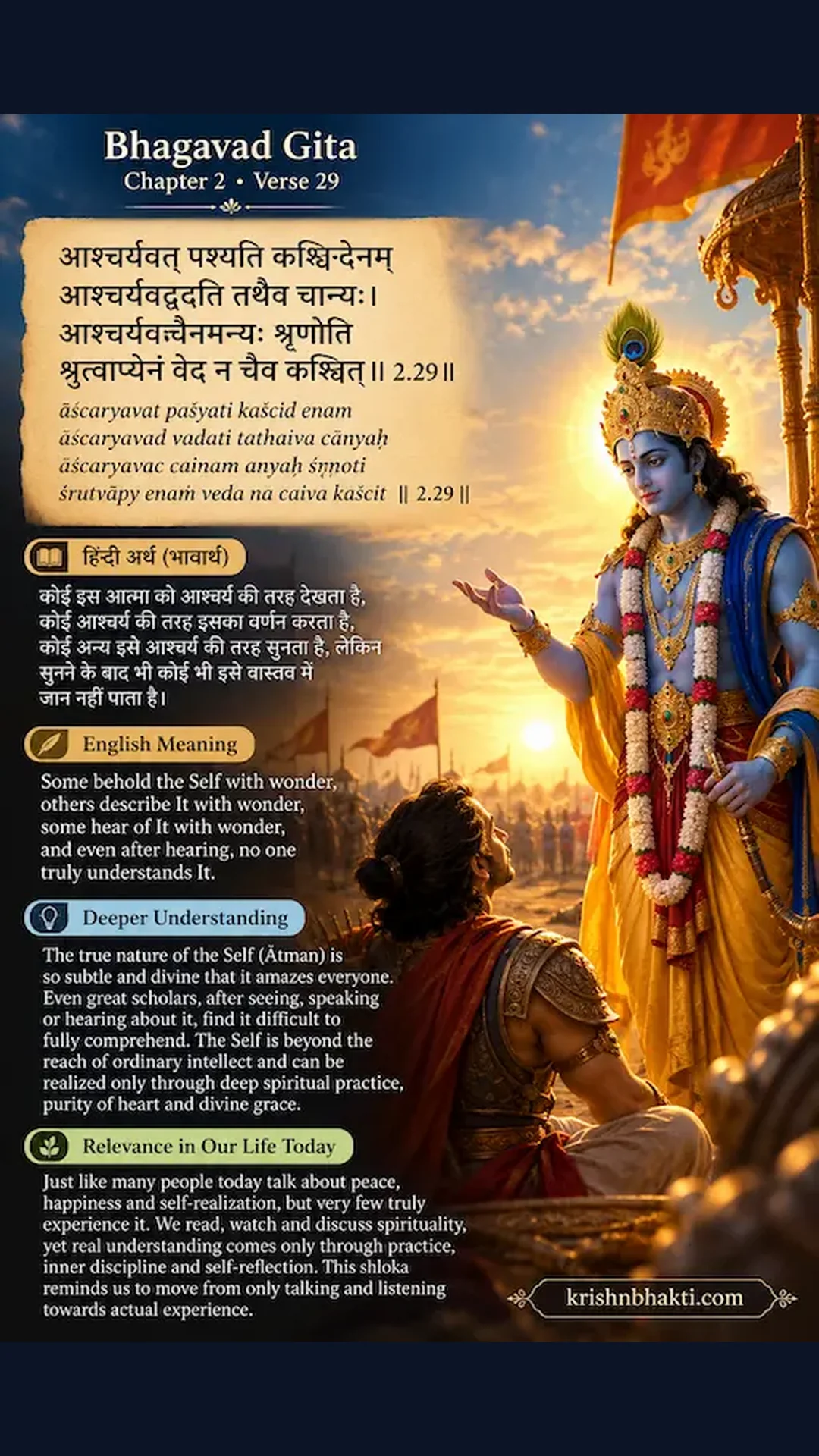
In the previous verse, Lord Krishna explained to Arjuna that all created beings are unmanifest in the beginning, manifest in their interim state, and again unmanifest upon dissolution. So why lament over this inevitable cycle of the physical body? Continuing this profound exploration of existence and impermanence, Krishna now points toward that immutable, eternal reality residing within all of us — the soul. In today's hyper-connected yet deeply lonely world, where every young person struggles with identity crises, career anxieties, and social media comparison, this verse acts as a profound healing balm. When we wake up and scroll through curated feeds showcasing everyone else's seemingly perfect lives, a subtle sense of inadequacy and emptiness creeps into our chests. We begin to believe that our bodies, our job titles, our bank accounts, and our social circles are the absolute measure of who we are. Because of this fundamental illusion, we shatter over minor failures, plunge into depression when relationships end, and view career setbacks as the ultimate defeat of our existence.
Yet have you ever wondered why your inner restlessness never truly fades away? It is because you have mistaken the costume for the actor. Today's youth are crushed under the weight of corporate deadlines, toxic dating apps, and parental expectations, constantly striving to prove their worth in the eyes of society. In this frantic race, we forget who we actually are beneath the surface of skin, bones, and labels. Modern life has numbed our consciousness to such an extent that we have lost touch with the eternal energy within us that transcends birth and death. When a job is lost or a heartbreak strikes, it feels as though our entire universe has collapsed. We forget that this world is merely a stage and we are all playing temporary roles.
It is precisely at this juncture that Lord Krishna steps in to lift the heavy veils blinding our vision. People often assume that spirituality is exclusively reserved for temples, rituals, or abandoning society to live in the Himalayas. However, the spirituality of the Bhagavad Gita is a practical art of living designed to steady Arjuna on a terrifying battlefield, and equally capable of keeping a modern corporate professional calm amidst high-stakes targets. Building upon the previous verse, Krishna now introduces us to a staggering, awe-inspiring truth that sages have meditated upon for millennia. This is not mere bookish philosophy; it is a living realization that can dissolve every phobia, anxiety, and existential dread gripping your heart.
We spend our entire lives grieving over things entirely beyond our control. Our bodies age, our physical energy fluctuates, our circumstances shift unpredictably, and loved ones come and go. Witnessing the fragility of this physical vessel naturally triggers deep-seated fears. What if I fail? What if I lose my reputation? What if I end up completely alone? At the root of all these frantic anxieties lies a single fundamental error — identifying the self with the perishable body. As long as we believe we are nothing more than fragile biological machinery, fear will remain our constant companion.
Lord Krishna directly attacks this delusion in this verse. He reveals to Arjuna and to all of us that the soul residing within is the greatest wonder in the entire universe. Some look upon it in utter amazement, others speak of it with profound wonder, some hear about it with awe, and yet others, even after hearing, cannot comprehend it at all. This highlights the reality that spiritual awakening is not a matter of intellectual debate, but an internal realization. The person who catches a glimpse of this truth stops trembling before the storms of the world. Whether the economy crashes, your company lays you off, or the whole world turns against you, your inner throne remains unshaken.
This is why, in today's era marked by skyrocketing rates of depression and anxiety, the message of the Bhagavad Gita is not just an ancient scripture, but the ultimate masterclass in mental health. When a young person realizes they are not merely this bag of flesh and bones, but an inseparable spark of infinite consciousness that weapons cannot cleave, fire cannot burn, water cannot wet, and wind cannot dry, an unshakeable fearlessness takes root within. They dive into their duties with total dedication, completely liberated from paralyzing anxiety over outcomes.
Let us now step across the threshold of this magnificent verse and witness how Lord Krishna unveils this breathtaking mystery. Do not approach this as a mere collection of Sanskrit words or religious dogma; receive it as the ultimate psychological breakthrough for your modern life. As we unpack its layers, centuries of accumulated confusion and fear will begin to melt away, preparing you to meet the sovereign self residing deep within your own heart.
आश्चर्यवत्पश्यति कश्चिदेनमाश्चर्यवद् वदति तथैव चान्यः।
आश्चर्यवच्चैनमन्यः शृणोति श्रुत्वाप्येनं वेद न चैव कश्चित् ॥ २.२९ ॥
Let us now examine the simple meaning and breakdown of this verse to let its profound truth sink into our consciousness. The verse repeatedly employs the concept of wonder or astonishment (āścharyavat). Translated simply, it means: 'Some look upon the soul as a marvel, another speaks of it likewise, another hears of it as a wonder, but even after hearing about it, someone scarcely knows it at all.' Here, Lord Krishna highlights the extraordinary and incomprehensible nature of our spiritual essence.
Breaking down the core Sanskrit terms brings absolute clarity. Āścharyavat paśyati kaśchit means that someone rare—out of millions—actually perceives this soul as a profound wonder. For ordinary human beings absorbed purely in physical sensory experiences, the material world is all that exists; thus, when someone perceives this transcendent soul, they are struck with utter astonishment. Kaśchit emphasizes the rarity of this vision. Vadati tathaiva cānyaḥ means another speaks of it with equal wonder. When a realized master describes the glory of the soul, listeners are left spellbound because those words carry the fire of direct experience.
Thirdly, Krishna states, āścharyavaccainam anyḥ śr̥ṇoti — another hears of it with awe. When modern youth first encounter the concept that 'you are not this body, you are the soul,' a wave of curiosity washes over them, wondering if something truly exists beyond physical death. Yet the final line carries a sobering warning: śrutvāpyenam veda na caiva kaśchit — many hear about it, read countless books on it, debate it passionately, but scarcely anyone truly understands or realizes it. Most individuals listen to it as a fascinating philosophical idea and then immediately return to the frantic treadmill of ordinary material life.
From this verse, we draw four vital takeaways that can radically transform our daily lives. First, our true identity exists far beyond the rigid laws of the material universe. Second, this truth cannot be grasped through dry intellectualism; it requires deep inner vision and a sense of sacred awe. Third, every victory and defeat we experience happens solely at the level of the body and mind, leaving the soul completely unstained. Fourth, most people never experience this reality because they remain hopelessly entangled in external glitter, lacking the stillness needed to look inward. Let us now explore these depths through the commentaries of great spiritual masters.
In-Depth Perspective by Swami Ramsukhdas Ji
Swami Ramsukhdas Ji Maharaj, in his monumental commentary Sadhak Sanjivani and various discourses on the Gita, unpacks every nuance of verse 2.29 with remarkable simplicity, warmth, and profound depth. Swami Ji places special emphasis on why the Lord specifically used the word āścharya (wonder). He explains that in the material world, whatever has a visible form, color, and shape rarely causes genuine astonishment because we are accustomed to seeing physical objects like trees, cars, and buildings every single day. True wonder arises when something exists that is entirely invisible to ordinary physical eyes, completely beyond the reach of gross intellect, yet overwhelmingly more real and permanent than anything else. The soul is precisely such a reality.
Swami Ji offers a beautiful analogy: imagine someone waking up from a deep slumber with a sudden, startling realization of their separation from the physical body, leaving them wide-eyed with awe. Swami Ramsukhdas Ji notes that people conditioned to view the body as the ultimate reality are naturally shocked when a realized saint tells them, 'My friend, you are not this perishable flesh; you are the eternal soul which weapons cannot cut and fire cannot burn.' To material-minded individuals, this sounds like pure fiction or magic. Swami Ji clarifies that āścharyavat paśyati means perceiving the infinite sky-like consciousness hidden within this fragile earthen vessel of a body is no ordinary feat; it requires immense spiritual merit and deep-rooted purificatory karma from past lives.
In his discourses, Swami Ramsukhdas Ji repeatedly stresses that seekers must not treat this verse as mere intellectual information. He observes that people read massive spiritual texts, memorize shlokas effortlessly, and yet the moment a minor insult occurs, a relationship breaks, or a business suffers a loss, they weep and break down just like anyone else. This proves they have only heard the words with their ears without internalizing them. Swami Ji asserts that anyone who even slightly experiences the wonder of this soul immediately finds all their grief, attachment, and fear naturally incinerated. For such a person, worldly joys and sorrows become like a dramatic play where they perform their role with complete sincerity without becoming entangled in it.
The cornerstone of Swami Ramsukhdas Ji’s practical spiritual instruction is that a seeker must constantly practice remembering: 'I am not this body.' He suggests that whether you are bathing, changing clothes, or eating meals, your inner awareness should recognize these as activities of the physical instrument while you remain the silent witness. According to Swami Ji, until an individual learns to dissociate themselves from the body, they cannot taste true liberation. This verse serves as a vigorous wake-up call to shake off our heavy slumber and recognize the wondrous reality pulsing behind every breath we take.
A.C. Bhaktivedanta Swami Prabhupada (ISKCON) Perspective
A.C. Bhaktivedanta Swami Prabhupada, in his universally acclaimed commentary Bhagavad Gita As It Is, interprets this verse entirely through the lens of pure Krishna bhakti and the eternal nature of the soul. Prabhupada’s perspective is uncompromising and crystal clear. He explains that modern scientists and materialists fail to comprehend the existence of a spiritual spark within the body because their gross laboratory instruments are incapable of measuring subtle spiritual energy. Prabhupada points out that today's materialistic educational systems reduce human beings to mere biological machines programmed only to eat, sleep, mate, and die. Driven by this mechanical worldview, modern youth suffer from a severe spiritual famine.
Interpreting the word āścharya in this verse, Prabhupada writes that the intimate, loving relationship between Lord Krishna and the living entity is so wonderfully sublime that individuals drowning in material sense gratification find it utterly astounding. Prabhupada explains that for an ordinary person drenched in material desires, it is nearly impossible to conceive that they are something far purer and eternal than this decaying body — an eternal servant of Lord Krishna. The moment a sincere person takes to the path of Krishna Consciousness and chants the holy names, this heavy material covering begins to dissolve. They finally realize: 'I am an eternal servant of the Supreme Lord, and this material world is merely a temporary foreign place for me.'
Prabhupada beautifully illustrates how people can become brilliant scholars of Sanskrit grammar, earn prestigious academic degrees in philosophy, and yet remain completely oblivious to the real meaning of this verse. Citing the line śrutvāpyenam veda na caiva kaśchit, Prabhupada notes that prominent professors and intellectuals write massive volumes on the Gita throughout their lifetimes, yet they refuse to accept Krishna as the Supreme Lord and remain utterly ignorant of the soul. They remain trapped in a labyrinth of dry words. Conversely, a simple devotee—even one lacking formal education—who chants the Hare Krishna Mahamantra with pure faith directly experiences the transcendental bliss of the soul that intellectuals vainly chase through libraries.
This perspective offers immense relief to modern youth. Prabhupada teaches that you do not need to abandon your life and retire to a Himalayan cave to understand the soul. Right where you are, amidst your studies or career, you can anchor your consciousness at the lotus feet of Lord Krishna. When you place Krishna at the center of your life, the wonder of the soul naturally manifests within your awareness. All anxieties, feelings of loneliness, and bouts of depression are instantly incinerated in the blazing fire of pure devotion.
Modern Interpretation by Swami Mukundananda Ji
Swami Mukundananda Ji is celebrated worldwide for his modern, logical, and psychologically grounded approach. An alumnus of IIT and IIM, Swami Mukundananda breaks down verse 2.29 using contemporary analogies and principles of modern behavioral science tailored for today's generation. Swami Ji notes that modern youth demand logical validation for everything. They want to know: if the soul exists, why can't we see it? If it is immortal, why do we experience fear? Explaining this verse, Swami Ji presents one of his most powerful analogies — the Virtual Reality (VR) headset.
Swami Ji explains that when someone straps on a VR headset and steps into a terrifying virtual game, encountering a charging digital tiger makes their heart hammer and sweat pour. They panic and scream in terror. Yet the moment someone gently lifts the headset off their face, they take a deep sigh of relief and laugh, realizing, 'I was sitting safely in my living room all along; the danger was only on a screen!' Swami Ji states that similarly, we have all strapped on the VR headset of this physical body and mind. The emotional turmoil of broken relationships, failing stock portfolios, and office politics are like scenes within that virtual game. Because we have accepted this headset as our absolute reality, we take every minor incident to heart and spiral into depression.
Expounding on the 'wonder' mentioned in this verse, Swami Mukundananda Ji explains that when a rare seeker finally removes this VR headset and experiences their true spiritual nature, they are struck with profound astonishment: 'I am the pure, blissful consciousness, and I was crying over a fictitious game!' Swami Ji emphasizes that for today's youth, meditation and mindfulness are fundamentally about cultivating detachment from passing thoughts and emotions. When you step into 'observer mode'—watching your mind feel anxious rather than becoming the anxiety itself—you detach from the mind. This is direct experience of the soul.
Swami Ji also addresses why people fail to transform despite hearing these truths. He points out that our conditioning and habits run so deep that attending a single Gita lecture or watching an inspirational video makes us want to change, but walking back into the office the next morning plunges us straight back into the rat race. Swami Ji advises that just as building physical muscles requires consistent daily workouts rather than lifting heavy weights once, spiritual awakening requires daily introspection and mantra meditation. This verse reminds us that your true strength lies not in this fragile body, but in the infinite consciousness untouched by any virus, career crisis, or heartbreak.
Real-Life Examples and Inspiration
Let us translate these profound teachings into concrete scenarios from our everyday lives. Imagine a 26-year-old software engineer. You spend your days writing code, meeting aggressive project deadlines, and enduring your manager's explosive temper. One afternoon, your manager severely reprimands you in front of your entire team during a review meeting, leaving you feeling utterly humiliated. You return to your apartment, lock the door, collapse onto your bed, and weep bitterly. A dark voice whispers that your life is worthless and your career is finished. You lie awake all night, returning to work the next morning swallowed by crippling anxiety.
Now bring verse 2.29 into this exact scenario. When you feel your dignity has been destroyed, whose dignity do you think has been shattered? The corporate title, the employee ID, and the designation granted by that company. But Lord Krishna reminds you that you are an inseparable spark of infinite consciousness before whom this entire company and manager are insignificant. Can your manager's harsh words cut your soul? Can his critique diminish your true spiritual worth? Absolutely not! His anger operates strictly at the superficial level of the physical body and mind. By anchoring yourself in this 'witness consciousness,' the next time your manager reprimands you, an unshakeable inner peace will envelop you. You will smile inwardly, recognizing that this is merely a temporary drama unfolding on a stage while your true self remains completely untouchable.
Consider another common scenario: a young student preparing intensely for competitive civil services examinations. You study twelve to fourteen hours a day, attend rigorous coaching classes, and write endless mock tests, yet you fail to clear the preliminary cutoff while your peers succeed. A crushing wave of inadequacy and depression suffocates you. You feel your life is ruined, fearing what society will say and crushed by parental expectations. For this student, this verse serves as ultimate psychological armor. Realizing that passing or failing an exam is an event restricted entirely to the physical brain and intellect, while your true identity transcends academic metrics, instantly dissolves paralyzing fear. Failure ceases to be an absolute defeat and becomes a temporary stepping stone.
Specific meditation scenarios benefit equally from this insight. When you sit down for morning meditation with expectations of an instantly calm mind, reality often strikes differently: the moment you close your eyes, office emails, past arguments, and social media notifications flood your awareness. Frustration sets in, and you conclude that meditation is not for you. This verse bursts through that frustration: Krishna declares that the mind's nature is constant wandering. Your success does not lie in stopping the mind from wandering, but in gently pulling it back every single time it drifts. Each time you patiently guide your awareness back, your inner spiritual muscle strengthens. Never despair over a distracted mind; view it as your sacred training ground.
Self Q&A
Q1: When we are surrounded by crushing everyday stress, financial pressures, and personal crises, how is it practically possible to remember this verse about the soul? Aren't these lofty philosophical concepts detached from reality?
Answer: This is a completely natural and practical question shared by every young seeker. When debt piles up, jobs are threatened, or severe illness strikes, preaching 'I am the soul, the body is nothing' feels nearly impossible. However, Swami Ramsukhdas Ji explains that spirituality is never an overnight leap; it is built through consistent daily practice. When you dedicate just five minutes every morning to gently reminding yourself, 'I am not the owner of these thoughts and bodily reactions; I am the witness,' you gradually build a robust mental resilience. When a massive crisis eventually hits, that accumulated inner practice sustains you. Just as learning to drive requires intense conscious effort with gears and clutches before becoming second nature, spiritual awareness requires daily repetition. Do not dismiss it as academic philosophy; make it your daily mental habit.
Q2: The verse states that 'someone scarcely knows this soul.' Does this imply that ordinary people like us can never attain this realization, and it is exclusively reserved for great saints?
Answer: Addressing this concern, Swami Prabhupada offers an immensely encouraging perspective. He clarifies that when the Gita uses the word kaśchit (someone rare), it does not mean ordinary people are barred from realization. It simply signifies that ninety percent of humanity spends their entire lives exclusively absorbed in eating, sleeping, mating, and defending, never even glancing inward. Anyone who sincerely turns toward truth and surrenders to the Supreme Lord immediately enters that rare category. Prabhupada teaches that by taking shelter of Krishna Consciousness and chanting the holy names with faith, the Lord Himself ignites that lamp of knowledge within your heart. Never feel ordinary or disqualified; the spiritual door stands wide open for anyone willing to step through.
Q3: In an era where mental health challenges, chronic anxiety, and depression plague modern youth, what is the most practical application of this verse according to Swami Mukundananda Ji?
Answer: Swami Mukundananda Ji provides a brilliant, scientifically grounded psychological solution for this exact crisis. He explains that modern anxiety stems fundamentally from 'over-identification' — mistakenly concluding that your thoughts and emotions define who you are. If a negative thought arises, you assume 'I am a negative person.' If failure strikes, you assume 'I am a failure.' Swami Mukundananda Ji utilizes this verse to teach the practice of conscious detachment and 'observer mode.' Whenever sadness, anger, or stress washes over you, mentally step back and declare: 'My mind is experiencing sadness; I am the soul, peaceful and untouched.' The moment you establish this boundary between mind and soul, half your psychological distress vanishes instantly. This is the ultimate mental first aid for contemporary life.
Q4: People often ask why the mind wanders so relentlessly during meditation. Does this prove spiritual weakness and mean we are incapable of spiritual growth?
Answer: This is a universal doubt faced by every meditator. Swami Ramsukhdas Ji offers a deeply reassuring resolution: the nature of the mind is restlessness; it behaves just like the wind, impossible to capture and tether in one place. Therefore, a wandering mind during meditation does not indicate spiritual weakness or failure. Your spiritual success is measured solely by how patiently you guide your attention back every single time it drifts away. Each repetition strengthens your inner willpower. Never grow frustrated with a wandering mind; treat it as the very gymnasium where your spiritual strength is forged.
Q5: Does this verse imply we must abandon our worldly responsibilities, careers, and families to seek the soul in isolation? How should young professionals apply this practically?
Answer: Both Swami Prabhupada and Swami Mukundananda Ji strongly emphasize that the Bhagavad Gita is not a manual for escapism; it was spoken on a chaotic battlefield with immense family and societal stakes hanging in the balance. This means you are not required to quit your job, abandon your family, or run off to a cave. You must remain exactly where Krishna has placed you, but radically transform your internal perspective. Like an actor performing the role of a king or beggar on a stage while fully knowing their off-stage identity, you must execute your worldly duties with absolute excellence and integrity, while inwardly recognizing that your true home and eternal identity rest in the divine consciousness. This is the supreme practical message of the Gita.
🙏 Hare Krishna — Jai Shri Krishna 🙏
📖 Also Read: When the World Appears and Disappears: The Deeper Truth of Life 🧘♂️