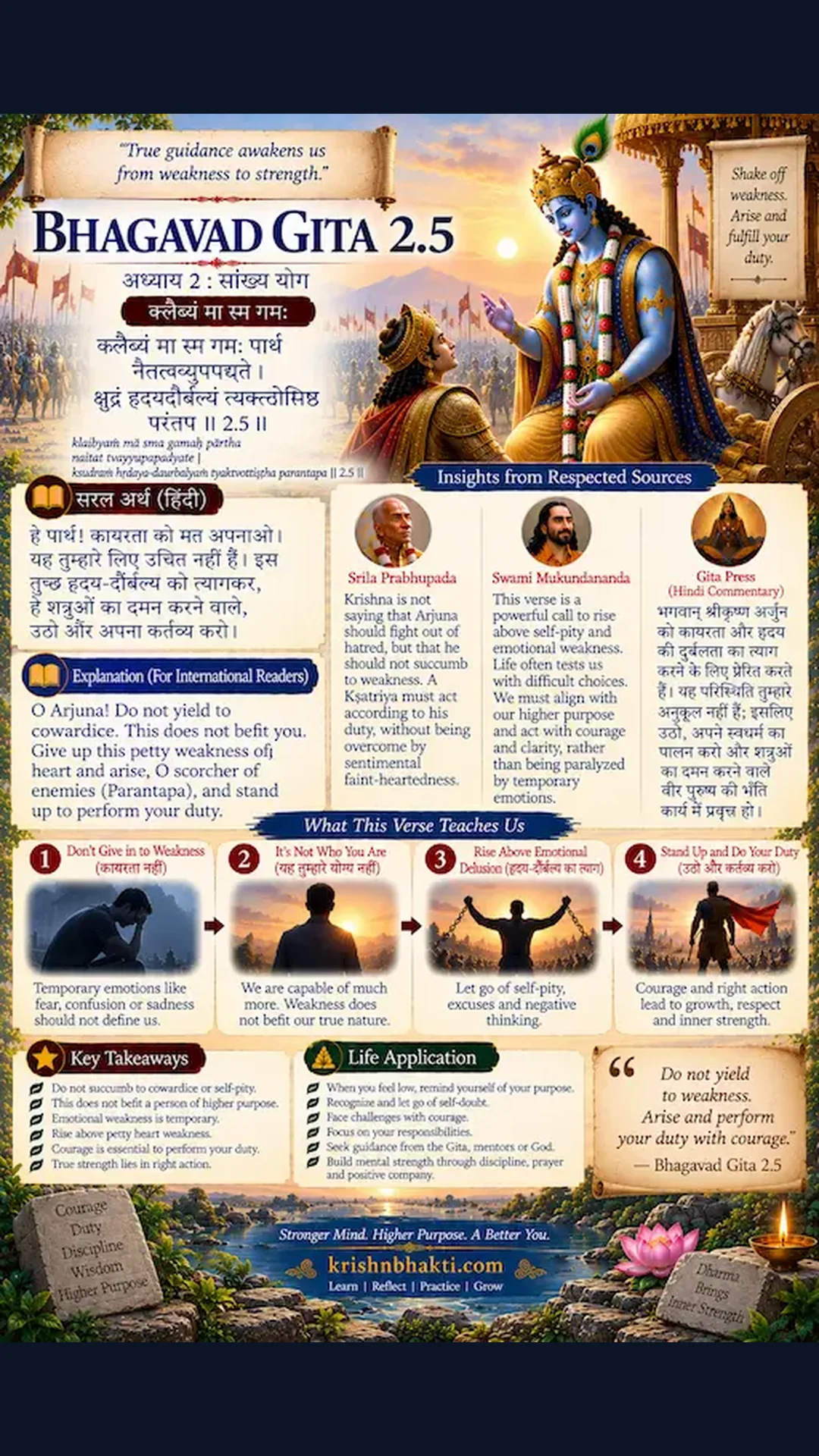
The Unspoken Conflict Beneath the Surface
In the previous verse (2.4), Arjuna posed a question that haunts every sensitive human being. He asked how he could possibly shoot arrows at those who were his mentors, elders, and guides. This wasn't just a tactical question; it was the cry of an ethical soul trapped in a world of complexity. We all face these moments — perhaps at work, when a mentor asks us to compromise our integrity, or in our personal lives, when the people we respect most seem to be walking the wrong path. Is it defiance? Or is it the highest form of duty?
Modern youth often confuse 'respect' with 'blind obedience'. We are told that being successful means climbing the ladder, regardless of who gets stepped on. But deep down, like Arjuna, we feel the weight of these choices. Does success feel like 'success' if it is built on the ruins of our relationships? The world might call it a smart career move, but our conscience calls it a betrayal. Arjuna’s hesitation wasn't cowardice; it was a profound acknowledgement that life is not just about winning; it is about how we win.
We live in a world of social media comparisons and cut-throat corporate competition. Everyone seems to be in a rush to prove their worth. But what happens to the person underneath the ambition? When we are pressured to choose between our values and our elders' expectations, we feel paralyzed. This is where Arjuna’s voice becomes our own. He didn't want the kingdom if it meant blood-stained hands. He was questioning the very definition of a 'reward'.
People often misunderstand Arjuna’s hesitation as weakness. They think he is just scared of fighting. But look closer. He is not afraid of death; he is afraid of committing a sin. He is afraid of destroying the very foundation of his life—his teachers. Today, we need this kind of introspection. Are we rushing into decisions that we will regret tomorrow? Are we sacrificing our 'dharma' for 'artha' and 'kama' (money and desire)?
The narrative arc here is brilliant. Krishna does not immediately tell him to fight. He listens. He lets Arjuna pour out his heart. This teaches us that before we solve a problem, we must understand the pain behind it. Arjuna’s struggle is the quintessential human struggle. It is the clash between the heart that loves and the mind that knows what is 'right'. Let us look at what he says in the shloka below.
॥ २.५ ॥
गुरूनहत्वा हि महानुभावान्
श्रेयो भोक्तुं भैक्षमपीह लोके ।
हत्वार्थकामांस्तु गुरूनिहैव
भुञ्जीय भोगान्रुधिरप्रदिग्धान् ॥
The Simple Meaning: A Disciple's Plight
Arjuna says: "It would be better to live on alms in this world than to enjoy life by killing these noble elders, who are my teachers. Even though they are driven by the desire for wealth and power, they are still my gurus. If I kill them, all the pleasures I enjoy will be stained with blood."
Breakdown of key words:
Guruna-hatva: Not killing the gurus.
Mahanubhavan: Great souls/highly respectable people.
Shreyo: Better/more auspicious.
Bhaiksham-api: Even living by begging (alms).
Rudhir-pradigdhan: Stained/smeared with blood.
Arjuna's logic is grounded in compassion. He values a simple life of poverty over a life of royal luxury that comes at the cost of his moral integrity. This is a vital lesson for the young professional: what is the true cost of your success? If your success brings you riches but leaves you with a heavy heart, is it really success?
Swami Ramsukhdas Ji's Perspective
Swami Ramsukhdas Ji beautifully highlights the 'sacrifice' in Arjuna's tone. He notes that Arjuna is a warrior prince; he has every right to the throne. Yet, he is ready to give it all up to beg on the streets. This shows that Arjuna’s values are not tied to material gains. Swami Ji emphasizes the term 'Mahanubhavan', pointing out that even if the gurus are wrong, they were the ones who gave Arjuna his knowledge.
Swami Ji notes that Arjuna explicitly mentions 'Arthakama'—that his gurus are chasing material benefits. Even so, Arjuna refuses to judge them harshly. He acknowledges their mistake but refuses to discard his duty to respect them. This is the hallmark of a true disciple. Swami Ji insists that we must always look at the 'upakar' (favors/lessons) given by our mentors, rather than their current flaws.
The deeper philosophical point here is the state of a 'Viveki' (a person of wisdom). A wise person prefers personal suffering over the suffering of others. Swami Ji emphasizes that for a seeker, nothing is more valuable than maintaining the sanctity of one's conscience. When you choose your values over the world, you are truly practicing spirituality.
Ultimately, Swami Ji’s explanation teaches us that there is a time and place to act, but until your mind is clear and your heart is pure, you must not act out of impulse. Arjuna is not being weak; he is being precise about his moral path.
Bhagavad Gita As It Is: Prabhupada's Devotional Lens
Srila Prabhupada brings a devotional depth to this verse. He explains that Arjuna’s hesitation is the sign of a Vaishnava (a devotee of the Lord). A true devotee, even when faced with the fiercest battle, does not want to cause harm to others for selfish gain. Prabhupada argues that Arjuna's concern is about the 'sin' (papa) he might incur, not the 'defeat' he might suffer.
Prabhupada emphasizes that killing a guru is an spiritual offense. Even if they have taken the wrong side (due to their own material entanglement), they remain gurus. He contrasts this with modern tendencies where people discard elders the moment they disagree. Prabhupada calls this an 'asuric' (demonic) mentality. He teaches us that true strength is in recognizing our roots, even when we have outgrown them.
He explains that the battle is only 'dharma' if it is done on the order of the Supreme. Arjuna was waiting for that divine guidance. Prabhupada notes that this is the perfect example of surrender—Arjuna is not taking matters into his own hands; he is placing his dilemma at the lotus feet of Krishna.
To Prabhupada, this verse shows that spiritual life isn't about being heartless or robotic. It is about having a heart that cares for everyone, but ultimately surrenders the final decision to the Lord. It is a gentle, loving practice of devotion, not a harsh discipline of the ego.
Swami Mukundananda Ji's Modern Wisdom
Swami Mukundananda Ji bridges the gap between ancient Sanskrit and modern corporate challenges. He uses the analogy of a 'mental gym'. When we are faced with a difficult decision, our internal 'values' are the muscles. When we are forced to choose between a mentor's bad advice and our ethics, it is like lifting a heavy weight. It hurts, but it is necessary for growth.
Swami Ji explains that Arjuna is trapped in an 'ethical dilemma'. He suggests that the modern youth should not run away from these dilemmas. Don't suppress the conflict; sit with it. Arjuna didn't just ignore his problem; he vocalized it to Krishna. Mukundananda Ji uses this to explain the importance of having a mentor or a 'higher power' to look up to when the world gets confusing.
He advises that true 'dharma' is not always about doing what is easy; it is about doing what is right. He warns against the modern trend of 'convenience-based ethics'. We often change our values to suit our comfort. Arjuna, on the other hand, was ready to sacrifice his comfort to uphold his values.
Swami Ji concludes by saying that when you feel the conflict between the 'heart' and the 'mind', take a step back. Reconnect with your purpose. Like Arjuna, realize that you are an instrument of a higher plan. This shift in perspective will give you the clarity you need to face any battle—be it in the office, at home, or within your own mind.
Real-Life Application: The Moment of Choice
Consider a scenario: you are working under a mentor who has taught you everything you know about your industry. One day, they ask you to falsify a report to secure a client. They say, "It's just a small change, everyone does it." You feel that inner tug-of-war. Your loyalty to the mentor (your 'guru') clashes with your integrity. Arjuna’s words echo here: "Will I enjoy the fruits of this success knowing it was gained through a lie?" This is a test of your moral fiber.
Or think of a relationship. Your parents want you to take a path that you truly know is not for you. They are your 'gurus' who brought you into this world. Defying them feels like a betrayal. Applying this verse means acknowledging that while you respect them, your soul has a unique path to follow. You don't have to be disrespectful to be independent. You can communicate with love while holding your ground.
Even in meditation, we face this. You sit to focus on your breath, but your mind is full of 'memories' and 'attachments'—your mental gurus. You don't want to kill those thoughts because they feel comfortable and familiar. But you know they are the distraction preventing your peace. The loop of "distraction -> realizing -> returning" is your personal Kurukshetra.
The takeaway is: Don't let your success be 'blood-stained'. Whether it is in your career or your inner journey, ensure that every step you take is aligned with your conscience. If you feel lost, remember how Arjuna stopped and turned to Krishna. You can do the same. Turn to your own inner witness, your own inner Krishna, before making that big move.
Self Q&A
1. Is it ever okay to oppose a mentor?
Swami Ramsukhdas Ji says that while respect is eternal, truth is supreme. If a mentor's actions lead to 'adharma' (unrighteousness), opposing that action is not an insult, but a service to the truth. One must stand for the principle, not against the person.
2. Was Arjuna just being a coward?
Srila Prabhupada clarifies that Arjuna’s hesitation was born of a great, compassionate heart, not cowardice. A heartless person would have fought without blinking. Only a great soul feels the pain of hurting those they love.
3. How do I know if I am doing the right thing?
Swami Mukundananda Ji suggests: "If your decision brings you closer to your spiritual purpose and is rooted in truth rather than selfishness, it is the right thing." If you are in doubt, pause and seek wisdom, just like Arjuna did.
4. Is guilt a sign of weakness?
No, guilt is a signal from your conscience. Don't ignore it. Use it to reflect, as Arjuna did, and ensure your next step is better aligned with your values.
5. How can I apply this to my daily stress?
Start by asking: "Is my current worry about money, or about my soul?" If it's about money, breathe and step back. If it's about your soul/values, be patient and wait for the light of clarity. That is the essence of Gita 2.5.
🙏 Hare Krishna — Jai Shri Krishna 🙏
📖 Also Read: When Your Mind is Paralyzed by Fear: Lessons from Arjuna's Doubt 🛡️