Can Material Success Silence the Inner Noise?
We often convince ourselves that if we reach a certain position, earn a certain amount, or stabilize our relationships, we will finally be at peace. We run, struggle, and chase these goals tirelessly. Yet, when we finally attain them, we are greeted by a hollow feeling that refuses to leave. Arjuna was in this exact situation. He was a legendary warrior, possessed power, had a kingdom, and was guided by Lord Krishna himself. Yet, on the battlefield, he was shattered internally. In verse 2.8, Arjuna acknowledges this state. This isn't just Arjuna's story; it is the story of everyone in this modern, fast-paced world who is successful yet terrified deep inside.
We often mistakenly believe that spirituality implies running away from the world. However, Arjuna’s dilemma teaches us that the spiritual journey doesn't begin when we retreat to a forest; it begins when we surrender our ego in the face of our problems. Many people say, "I am smart enough; I can fix my own life." This ego is the greatest barrier. In the age of corporate rat races and the curated perfection of social media, we hide our true selves. Arjuna’s Kurukshetra is the same office, home, and mind where we struggle every single day.
The most powerful thing Arjuna did was to wait for Krishna’s guidance. He didn't claim he could solve it alone. He said, "Nahi prapashyami mamapanudyad yacchokamuchoshanamindriyanam." He confessed his helplessness. In our world, we fear that showing weakness will make us seem inferior. But the Gita teaches that admitting our weakness before the Divine is actually the greatest strength. When we stop trying to play God and instead become a child before Krishna, the solution appears.
Imagine you are working on a massive project, and everything seems to be falling apart. You are gripped by anxiety. What do you do? You either run or react with anger. Arjuna did neither. He articulated his inner state clearly to Krishna. Verse 2.8 is the turning point where the real solution begins. It shows us that without the right direction, all your hard work is just running in circles.
This verse is not just a Sanskrit shloka; it is an emotional blueprint. It teaches us that when everything feels like it's slipping away, the first step is to accept our state and turn toward a higher wisdom. In an era drowning in information, true wisdom is rare. Krishna teaches us to pause, acknowledge our limits, and then move forward with a new, divine perspective.
After reading this, you will realize that your pain is not unique. Arjuna stood as the greatest warrior in history and still admitted his pain. That is not shameful; it is a mark of true maturity. Only when we recognize our limits can we turn toward the limitless power of the Divine. Let us dive deep into this verse and see how it serves as the ultimate remedy for our modern-day existential crises.
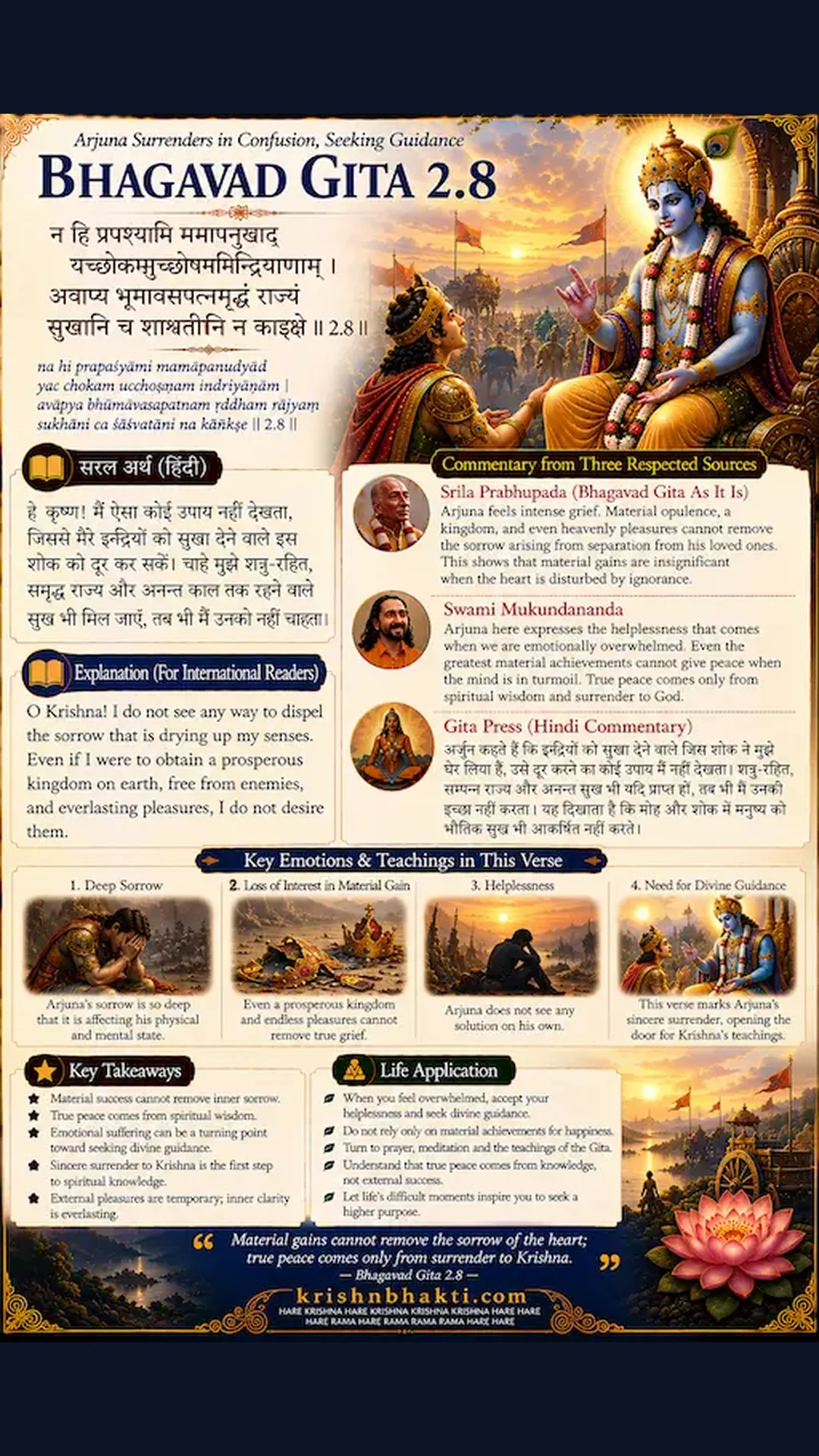
न हि प्रपश्यामि ममापनुद्याद् यच्छोकमुच्छोषणमिन्द्रियाणाम्।
अवाप्य भूमावसपत्नमृद्धं राज्यं सुराणामपि चाधिपत्यम् ॥ २.८ ॥
Simple Meaning: Breaking Down the Essence
Let's look at the components of this verse: Nahi prapashyami (I do not see), mamapanudyat (that which can remove my distress), yacchokamuchoshanam (this grief that is drying up my senses). Arjuna states that even if he were to receive a kingdom on earth without rivals, or even the lordship over the demigods, it would not wash away this grief.
Notice that for Arjuna, material power has lost all meaning. For modern youth, this is a profound lesson. We believe a promotion will make everything right. Arjuna is telling us that external achievement cannot fill internal voids. We must move beyond the trap of thinking that more money or status will heal the soul.
Three key takeaways: 1. Acknowledge your state honestly, 2. Understand the limitations of material happiness, 3. Cultivate a longing for spiritual wisdom. Without these, we are merely patching our wounds instead of healing them.
Three Great Perspectives
Swami Ramsukhdas Ji: Swami ji emphasizes that Arjuna's confession of "I do not see" is crucial. It shows that when one exhausts all intellectual efforts, only then does one truly turn to Krishna. He points out that this grief is described as one that 'dries up the senses' (indriyas). Swami ji notes that Arjuna realizes no position of power can remove the existential pain that gnaws at the soul; only divine knowledge can.
A.C. Bhaktivedanta Swami Prabhupada: Prabhupada explains the term 'Avapya bhumavasapatnam'. He highlights that Arjuna makes it clear that even heavenly happiness would not satisfy him. Prabhupada interprets this as the level of Arjuna’s consciousness. He asserts that devotion to Krishna is the only force capable of transcending the dualities of sense gratification and sensory distress. Arjuna acts not just as a warrior, but as a surrendered devotee.
Swami Mukundananda Ji: Swami Mukundananda applies modern psychology, noting that this is the root cause of our depression. We seek happiness in external objects, but external satisfaction is ephemeral. He uses the analogy of a gym: while you can build external muscle, peace only comes from within. He describes Arjuna’s breakdown as a vital stage that ultimately leads to a spiritual breakthrough, urging us to look inward when the world overwhelms us.
Real-Life Scenarios
Imagine you are in an important office meeting, and you are publicly humiliated by a superior. You go home—you have everything—the house, the money, the comfort—but you are burning inside. You try to drown the pain in distractions. Instead, like Arjuna, if you pause and admit, "This grief is drying up my senses," you break the cycle of reactive stress. By naming the pain and handing it over to Krishna, you begin to detach from the ego's need for validation.
Or consider the anxiety of a relationship. Everything is seemingly perfect, yet you live in constant fear of losing it. This is the same 'shoka' Arjuna talks about. The Gita teaches that external security is an illusion. True security resides in the shelter of the Divine. When you accept this, the constant fear of loss begins to dissipate, replaced by a grounded sense of presence.
Q&A: Seeking Clarity
Question 1: Is this just my personal struggle? Answer: Swami Ramsukhdas ji teaches that this is the universal human struggle. The nature of the world is inherently incomplete; it will never satisfy you fully. Acceptance of this fact is the first step toward freedom.
Question 2: Why do I feel empty even after succeeding? Answer: Swami Mukundananda explains that success is a moving target. Once you reach one goal, the mind sets another. True peace is not found in goals but in the internal connection with the Divine.
Question 3: Does this make Arjuna a coward? Answer: Prabhupada emphasizes that admitting one's limitations to the Divine is the ultimate act of courage. Only the brave dare to be vulnerable before the Supreme Lord.
🙏 Hare Krishna — Jai Shri Krishna 🙏
📖 Also Read: When You Are Lost in Life, How to Surrender Like Arjuna? 🙏