The Moment of Total Breakdown: Why Arjuna’s Struggle is Yours
At the end of the first chapter, we witnessed Arjuna dropping his Gandiva bow. His body was trembling, his mind was shattered, and he was paralyzed by the confusion of duty versus emotion. In our modern times, we face similar battles. Whether it's the crushing pressure of a high-stakes job, the pain of a broken relationship, or the constant comparison on social media, we all reach a point where we don't know what to do. Many people think, 'I must solve this on my own,' but the Gita suggests that admitting one's limitations is the first step toward true wisdom.
We often feel that asking for help is a sign of weakness. In a world of 'hustle culture' and polished profiles, everyone is showing off their successes, but deep down, many are trembling just like Arjuna. Have you ever felt that all your degrees, your salary, or your possessions feel meaningless when your mind is in turmoil? This is the exact moment Arjuna is in, and it is precisely from here that the real wisdom of the Gita begins.
A common misconception is that Arjuna’s surrender was an act of cowardice. People think he was just giving up. But the truth is, this was the triumph of his intelligence. He realized that his own logic had failed him. When we live in the ego of 'I can fix everything,' the divine knowledge of Krishna cannot enter our hearts. This verse is a roadmap for when you feel utterly hopeless, guiding you to drop your ego and seek genuine direction.
Imagine you are caught in a massive project at work. Your boss is pressuring you, your team is unsupportive, and you are spiraling into anxiety. You go home, close the door, and feel like you have no options left. This is your 'Arjuna moment.' When you stop relying on your own limited wit and hand your burden over to a higher intelligence, that is when you begin to find clarity. The Gita isn't just an ancient text; it is a psychological manual for the modern soul.
Arjuna’s words here are not born of fear, but of deep respect for 'Dharma.' He is not afraid of the battle; he is afraid of committing an 'Adharma' (wrongful act). Understanding this distinction is vital. We often look for short-term fixes, but Arjuna is seeking the 'eternal solution.' This curiosity, this openness to be taught, is what transforms an ordinary person into a seeker.
Let us now look at the Sanskrit verse that turned Arjuna from a confused warrior into the greatest student of all time.
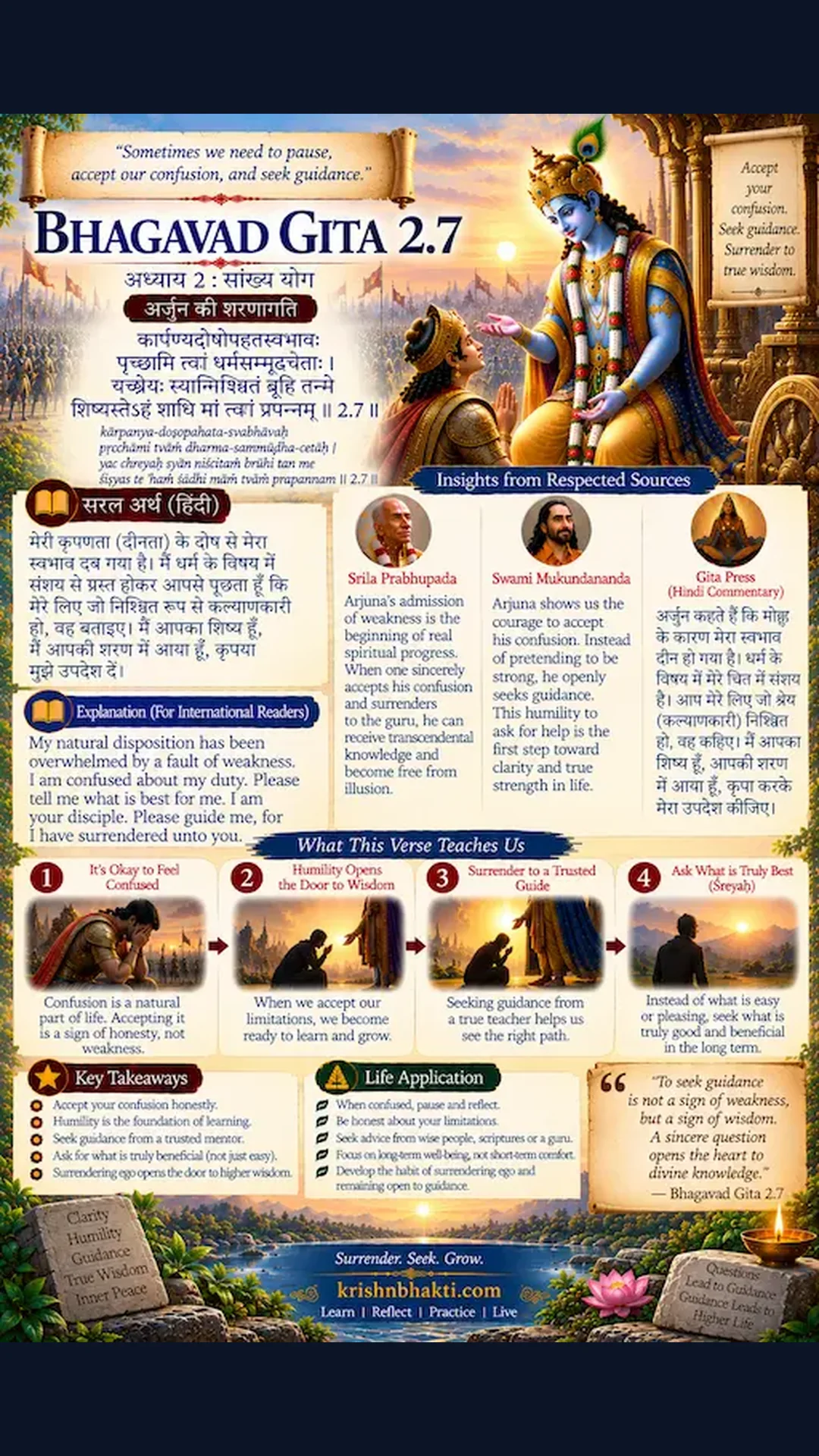
कार्पण्यदोषोपहतस्वभावः पृच्छामि त्वां धर्मसंमूढचेताः । यच्छ्रेयः स्यान्निश्चितं ब्रूहि तन्मे शिष्यस्तेऽहं शाधि मां त्वां प्रपन्नम् ॥ २.७ ॥
Simple Meaning: The Path of Surrender
Here, Arjuna says to Krishna: Karpanya-dosho-pahata-svabhavah — My 'miserly' (crippling) compassion has destroyed my nature; my ability to make decisions has vanished. Prcchami tvam dharma-sammudha-cetah — My mind is completely confused (sammudha) regarding my duty (Dharma), so I am asking you.
Yac-chreyah syan-niscitam bruhi tan me — Please tell me definitely what is best (shreyah) for my ultimate welfare. Shisyas te 'ham sadhi mam tvam prapannam — I am your disciple, I surrender to you; please instruct me.
There are four key takeaways: First, acknowledging one's limitations (Karpanya). Second, the awareness of being confused about duty. Third, asking for 'Shreyah' (ultimate good), not just temporary happiness. And fourth, total surrender (being a disciple and taking refuge).
Swami Ramsukhdas Ji’s Perspective
Swami Ramsukhdas Ji emphasizes that Arjuna lost his 'Kshatriya' (warrior) nature due to excessive attachment. He explains that whenever a person is caught in the web of attachment and self-interest, their intellect stops functioning. Swami Ji insists that 'Karpanya' is not just being cowardly, but the state of fleeing from one's duty.
He highlights the phrase 'Shisyas te 'ham' (I am your disciple). Unless we accept someone as a teacher, we cannot receive true knowledge. Arjuna completely surrendered his ego to Krishna here. 'Sadhi mam' means 'Please command me.' When we allow the divine to 'command' our lives through our conscience and scripture, our paths become illuminated.
A.C. Bhaktivedanta Swami Prabhupada’s Insight
In 'Bhagavad Gita As It Is,' Prabhupada explains that this verse marks the true beginning of the path of Bhakti (devotion). Prabhupada argues that material education is insufficient for solving life’s deeper problems. The troubles of this material world require a spiritual remedy.
By surrendering to Krishna, Arjuna demonstrates that the only way to perform our duties correctly is by staying in 'Krishna Consciousness.' Prabhupada teaches that we should not look at our worldly tasks as burdens, but as services that we perform under the divine guidance of the Lord.
Swami Mukundananda Ji’s Modern Application
Swami Mukundananda Ji views this verse through the lens of modern leadership. He suggests that we often make terrible choices because we are confused (sammudha). Arjuna’s confusion is a form of 'over-thinking'—a problem every modern professional faces.
He uses the analogy of a coach and an athlete. If an athlete tries to learn a complex sport on their own, they might get injured. Arjuna goes to his 'Life Coach,' Krishna. He says that today’s youth avoid asking for advice out of ego, whereas seeking guidance is the first sign of a leader who is ready to grow.
Applying it in Real Life: A Scenario
Suppose you are working on a massive project. A colleague takes credit for your hard work. You are angry, you want revenge, but your conscience tells you that reacting with rage is wrong. You come home, stressed and exhausted. What do you do?
You must become like Arjuna. Instead of acting on your reactive ego, you sit down and surrender your plan. You ask, 'Krishna, what is truly best for me?' When you stop viewing the situation through the lens of 'my ego' and start viewing it through the lens of 'what is right,' the path becomes clear. You choose to act with calm professionalism instead of destructive anger.
This applies to meditation as well. When your mind wanders, don't get frustrated. Instead, bring it back with a prayer: 'Krishna, guide my mind to stillness.' This shift from force to surrender makes all the difference.
Self Q&A
1. Is admitting my weakness actually a weakness?
As Swami Ramsukhdas Ji says, acknowledging your mistakes or limitations is the highest form of maturity. Without accepting a flaw, you can never work to fix it.
2. How do I choose a guide or teacher?
Prabhupada suggests that a true guide is one who follows the path of the Gita and is established in the service of the Lord. They show you the path of truth, not a path of worldly exploitation.
3. Should I ask God about every small decision?
Swami Mukundananda Ji explains that 'asking God' is about aligning your intellect with your conscience. It’s about ensuring that your decisions are rooted in values rather than just impulses.
4. Was Arjuna's surrender only for a battlefield?
No, it is for every person fighting the battle of life. We all have inner conflicts, and we all need that divine clarity.
5. What does 'Prapannam' truly mean?
It means complete surrender. It is the moment you realize that your limited understanding isn't enough, and you place your trust in the infinite wisdom of the Divine.
🙏 Hare Krishna — Jai Shri Krishna 🙏
📖 Also Read: Do You Know Where Your Real Victory Begins? 🕊️