The previous verses gave us the outer preparation for meditation — the right space, the right seat, the right posture, the controlled gaze. But all of that is just the container. What goes inside the container — the actual inner state of the mind during meditation — has not been addressed until now. This verse is where Krishna finally reveals that most essential piece: where does the mind go? What should it feel like on the inside when you sit?
And the answer He gives is not a technique. It is not a breathing pattern or a mantra sequence. It is a state — five qualities of inner being that, when present together, make genuine meditation possible. And the final destination for the mind, He says clearly, is Him.
This verse is for everyone who has sat down to meditate and found themselves wondering what to actually do with the mind once the eyes are closed and the body is still. Krishna is answering that question directly — and the answer is both simple and profound.
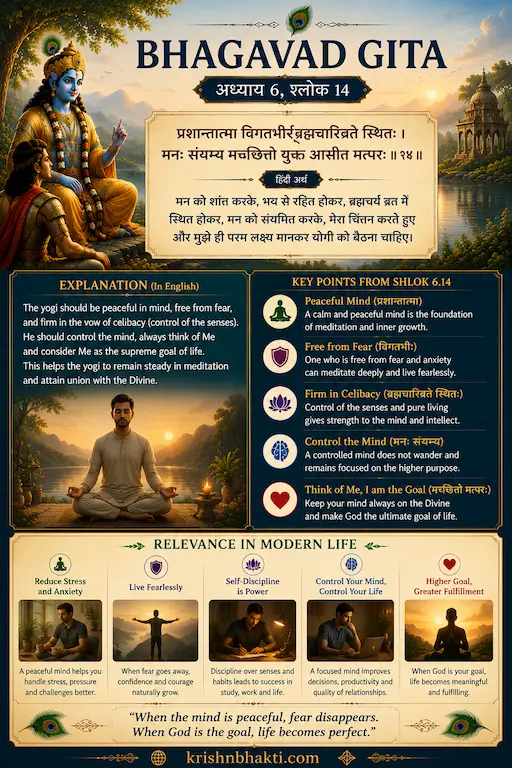
प्रशान्तात्मा विगतभीर्ब्रह्मचारिव्रते स्थितः ।
मनः संयम्य मच्चित्तो युक्त आसीत मत्परः ॥ ६.१४ ॥
What Is Krishna Actually Saying?
Krishna says — with a serene mind, free from fear, established in the vow of brahmacharya — having controlled the mind, with the heart fixed on Me, with Me as the supreme goal — sit in yoga.
Five inner qualities. Prashanta-atma — a serene, completely settled mind. Vigata-bhih — free from fear. Brahmacharivrate sthitah — established in the discipline of brahmacharya. Manah samyamya — having controlled and gathered the mind. And mach-chittah mat-parah — mind fixed on Me, Me as the supreme destination. These five together constitute the inner state of genuine meditation.
Sadhak Sanjivani — Swami Ramsukhdas Ji
In Sadhak Sanjivani, Swami Ramsukhdas Ji begins with prashanta-atma — the serene mind — and says this is the prerequisite, not the outcome, of sitting. When the mind enters meditation in a state of agitation, anxiety, or restlessness, the quality of the session is significantly diminished from the start. A few minutes of breath awareness, bhajan, or simple silent sitting before formal meditation allows the mind to arrive in a more settled state — and from there, depth comes more readily.
On vigata-bhih — free from fear — Swami Ji says fear is one of the most common hidden obstacles in meditation. The fear of doing it wrong. The fear that nothing will happen. The fear that something unexpected will happen. These subtle anxieties create a tightness in the mind that prevents genuine opening. When the practitioner genuinely releases the outcome — sits without needing anything specific to occur — a natural spaciousness comes.
On brahmacharya, Swami Ji offers an interpretation that goes beyond the conventional one. He says the word itself means "moving in Brahman" — moving in God. When the mind is established in God, the senses naturally come under control — not through force, but because the mind has found something more compelling than any sensory object. That is the deepest form of brahmacharya.
On mach-chittah mat-parah — mind on Me, Me as supreme — he says this is the soul of the entire verse. Meditation is not ultimately about technique or experience. It is about union with God. When the mind rests in Krishna — that is the meditation. Everything else is preparation for this.
Prabhupada — Bhagavad Gita As It Is
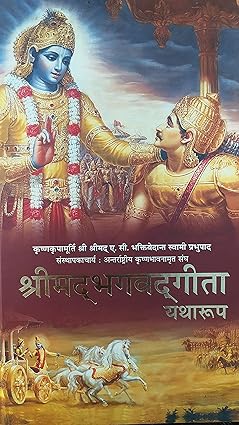
Srila Prabhupada, in Bhagavad Gita As It Is, says Krishna is here describing both the outer and inner conditions for meditation in one verse. The outer — brahmacharya, sense restraint. The inner — serene mind, freedom from fear, mind fixed on Krishna.
On brahmacharya, Prabhupada is emphatic — without this discipline, deep meditation is very difficult to achieve. When the senses are constantly running after external objects — food, entertainment, stimulation — the mind is perpetually scattered. Bringing the senses under reasonable control is not the destination of practice — it is the foundation that makes everything else possible.
On mach-chittah — mind on Me — Prabhupada says this is where the Gita's teaching diverges from impersonal approaches to meditation. The goal is not an abstract void, not a state of emptiness, not mere mental quietness. The goal is conscious awareness of Krishna — of the personal God who is at once the source of everything and the most intimate friend of every being. Meditation that arrives at this is complete.
Swami Mukundananda Ji's Perspective
Swami Mukundananda Ji opens by connecting vigata-bhih — freedom from fear — to what he calls the defining inner crisis of modern life. He says — we live in the most fear-saturated age in human history. Fear of the future, of failure, of illness, of being alone, of not being enough. And these fears do not stay outside when we sit to meditate — they follow us in. They manifest as restlessness, as the inability to settle, as the compulsion to check something or do something rather than simply be.
He says — the gift of daily meditation is that over time, it addresses fear at its root. Because in meditation you connect with something larger than yourself, something that holds everything — and in that connection, the fears gradually lose their grip. This is not a one-session result. It is the long-term fruit of a sustained practice. But it is real, and it is the most practical benefit meditation offers.
On prashanta-atma, Swami Ji offers a simple and effective approach — five to ten minutes of pranayama before sitting. Long, slow inhales, long slow exhales. This simple practice signals the nervous system to shift from activation to rest — and the mind follows. Starting meditation from that settled baseline is incomparably easier than starting from agitation.
On mach-chittah — mind fixed on Me — Swami Ji says this is the most direct answer to the question most meditators never ask clearly enough: what exactly does the mind rest on? It rests on Krishna. A form, a name, a quality — some aspect of the divine that the heart can hold. When the mind wanders from that — bring it back. That returning is the practice. And the form it returns to is what makes this meditation bhakti.
What Does This Look Like in Real Life?
Before sitting, take five minutes. Sit quietly and breathe slowly. Or sing a bhajan softly, or simply repeat God's name. Let the mind arrive somewhere quieter than it was when you first sat down. This is prashanta-atma being cultivated — not as a result of meditation, but as the preparation for it. The difference in the quality of what follows is significant.
When you sit, bring one simple intention: "I am in God's presence. There is nothing to fear here. Nothing needs to happen." That small inner shift — from seeking to simply being present — is vigata-bhih in practice. And it creates a spaciousness in the mind that technical instruction alone cannot.
And for mach-chittah — the actual object of meditation. Bring to mind a form of Krishna — perhaps the flute-playing figure in Vrindavan, or the image of Him speaking the Gita to Arjuna. Rest the mind there. When it drifts — to a thought, a memory, a plan — gently return to that form. No frustration, no force. Just a patient, repeated returning. That is the whole practice. And with time, the mind's stays become longer, the returning easier, the presence more felt.
Questions That Probably Live in Your Heart
Is brahmacharya only for celibates — can householders practice this?
Swami Ramsukhdas Ji says — brahmacharya in its deepest meaning is about where the mind lives, not about external renunciation. A householder who fulfills their responsibilities while keeping the mind oriented toward God and not scattering the senses in unnecessary indulgence is practicing brahmacharya. It is available to anyone in any situation.
Why does fear arise in meditation — and how do you work with it?
Swami Mukundananda Ji says — fear arises because the inner space is unfamiliar. The mind is accustomed to activity and outer engagement. Stillness and inner attention feel strange at first — even threatening. As familiarity grows through consistent practice, fear naturally reduces. It does not have to be fought — it softens on its own as the practice deepens.
How do you practically fix the mind on Krishna — what does that look like moment to moment?
Prabhupada says — bring a specific form or aspect of Krishna to the mind. His face, His smile, the image of Him playing the flute, or simply the syllables of His name. Rest the mind there. When it moves — return. There is no other technique required. The sincerity of the return, repeated day after day, is what builds the practice.
What if the mind simply will not calm down before meditation?
Swami Ramsukhdas Ji says — meditate anyway. Even an unsettled mind benefits from the practice. But use the pre-meditation tools — slow breathing, a few minutes of bhajan, simple silence. These are not delays — they are preparation. And the quality of what follows is worth the five minutes of preparation they require.
What do 6.13 and 6.14 together teach?
6.13 described how to hold the body — erect, still, gaze fixed. 6.14 describes how to hold the mind — serene, fearless, controlled, resting in Krishna. Together they give the complete picture of the meditating person: what the body is doing and what the mind is doing. The outer stillness and the inner orientation. Both together — that is the whole instruction for genuine meditation.
Read this also: How to Hold Your Body in Meditation: Krishna's Exact Posture Instructions 👇👇👇
🙏 Hare Krishna — Jai Shri Krishna 🙏