Are You Still Praying Only for Your Needs?
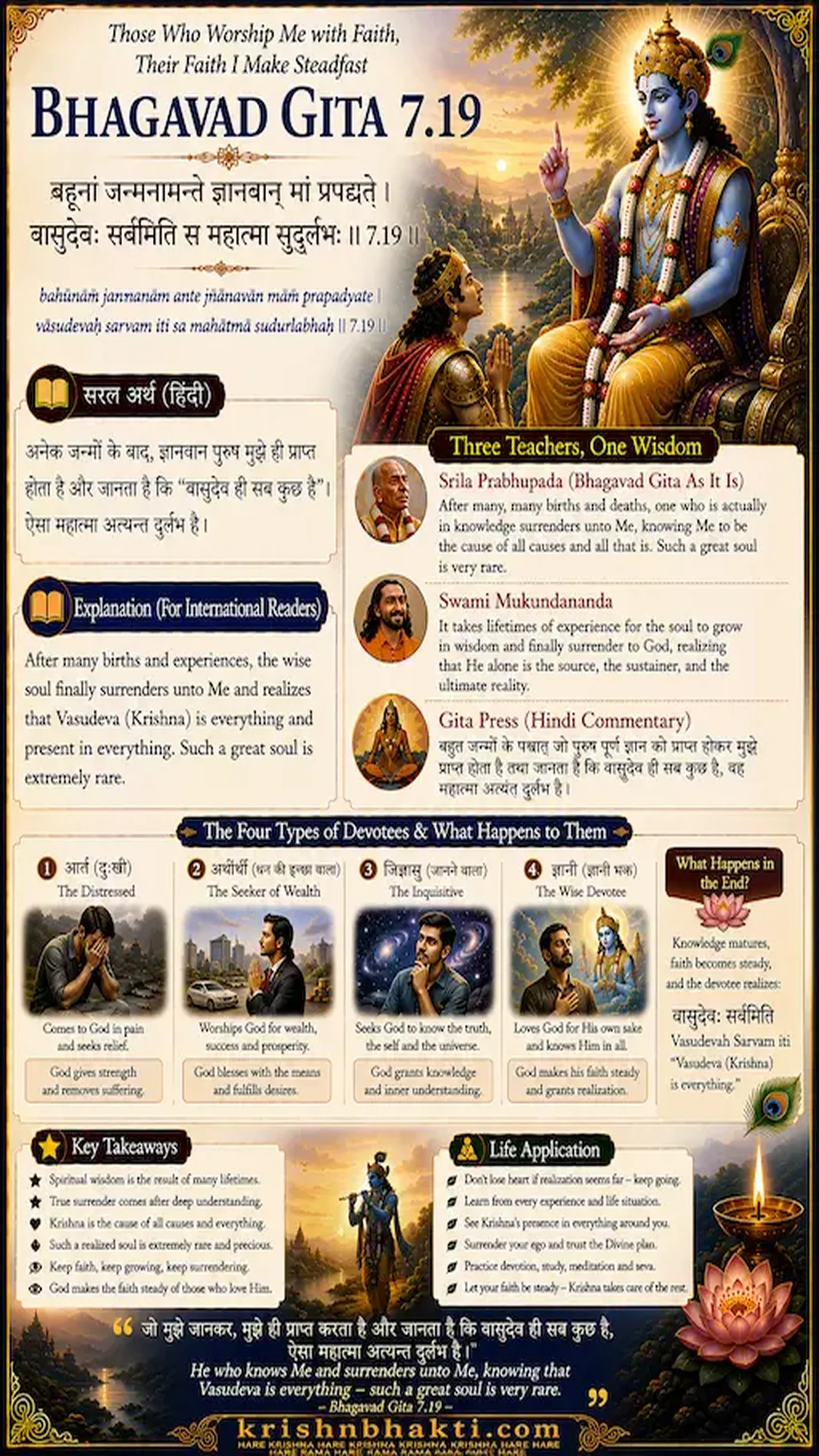
In the previous verse, Krishna described the four types of devotees who approach Him. He clarified that while all are noble, the 'Jnani' or the wise devotee is the dearest to Him. Today, we are diving into verse 19, a verse that unravels the identity of the true wise person and why such a soul is so rare in this world.
We often carry a massive misconception about spirituality. We believe that visiting temples, performing rituals, or asking God for favors is the pinnacle of devotion. We pray for promotions, for success in exams, or to resolve conflicts at home. Is this wrong? Not at all; Krishna acknowledges this as valid. But the problem arises when we get stuck at this level of 'transactional' devotion.
Imagine you post a photo on social media and constantly check how many likes it receives. Your mood fluctuates based on the validation of others. In the hustle of life, we do the same with God. We treat the Divine as a 'Supplier' who is available to fulfill our wish list. Once the need is met, we often move on, forgetting the Source.
Krishna, in today’s verse, reveals a profound secret. He says that after many, many lifetimes of searching, a person of wisdom finally realizes that everything—whether seen or unseen, sentient or insentient—is nothing but Vasudeva, the Supreme Lord.
Have you ever wondered why we remain anxious? It is because we perceive everything as separate from us. My boss is different, my problems are separate, my future is uncertain. Krishna says that when you realize that 'everything is Krishna,' then where is the scope for worry? This realization is what makes such a soul 'Mahatma' (great soul) and why they are so rare.
For the youth of today, this perspective is vital. We are chasing careers, relationships, and material success, thinking that 'once I get this, I will be peaceful.' But peace is not found in the acquisition of objects. Peace is found in the awareness that the entity you are searching for is already within and around you.
Let’s explore the depth of 'Vasudeva Sarvam' and see how it serves as the ultimate remedy for the modern epidemic of mental stress.
बहूनां जन्मनामन्ते ज्ञानवान्मां प्रपद्यते ।
वासुदेवः सर्वमिति स महात्मा सुदुर्लभः ॥ ७.१९ ॥
Simple Meaning and Breakdown
The meaning of this verse is profound. 'Bahunam janmanam ante' means 'at the end of many, many births.' It signifies that this is not an overnight transformation. It comes after repeated experiences of trial and error, realizing that worldly pleasures offer no permanent fulfillment.
'Jnanavan mam prapadyate'—the wise person surrenders unto Me. Surrender here doesn't mean becoming passive; it means realizing that since everything belongs to Krishna, the heavy burden of 'doing' and 'controlling' can be lifted and placed at His feet.
'Vasudeva Sarvam'—this is the core of the verse. It means that everything you perceive, from your best friend to your harshest critic, from your laptop to the stars in the sky, is an extension of the Divine. 'Iti sa mahatma sudurlabhah'—such a great soul is very rare.
Key Takeaways:
1. This state requires patience and consistent practice over time.
2. We suffer as long as we view the world through the lens of separation.
3. 'Everything is Krishna' is not just a concept; it is an experience to be cultivated.
4. The one who reaches this level no longer craves external validation.
Swami Ramsukhdas Ji’s Perspective
Swami Ramsukhdas Ji emphasizes that 'Vasudeva Sarvam' is not a mere philosophical statement but a practical realization. He explains that as long as we are trapped in the prison of 'I' and 'mine,' we remain blind to the presence of the Lord. Surrender, according to him, is the complete shedding of ego.
He highlights that the term 'Sudurlabh' (very rare) is used by Krishna to caution us. It reminds us that while the path is difficult, it is the highest path. He points out that every birth we take is an opportunity to move closer to the moment of total surrender, which he calls 'Prapadyate.'
Swami Ji beautifully phrases it: "The moment you realize that the One you have been searching for is actually the one who exists in everyone, the search ends, and the realization begins."
Srila Prabhupada’s Bhakti Lens
Srila Prabhupada approaches this verse from the perspective of pure devotional service. He argues that the ultimate goal of knowledge (Jnana) is to engage in the service of the Lord. True wisdom is not about accumulating information but about understanding our eternal relationship with Krishna as His servant.
Prabhupada explains that 'Vasudeva Sarvam' means everything is Krishna's energy. Just as an electrical appliance cannot function without electricity, this world cannot exist without Krishna. The one who understands this secret surrenders to Him completely.
He says, "The wise man understands that Krishna is the cause of all causes. By serving Him, one naturally serves everyone and everything, just as watering the root of a tree nourishes all its branches and leaves."
Swami Mukundananda Ji’s Modern Application
Swami Mukundananda Ji bridges the ancient wisdom with the challenges of modern youth. He uses the analogy of 'mental training.' Just as you go to the gym to strengthen muscles, you must train your mind to see the Divine in all situations.
He suggests: "When you are dealing with a difficult person in the office, remind yourself that this person is also an expansion of the Divine, and this situation is a test of your patience and character. When you shift your perspective from 'he is bothering me' to 'this is a learning opportunity provided by Krishna,' your stress levels drop instantly."
He emphasizes that 'Vasudeva Sarvam' is the ultimate stress-buster for the young professional who is constantly overwhelmed by deadlines and social pressures.
Real-Life Scenarios
Imagine you are stressed at work because your manager is demanding. You have two choices: get angry and bitter, or practice 'Vasudeva Sarvam.' When you realize that the manager, the task, and your anxiety are all within the realm of Krishna's energy, you gain the objectivity to perform your work efficiently without the emotional weight. This is the transformation that wisdom brings.
The same applies to your meditation. When your mind wanders, don't fight it with frustration. Simply acknowledge, "Even this wandering mind is part of the Divine play," and gently bring it back to Krishna. This cycle of wandering and returning is your practice, and eventually, it leads to the state of the Mahatma described in this verse.
Q&A: Addressing Your Doubts
1. Does this mean I should quit my job and become a monk?
No. Swami Ramsukhdas Ji clarifies that true renunciation is the renunciation of ego, not the abandonment of duties. You can perform your professional duties while maintaining the awareness that everything belongs to the Divine.
2. How do I know if I am making progress?
Swami Mukundananda Ji says that when your irritation decreases and you find yourself reacting with composure instead of impulsive anger, that is a sign of real progress.
3. Is it necessary to stop every single thought?
Prabhupada explains that rather than struggling to stop thoughts, simply engage them in thinking about Krishna. That is the easiest and most effective way.
4. How does this connect to the previous verse?
The previous verse introduced the four types of devotees, and this verse specifically honors the one who has reached the pinnacle of knowledge—seeing God everywhere.
5. How can I practice surrender daily?
Surrender is a moment-to-moment practice. Start by offering your efforts to Krishna, acknowledging that the result is in His hands, and accepting the outcome as His grace.
🙏 Hare Krishna — Jai Shri Krishna 🙏
📖 Also Read: Are You Only Remembering God for Your Own Needs? 🙏