Connecting to the Previous Verse: The Veil of Maya
In the previous verses, Krishna explained how the duality of desire and hatred traps us in this world. We feel happy one moment and miserable the next. This is the game of Maya, which keeps us away from the ultimate truth. Often, the youth today ask: 'Is it ever possible to get out of this mess? Will my past mistakes define my future forever?'
We often compare ourselves to others on social media. We feel that everyone else has a perfect life, and we are the only ones struggling. We live in stress, anxiety, and the fear of the future. We feel that our destiny is flawed or that we are carrying the burden of 'sin'. But Krishna, in this verse, is about to offer a beautiful and optimistic message.
People think that to get rid of past sins or karmic baggage, one needs extreme penance or complex rituals. This is a massive misconception. Krishna is about to show us that the path to liberation is not through hardship, but through a 'decision'. When you decide to turn towards the truth, the clouds of your past begin to dissipate.
Imagine being at work, under pressure from your boss, facing relationship issues at home, and late at night, when you are alone, those old thoughts won't let you sleep. You wonder, 'Will I ever change?' Krishna is addressing this exact fear. He is offering you a guarantee of a new beginning.
This verse is not just a mantra; it is a spiritual blueprint. It tells you how to get out of the web of karma that has bound you. It is for those who want to be deeply spiritual but feel they are unworthy. Krishna says that unworthiness is just a mental construct.
Today, we will discuss how, with a 'Pure Resolve', one can not only cleanse their past actions but step onto the path of devotion where there is no looking back. It is for those who feel their life is ruined. Krishna is saying, 'Your life is just beginning; just turn towards me.'
Bhagavad Gita Chapter 7, Verse 28
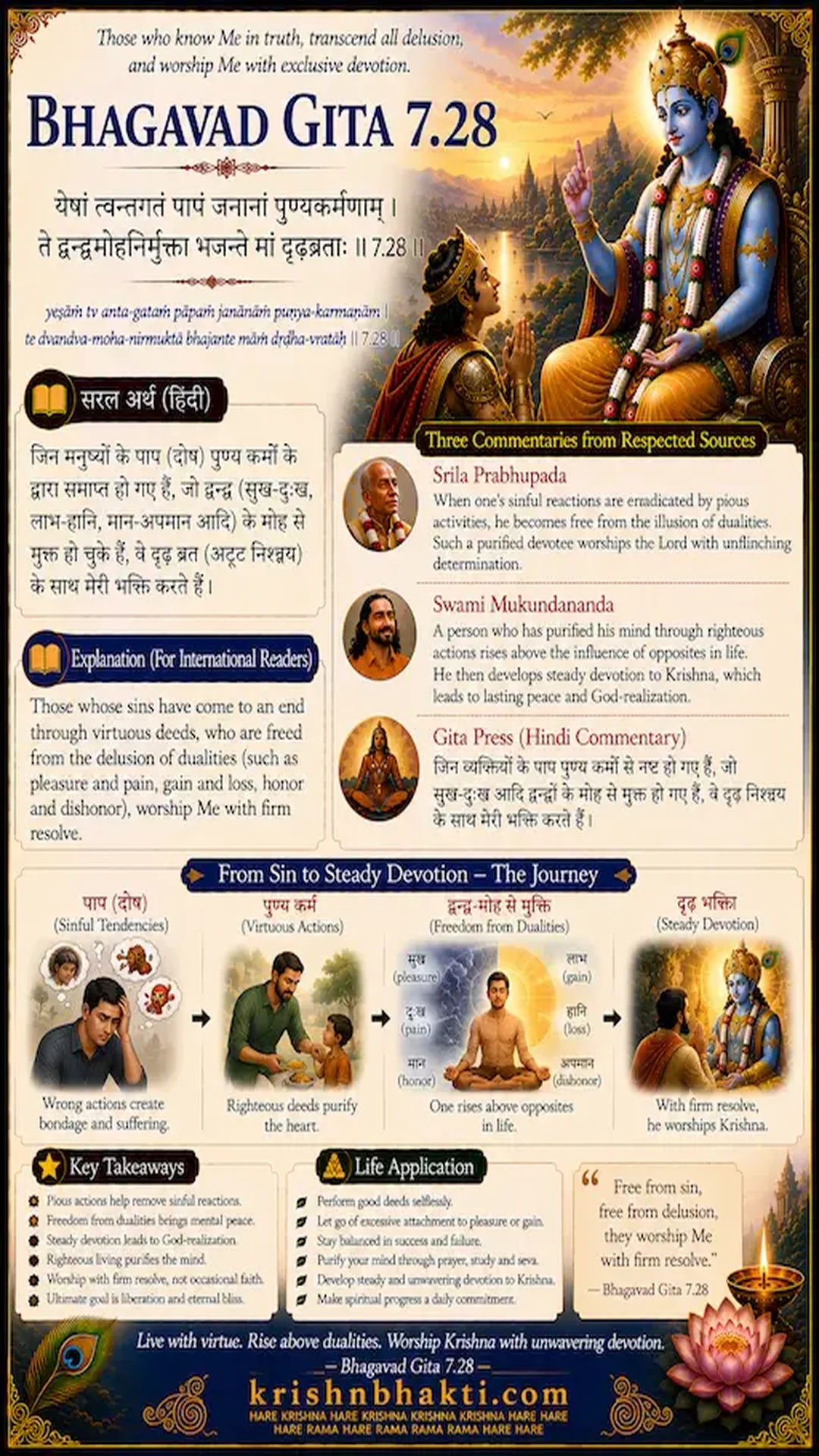
येषां त्वन्तगतं पापं जनानां पुण्यकर्मणाम् ।
ते द्वन्द्वमोहनिर्मुक्ता भजन्ते मां दृढव्रताः ॥ ७.२८ ॥
Simple Meaning and Analysis
Krishna says: "Those persons who have lived righteously, whose sins have been eradicated, and who are free from the delusion of duality, serve Me with firm resolve." Yeṣāṃ tvantagataṃ pāpaṃ (Yeṣāṃ — whose, tvantagataṃ — has come to an end, pāpaṃ — sin): Here, Krishna says that the end of sin means the cessation of the impact of past mistakes that were preventing you from seeing the truth. Janānāṃ puṇyakarmaṇām (Those who perform pious activities): This refers to those who have directed their lives toward the right path. Pious activity is not just charity; it is living with 'pure intelligence'. Te dvandvamohanirmuktā (They are free from the delusion of duality): The confusions of life—'This is mine', 'I want this'—disappear. When the mind is calm, you see Krishna in every situation.
Perspective of Swami Ramsukhdas Ji
Swami Ramsukhdas Ji emphasizes that the 'end of sin' means 'exclusive devotion'. He says that as long as there are other desires in the mind, the effect of sin remains. Sin is not just theft or violence; forgetting God is the greatest sin of all.
He says that 'pious work' is that which is surrendered to God. If you are doing something noble but with ego, it is not pious. True piety is what removes the sense of 'I' and brings you into the sense of 'God'. Swami Ji's belief is that the moment a person considers God as their own, the burden of all their past wrongdoings is lifted.
Swami Ji explains that 'Drḍhavratāḥ' means to remain unswerving. No matter what happens, no matter how much pain comes, one who does not leave the hand of God is a true devotee. He says this is not a great penance; it is just a choice. The choice is: 'I want Krishna's peace more than worldly distractions.'
His message that 'surrendering to Krishna wipes out the past' is a great relief for the youth. It means you don't have to work alone to change yourself; you just have to make Krishna your partner in life.
Bhaktivedanta Swami Prabhupada on the Path of Devotion
A.C. Bhaktivedanta Swami Prabhupada views this from the perspective of 'Krishna Consciousness'. He says that in this material world, we commit so many sins that it is impossible to wash them away, but even a small fraction of devotion to Krishna burns away all sins.
Prabhupada emphasizes 'Bhajante Mā'—serving Me. This devotion is not a ritual, but a loving relationship. Like a child who goes to their mother and forgets all fears, a devotee, by coming to Krishna, becomes free from all sins and delusions.
According to his interpretation, this verse is a ray of hope for those who consider themselves 'sinners' because of their past. He says that Krishna does not look at your past; He looks at your current desire. If you move towards Him with firm resolve, He Himself frees you from those sins.
This 'firm resolve' is what makes a common person a great soul. Prabhupada believes that chanting the Hare Krishna Mahamantra is the simplest way to rise above these dualities (happiness and distress).
Swami Mukundananda's Practical Wisdom
Swami Mukundananda connects this verse to the 'focus' required in modern life. He says that our mind is like a monkey, jumping from one branch to another. The delusion of duality is that we consider something good today and bad tomorrow.
He gives a beautiful analogy of the gym. Just as we lift weights repeatedly to build muscles, we have to make efforts (repetition) to bring the mind back to God. This is the 'firm resolve'. When your mind wanders, bring it back. When it wanders again, bring it back. This is the practice.
Swami Ji says that the reason for stress in modern life is that we are worried about the 'result'. This is duality. If we focus on the work and leave the result to Krishna, we become free from duality. This is practical spirituality.
He says the youth often ask, 'How will I know if I am on the right path?' Swami Ji's answer: 'When you start seeing your own pain in others' pain and your own joy in others' joy, understand that you are becoming free from duality.'
Real-Life Examples
Think of a young software engineer, Rahul, who is very unhappy with his job. He feels he is being discriminated against at the office. He comes home and just thinks everyone is against him. This is 'Dvandva Moha'—he is trapped in a world of his own making.
One day, he decided to spend one hour chanting or meditating on Krishna and dedicated his responsibilities to Him. He took a 'firm resolve'. The first day, the mind wandered, but he forcefully brought it back. It wandered the next day, too, but he kept bringing it back. Gradually, he noticed his stress decreasing. He started living in the office as an 'observer'.
This is the 'end of sin'. Here, sin means a wrong perception. His wrong perception that 'everyone is against me' ended. Now he does his work with full focus and doesn't worry about the results.
Second example: A student who is afraid of her exams. She thinks, 'What if I fail?' This is duality—pass or fail. She found this verse of the Gita. She started studying and said, 'Krishna, working hard is my dharma, the fruit is in your hands.' This resolve ended her fear.
Often, while meditating, people say thoughts come. This is very normal. But when thoughts come, identify them and say, 'These are not thoughts of my Lord,' and bring your focus back to Krishna's name or form. This is the 'firm resolve' that changes life.
Self Q&A
1. Is it a special problem that my mind wanders so much?
Swami Mukundananda says this is everyone's problem. It is the nature of the mind to wander. Do not consider it a fault; take it as a training process. Every time you bring the mind back, you are doing a 'mental rep'.
2. When will I see progress?
Swami Ramsukhdas Ji says progress is not something to be measured. Just stay in the shelter of the Lord. The day you stop feeling ill-will towards anyone, understand that your sins are ending.
3. Is it necessary to stop every thought?
No, Krishna does not say to make the mind zero. He says, 'Fix your mind on Me' (Bhajante Mā). Fill your mind with positive thoughts, and the negative ones will disappear automatically.
4. Will my past mistakes keep pulling me back?
Prabhupada has a clear stance: when you start devotion, Krishna reduces the impact of your past karma. He says, 'I don't care about your past mistakes; I care about your dedication today.'
5. What does freedom from duality mean?
It means we should not be disturbed by cold-heat, happiness-distress. Swami Mukundananda calls it 'Equanimity'. When you belong to God, the influence of the external world decreases.
🙏 Hare Krishna — Jai Shri Krishna 🙏
📖 Also Read: Why Does Your Mind Wander? The Krishna Solution to Desire and Aversion 🧠✨