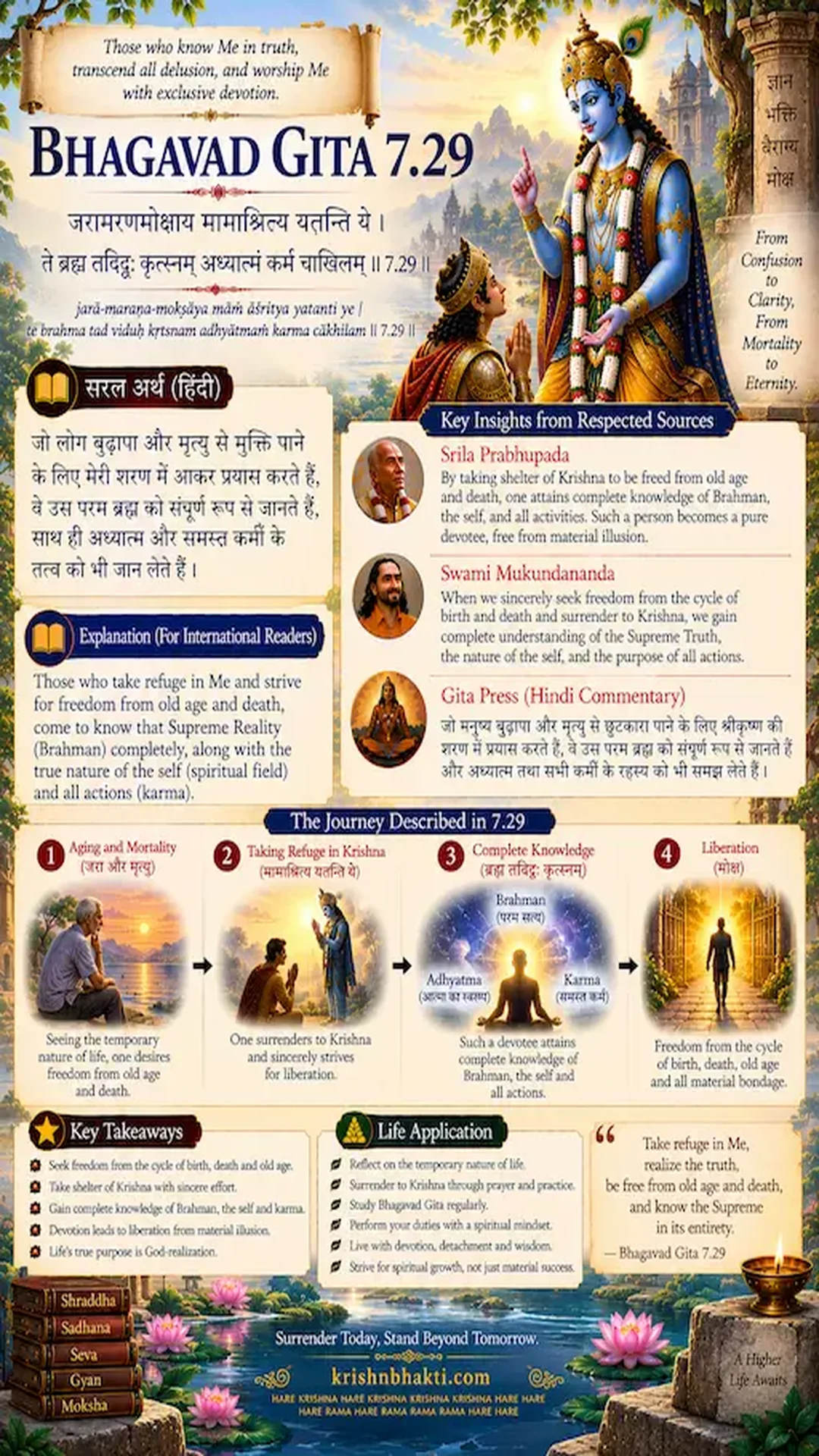
When the World Feels Heavy, Krishna Offers You This
In our journey through the Gita, we have been exploring how the world is governed by the three modes of material nature. We often find ourselves caught in the endless loop of wanting more, achieving less, and fearing the unknown. Think about your life right now. The constant ping of notifications, the pressure to maintain a social media image, the anxiety about your next career move, and the emotional exhaustion of navigating modern relationships. We are all searching for that one 'anchor' that will keep us steady when the tides of life get rough.
There is a massive misconception among youth today that spirituality is for the retired or those who have given up on life. We think, 'If I start focusing on God, won't I lose my competitive edge?' The reality is quite the opposite. Krishna tells us in this verse that true intelligence lies in understanding the source of everything. If you are constantly feeling burnt out, it is because you are trying to carry the weight of the universe on your shoulders alone. You were never meant to do that.
Consider the modern dilemma: we chase success to find security, yet we are more insecure than ever. We fear death, not just in the literal sense, but the 'death' of our reputation, our status, and our comfort. Krishna addresses this fundamental human fear. He doesn't tell you to run away to a cave; he tells you to change your perspective while you are standing right here in the middle of your battlefield—your office, your home, and your social circle.
The verse we are discussing today is like a master key. It unlocks the potential to live without the crushing weight of anxiety. When you align your intent with the Supreme, your actions transform from 'burden' to 'service'. This is not just poetic; it is the most practical way to live a high-performance, low-stress life in the 21st century.
Many of us feel that if we just get that promotion, find that partner, or buy that house, we will finally be at peace. But the mind is a restless machine; it simply upgrades its desires. Krishna is here to tell us that peace is not found in the 'what' of the world, but in the 'who' behind the world. Let’s look at the verse that bridges the gap between our mortal struggles and eternal wisdom.
जरा मरण मोक्षाय मामाश्रित्य यतन्ति ये |
ते ब्रह्म तद्विदुः कृत्स्नमध्यात्मं कर्म चाखिलम् || ७.२९ ||
Let's break this down into digestible, actionable parts. Jara-marana-mokshaya: For liberation from the cycle of old age and death. Mam-ashritya: Taking refuge in Me (Krishna). Yatanti ye: Those who strive with effort. Te brahma tad viduh: They come to know the Brahman (the absolute truth). This isn't just about 'knowing' information; it's about experiential realization. Krishna says that those who make the conscious effort to lean on Him are the ones who truly understand the nature of reality, the spirit, and the purpose of action.
Swami Ramsukhdas Ji, in his monumental commentary, emphasizes the word 'Mam-ashritya'. He notes that 'ashraya' (refuge) must be complete. If you lean on a wall for support but keep your hands on the ground, you aren't really leaning. You are still holding yourself up. He says that the moment a soul says, 'I belong to God, and God belongs to me,' the fear of death disappears because the soul realizes it is eternal. He explains that 'jara' (aging) and 'marana' (death) are the rules of the material body, but our refuge in the Divine allows us to transcend the anxiety caused by these natural processes.
A.C. Bhaktivedanta Swami Prabhupada approaches this from the lens of pure devotion. He explains that for a devotee, there is no separate struggle for success or failure. Because they have taken refuge in Krishna, every action becomes 'Bhakti-yoga'. They see everything as a manifestation of the Supreme. He often points out that materialistic people work very hard ('yatanti'), but they work for their own senses. The devotee works for Krishna, and in that, they understand 'Brahman' and 'Adhyatma' perfectly. It is a shift from 'my work' to 'His service'.
Swami Mukundananda Ji bridges the gap with modern psychology. He uses the analogy of a child in a crowded marketplace. As long as the child holds the parent's hand, they are calm, even in the chaos. The moment they lose the grip, they panic. Taking refuge in Krishna is exactly that 'grip'. He suggests that for youth dealing with anxiety, the practice is to mentally offer the outcome of every task to God. 'I will do my best, and I leave the rest to You.' This practice, he notes, is the ultimate way to maintain mental agility and peace in a volatile world.
Think of a moment when you are sitting to meditate or trying to focus at work. Your mind wanders to a past insult or a future worry. That is the moment of 'yatanti'—the effort. Gently bringing the mind back to Krishna is not a chore; it is an act of love. It is like calling back a straying child. You don't get angry; you just bring them back. Every time you bring your distracted mind back to the present moment, you are growing your spiritual muscle.
Consider a professional who is dreading a difficult meeting. Instead of letting the fear paralyze them, they decide to treat the meeting as an offering. They prepare with excellence but detach from the result, knowing they have done their duty for the Supreme. This shift in mindset immediately lowers cortisol levels and increases focus. This is the application of Verse 7.29 in modern corporate life.
Q: Is my anxiety a sign that I am not spiritual enough? A: Not at all. As Swami Ramsukhdas Ji points out, the fact that you want to be free from anxiety shows you are already on the path. The struggle is not a sign of failure, but a sign of growth. Keep striving.
Q: Do I have to stop wanting things? A: You don't have to kill your ambitions. Just realign them. As Prabhupada suggests, use your skills to serve, not just to feed your ego. Your ambition then becomes a tool for good.
Q: How do I know if I have taken 'refuge'? A: You will know when you stop blaming external circumstances for your inner state. When you can say, 'Whatever happens, God is the center of my life,' you have found your refuge.
Q: Is this hard to do every day? A: Swami Mukundananda Ji says it’s like training for a marathon. You don't run 42km on day one. Start by offering one small task today. Then another. It builds up over time.
Q: How does this link to the previous verse? A: The previous verse talked about the delusion caused by dualities. This verse provides the solution: refuge in the Divine, which cuts through that delusion like a sharp knife.
🙏 Hare Krishna — Jai Shri Krishna 🙏
📖 Also Read: When Your Past Holds You Back, Do This 🌸