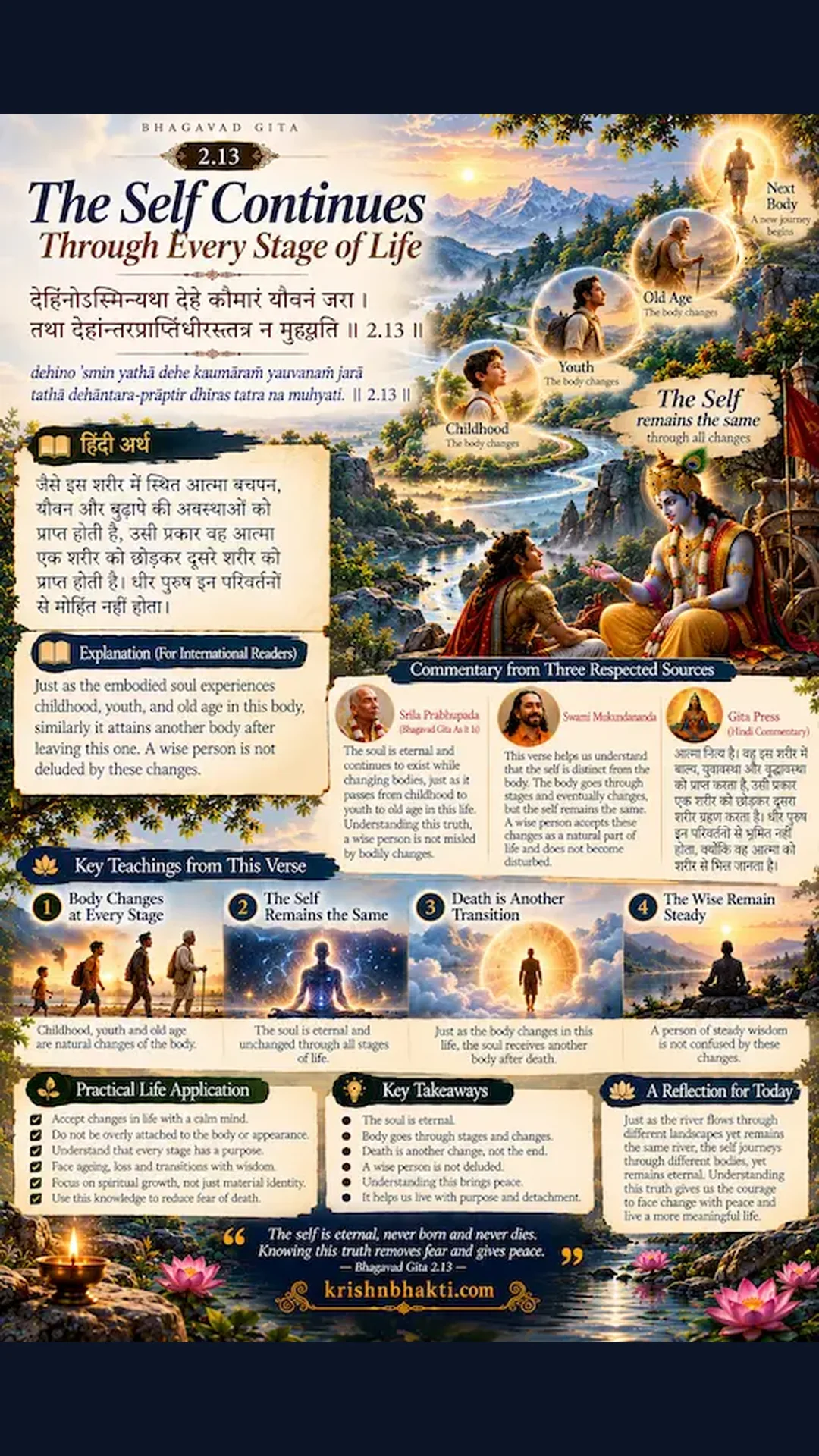
When Life Seems to Fade, What Does Krishna Say?
In the previous verse, we witnessed Arjuna expressing his deep distress and confusion to Krishna. He was caught in the middle of a moral crisis. Today, we reach the verse that essentially acted as the first layer of healing for Arjuna's terrified mind. Often, we define our entire existence by our physical being—our jobs, our social status, our relationships. When these change, we feel like we are dying.
Every morning, you look in the mirror and notice the changes—the signs of aging, the loss of youth, or perhaps just the feeling of stagnation. We mistakenly believe that these changes are happening to 'us.' But is the 'you' that feels the sadness the same 'you' that was a child playing in the garden? The physical form has shifted, yet the observer remains.
Most people assume that death is the ultimate end. The fear of losing a loved one, or the fear of one's own mortality, is the root cause of our modern anxiety. But have you ever paused to consider whether 'you' can actually cease to exist? Can the essence within you ever be destroyed?
Krishna gently reminds Arjuna that this fear is born of ignorance. He explains that the body is merely a set of clothes. Just as we cast aside old, tattered garments to wear new ones, the soul transitions from one body to another. By contemplating this verse, you will realize that death is not a dark, terrifying event; it is a natural, graceful transition.
This wisdom isn't just for scholars in robes. When you are facing a massive crisis—when your career seems to be crumbling or your personal life feels like it's falling apart—this perspective serves as your anchor. You are far greater than the body that experiences pain. You are the conscious observer witnessing that pain.
In our digital age, we get so caught up in curating our 'online persona' that we fear if that image loses popularity, our identity will vanish. This verse tears down that fragile, false identity. Let us dive deep into the profound reality of this teaching.
देहिनोऽस्मिन् यथा देहे कौमारं यौवनं जरा ।
तथा देहान्तरप्राप्तिर्धीरस्तत्र न मुह्यति ॥ २.१३ ॥
Simple Meaning: The Secret Within
The essence of this verse is foundational. Krishna explains that just as the embodied soul continuously passes, in this body, from boyhood to youth to old age, the soul similarly passes into another body at the time of death. The self-realized soul (the 'Dheera' or sober person) is not bewildered by this change.
Breakdown:
Dehinah asmin yatha dehe: Just as the soul dwells within this body.
Kaumaram yauvanam jara: Childhood comes, then youth, then old age.
Tatha dehantara-praptih: Similarly, the soul enters another body.
Dhiras tatra na muhyati: The wise/sober person is not confused or disturbed by this process.
Krishna is giving us a new lens. He points out that what you are witnessing—the change in the body—is happening right before your eyes every single day. If you didn't panic when your childhood transitioned into youth, why tremble when the final transition occurs?
Swami Ramsukhdas Ji’s Perspective
Swami Ramsukhdas Ji emphasizes the word 'Dheera'. He defines a 'Dheera' as one who keeps his intellect firm and unshakeable. He teaches that the soul undergoes absolutely no change; only the Prakriti (nature/matter) changes. We confuse ourselves by identifying with the change rather than the unchanging reality.
He explains that changing bodies is like changing houses. When you move to a new house, you don't become a different person. Similarly, for the soul, changing bodies is a natural journey. He calls this the 'flow of the universe'. If you can observe this flow without attachment, you will remain undisturbed.
He insists that attachment (Moha) is the root of all misery. We become attached to things that are inherently temporary. Knowing that the body is not permanent, yet clinging to it as if it were, is the cause of all our suffering.
His core practice involves 'Asangata' (detachment). He advises us to understand that the soul has no connection with these temporary forms. We create these links in our minds and then suffer when they break.
Srila Prabhupada’s Devotional Angle
Srila Prabhupada connects this verse directly to Krishna consciousness. He explains that this verse serves as a wake-up call, reminding us that we are not residents of this material world. Our true home is with Krishna. Body changes are merely temporary arrangements meant for our learning.
He notes that Arjuna was blessed to receive this knowledge because he was Krishna's friend. Prabhupada teaches that we are all eternal fragments of Krishna. The changing of the body is a process orchestrated by the divine.
According to Prabhupada, those who practice Bhakti Yoga understand that this world is like a school. We are here to learn and serve. The body is just a tool for service. Fear vanishes when we surrender to Krishna. Once you belong to Krishna, the fear of losing the body dissipates because your identity is rooted in the eternal.
Swami Mukundananda Ji’s Modern Wisdom
Swami Mukundananda Ji uses a brilliant analogy for the modern generation: the computer. If your hardware (the physical computer) gets old or breaks, do you lose your data? No, you simply transfer it to a new device. The soul is the data, and the body is the hardware.
This is extremely relatable for a youth professional. When you upgrade your phone or computer, you don't 'die' during the process. You remain the same, just with a new interface. He suggests that every major life transition—losing a job, changing cities, or facing failure—should be viewed as a 'hardware change'.
He advises that during meditation, we should practice separating our identity from our body. When you feel anxious, remember that the body is just a vessel. Your true self is the silent observer. This practice builds the 'mental muscle' of endurance.
He bridges ancient wisdom with modern stress management, showing that identifying with the soul is the ultimate hack for mental peace in a volatile world.
Real-Life Examples
Imagine you were working on a major project at your office, and suddenly, it's reassigned to a colleague. You feel like your entire career is over. This is a small 'body-transition'. You suffer because you identified yourself as 'the project manager'. Once you see this as a temporary shift of roles, the pain subsides.
Or consider the end of a relationship. We feel our existence is shattered. As Swami Mukundananda suggests, remember that just as childhood passed and youth arrived, this phase too shall pass. You are the one witnessing this change, not the change itself.
In meditation, when your mind wanders, that is just the 'mind-body' mechanism being restless. You bring it back to your breath. That act of 'bringing it back' is the practice of becoming 'Dheera'.
Another example: social media comparison. We see someone living a 'perfect' life and feel inadequate. This is attachment to an external image. The truth is, that image is temporary and flickering. The soul needs no external validation to be complete.
Self Q&A
Q: Should I become indifferent to everything?
Swami Ramsukhdas Ji clarifies that detachment doesn't mean renouncing your responsibilities. It means working while remaining aware that these things aren't 'yours'—you are the eternal soul performing your role.
Q: How do I eliminate fear completely?
Prabhupada suggests chanting Krishna’s names. Fear dwells where there is 'I' and 'Mine'. Where Krishna is, fear cannot exist.
Q: Is reincarnation necessary?
Swami Mukundananda explains that the cycle continues as long as we harbor attachments to the physical. Through Bhakti, we can transcend this cycle entirely.
Q: Can I become 'Dheera' (sober) today?
Yes, by practicing the realization that 'I am not this body' in small daily situations—when you get angry, when you feel sad, or when you are stressed.
Q: How does this connect to the previous verse?
Arjuna was terrified of the impending loss of his loved ones. Krishna immediately addressed the root of that fear by showing that the essence of life can never be lost.
🙏 Hare Krishna — Jai Shri Krishna 🙏
📖 Also Read: The Truth About Death and Your Eternal Soul: Gita's Biggest Lesson ✨