Why Does Life Feel Like an Endless Emotional Rollercoaster?
In the previous verses, Krishna established the eternal nature of the soul, contrasting it with the temporary nature of the body. Yet, Arjuna, much like us today, was struggling with the immediate emotional impact of his circumstances. We live in an age of constant stimulation—notifications, career anxieties, relationship insecurities, and the exhausting need to perform. We often feel like we are constantly at the mercy of our circumstances. Have you ever felt that if your boss is in a good mood, your whole day is great, but a single harsh comment ruins your entire week? That is exactly the state Krishna is addressing.
We often fall into the trap of believing that peace is a destination we will reach once everything in our outer life is 'perfect.' We think, 'If only I had this job, or that relationship, I would be happy.' But the reality is that the outer world is dynamic and ever-changing. Happiness and distress are like the changing weather. You cannot stop the rain, but you can change how you experience it. The misconception here is that being spiritual means becoming unfeeling or indifferent. That is not the case at all. Krishna is not asking us to be stone-hearted; He is asking us to stop being dependent on the external environment for our internal stability.
Think of your life as a commute on a crowded train. It gets hot, there is pushing, and it is uncomfortable. If you decide that you will be angry and miserable until you reach your station, you have wasted your time. But if you recognize that this crowd is temporary and you are on your way somewhere else, the discomfort loses its power to ruin your mood. That is the perspective we need for our modern lives.
This verse is not just ancient wisdom for hermits; it is a vital tool for the young professional, the student, and anyone trying to navigate the chaos of modern existence. Krishna is revealing the secret of 'Titiksha'—the power of tolerance. It is the ability to acknowledge the presence of both joy and pain without being swept away by them. When we understand that these dualities are temporary, we stop fighting the reality of life and start living with a deeper sense of inner freedom.
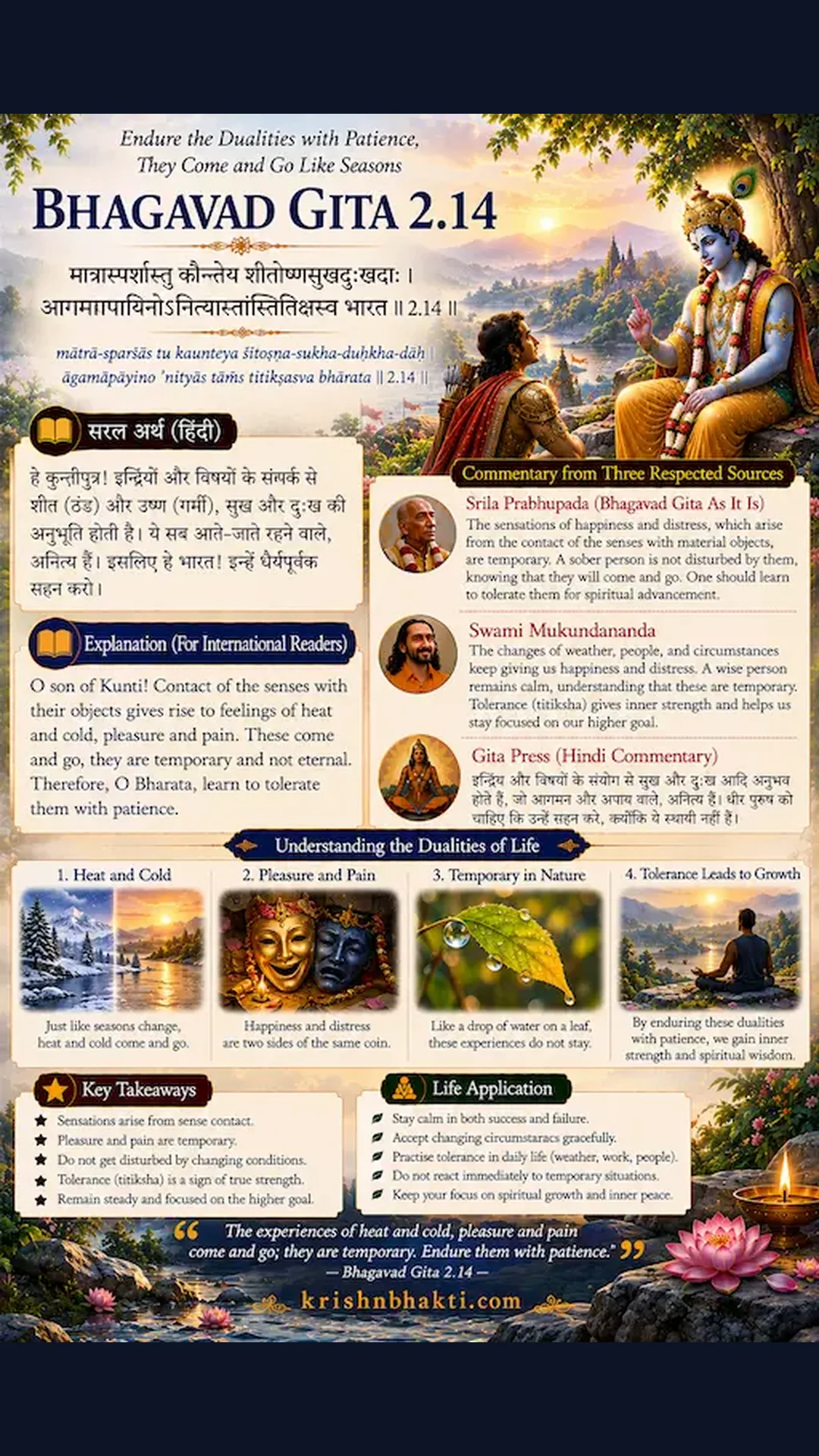
मात्रास्पर्शास्तु कौन्तेय शीतोष्णसुखदुःखदाः ।
आगमापायिनोऽनित्यास्तांस्तितिक्षस्व भारत ॥ २.१४ ॥
Simple Meaning: Breaking Down the Wisdom
Krishna explains that 'Matra-sparsha'—the contact between our senses and their objects—is what creates our experience of 'Sheeta' (cold), 'Ushna' (heat), 'Sukha' (happiness), and 'Dukha' (distress). Just as the weather changes, our feelings change based on these external contacts.
Line-by-line Breakdown:
Matra-sparshastu Kaunteya: O son of Kunti, the contact between the senses and their objects is the cause of everything we feel.
Sheetoshna-sukha-dukhadah: These contacts produce feelings of cold, heat, happiness, and distress.
Agamapayinah-anityah: They come and go; they are temporary. They do not last.
Tamstitikshasva Bharata: Therefore, O Bharata (Arjuna), you must learn to tolerate them.
The takeaway here is threefold: First, your feelings of joy and pain are triggered by the outside world. Second, they are inherently fleeting. Third, the solution is not to run away, but to 'tolerate' them. Tolerance here doesn't mean suffering; it means expanding your inner capacity so that you are no longer shaken by the passing storms of life.
Three Perspectives
Swami Ramsukhdas Ji: Swami ji emphasizes the word 'Titiksha.' He explains that we suffer because we 'claim' these experiences as 'my' happiness or 'my' pain. He teaches that when an event occurs, we should be like a witness to a movie. If you are watching a tragic scene in a film, you don't break down into tears because you know it's not real. Life is a grand drama, and by staying in the 'Sakshi' (witness) mode, we can handle the ups and downs without losing our core peace. For him, titiksha is not forced suppression; it is the natural outcome of realizing the temporary nature of the world.
A.C. Bhaktivedanta Swami Prabhupada: Prabhupada’s approach is deeply devotional. He explains that we are constantly tossed in the ocean of duality because we have forgotten our relationship with Krishna. He states that when we fix our consciousness on Krishna, the impact of these worldly dualities automatically decreases. He describes titiksha as a practice of steadying oneself in the service of the Lord. Instead of being affected by the external climate, one remains absorbed in the internal joy of Krishna consciousness. It is a gentle, persistent path of turning away from material dependence towards spiritual fulfillment.
Swami Mukundananda Ji: Swami ji uses brilliant modern analogies. He compares life’s challenges to the resistance training in a gym. If you want to build muscle, you need to lift weight; you cannot grow if you avoid the effort. Similarly, the 'cold and heat' of life are the weights that build our spiritual and mental muscle. He argues that we spend our lives chasing a perfect environment that doesn't exist. Instead of wishing for a life without problems, we should develop the resilience to stay calm within them. His advice: 'Don't run from the storm, learn to dance in the rain.'
Real-Life Scenarios
Imagine you have worked tirelessly on a project, and it gets rejected. Your immediate reaction is one of panic and despair. By applying this verse, you remind yourself: 'This failure is Agamapayin—it has come, and it will go.' It is not a definition of your worth. By tolerating this momentary setback, you save your energy to pivot and start fresh. You become a person who acts rather than one who reacts.
In your meditation practice, the same principle applies. When you sit down, your mind will wander to office stress or personal worries. Instead of getting frustrated or quitting, you accept that these thoughts are like passing clouds. You gently bring your focus back to your breath. Each time you bring your mind back, you are practicing 'titiksha.' You are training your brain to not be a slave to every passing thought.
In relationships, we often react instantly to hurtful words. But if we recognize that the other person's behavior is just their own internal 'sensory contact' playing out, we can choose not to get hooked. Titiksha gives you that precious 'space' between a trigger and your reaction, allowing you to respond with clarity and kindness instead of anger.
Self Q&A
1. Is my struggle with pain unique? Swami Ramsukhdas Ji clarifies that suffering is part of the human experience. You are not alone; every soul is navigating these same waves. The key is not to get 'stuck' in them.
2. Does tolerance mean being a doormat? Swami Mukundananda Ji explains that titiksha is mental strength, not cowardice. You can stand up for what is right while remaining internally calm and unruffled.
3. Should I stop enjoying happiness? Prabhupada teaches that you can enjoy life, but by offering that joy to Krishna, it becomes transcendental and you remain unattached to the result.
4. How do I measure my progress? If you previously spent days in misery over a minor setback, and now you recover in minutes, that is significant spiritual progress.
5. Is it necessary to stop every thought? No, that is impossible. The goal is not to stop the thoughts, but to stop getting 'attached' to them. Treat them as passing weather.
🙏 Hare Krishna — Jai Shri Krishna 🙏
📖 Also Read: Afraid of Death? This Gita Verse Will Change Your Entire Perspective 🌅