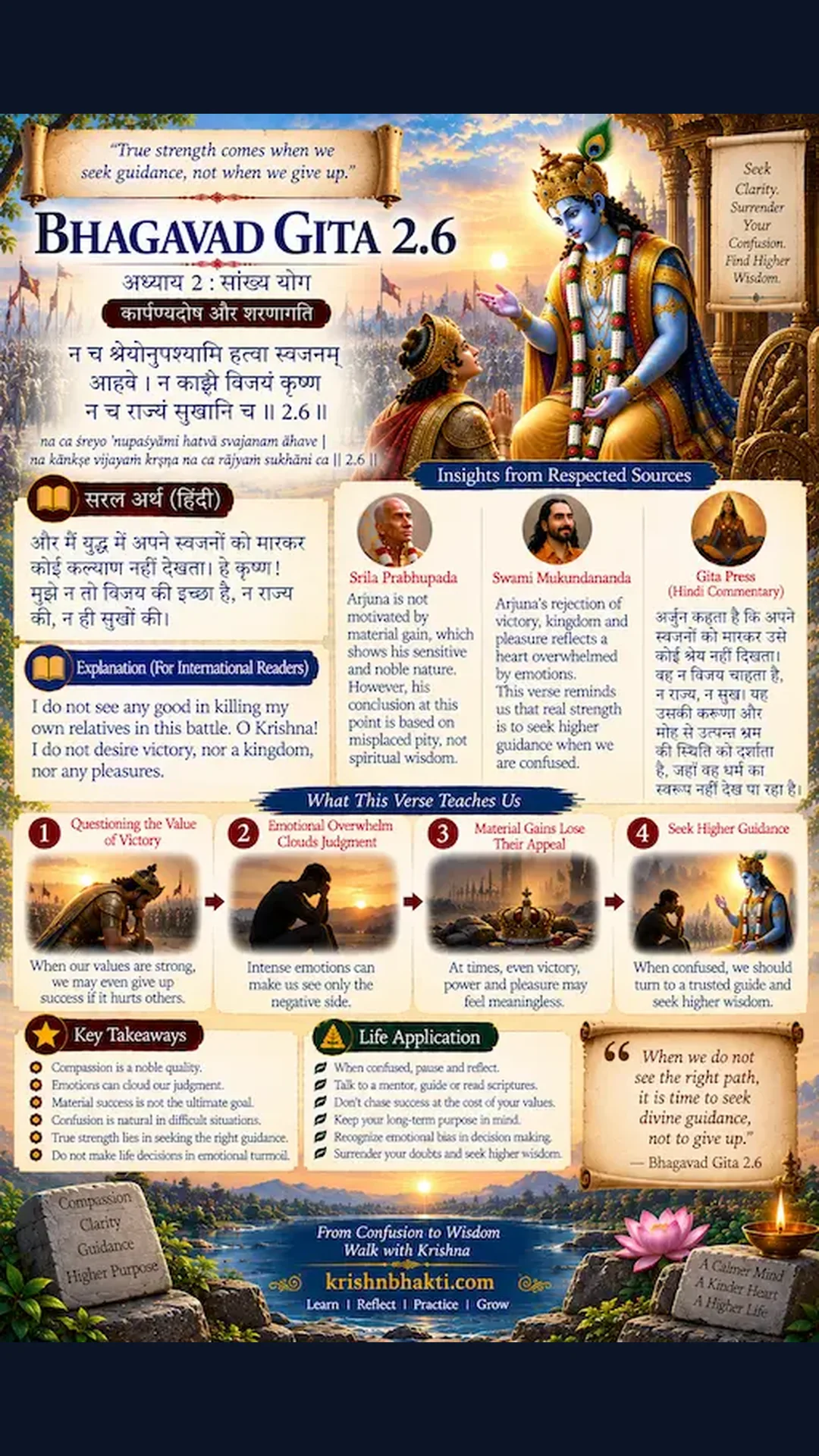
Life as an Endless Battlefield
Have you ever felt caught in a war that seems to have no end? From the constant ping of notifications on your phone to the complex pressures of your career and relationships, our minds have become a modern-day Kurukshetra. In the previous verse, we saw Arjuna reach a point of surrender. Today, in Verse 6, we look at the very state we all face daily: the paralysis of indecision. We often blame our unhappiness on our boss, our partners, or external circumstances. We seek peace outside, while the noise inside is deafening.
For today's generation, 'confusion' is the biggest challenge. Whether it is choosing a career path or navigating personal relationships, our minds are constantly at war. We believe that if our external circumstances change, we will finally be happy. But look at Arjuna—he had power, status, and the Divine Krishna as his charioteer. Yet, he was broken from within. This verse reveals a profound truth: outer victory is only possible when our internal ignorance is destroyed.
Many people mistakenly think that 'giving up' is a sign of weakness. However, Arjuna's claim that he will not fight is a different kind of ego. We, too, often use 'renunciation' as a shield to hide from responsibility. We say, 'Everything is Maya,' simply because we are afraid to face the music. Are we truly renouncing, or are we just scared? Krishna is about to dismantle this illusion. This verse is for those who look in the mirror every day and wonder if they are on the right path.
This verse is not just an ancient text; it is a guide for living. It will teach you how to calm the internal chatter. Arjuna, like us, is caught between 'Dharma' (duty) and 'Self-interest'. He is lost in the metrics of win and loss. In a world driven by social media comparisons, we lose heart before the game even begins. We think others are better, and that comparison is our true defeat. Arjuna was doing the same—thinking about his cousins and his reputation, forgetting that he had the Supreme Lord by his side. You, too, have that same guidance; you just need to open your eyes.
Prepare yourself, because we are about to look at the verse that perfectly encapsulates the human heart when it stands on the edge of defeat. This is not just a sentence; it is the raw emotion of a soul lost in its own labyrinth. Let us dive deep into the verse.
॥ २.६ ॥
न चैतद्विद्मः कतरन्नो गरीयो यद्वा जयेम यदि वा नो जयेयुः ।
यानेव हत्वा न जिजीविषामस्तेऽवस्थिताः प्रमुखे धार्तराष्ट्रः ॥
Meaning of the Words
Na (not) ca (and) etad (this) vidmah (we know) — We do not know for sure. Katarat (which) nah (for us) gariyah (better) — whether winning is better or losing. Yadvā (or) jayema (we win) yadi (if) vā (or) nah (us) jayeyuh (they win) — whether we defeat them or they defeat us.
Yān (whom) eva (only) hatvā (by killing) na (not) jijīviṣāmaḥ (want to live) te (they) avasthitāḥ (are standing) pramukhe (in front) dhārtarāṣṭrāḥ (sons of Dhritarashtra) — those by killing whom we do not wish to live, they are standing right before us. This verse reflects Arjuna's mental state—he is trapped in the calculation of 'victory' and 'defeat'.
Key takeaways: 1. The root of all mental confusion is 'attachment' or 'selfishness'. 2. When we worry about the future, we abandon our present duty. 3. Arjuna's frustration shows he is still operating on a physical/egoic level. 4. Krishna is about to elevate his perspective to the spiritual level.
Perspective of Swami Ramsukhdas Ji
Swami Ramsukhdas Ji explains that Arjuna is oscillating between 'Viveka' (wisdom) and 'Aviveka' (ignorance). He notes the phrase 'Na caitad vidmah'—Arjuna is admitting he does not know what to do. Swami Ji emphasizes that until a person admits they don't know, true learning cannot begin.
Arjuna is thinking with his physical intellect. He believes that killing will result in sin. Swami Ji explains that this is 'Moha' (delusion). When we have deep attachment to our loved ones, our 'Dharma' starts to look wrong to us. Arjuna’s statement that 'he doesn't want to live' is a form of self-destructive thinking that Krishna strongly rejects.
Swami Ji points out that Arjuna is trapped in the web of 'Mamata' (mine-ness). 'Yaneva hatva'—without whom I don't want to live. Swami Ji says that as long as there is 'Mamata' in this world, there will be no peace. Krishna will now teach him how to perform duty while letting go of attachment.
In Sadhak Sanjivani, Swami Ji explains that this verse also symbolizes Arjuna's ego. He thinks his actions alone will change everything, forgetting that the results are in the hands of the Divine. He is taking the burden of the universe upon himself, which causes his misery.
Perspective of A.C. Bhaktivedanta Swami Prabhupada
In Bhagavad Gita As It Is, Prabhupada explains that Arjuna's confusion is entirely material. He notes that Arjuna was a great warrior, but his material intellect prevented him from understanding what his true welfare was. Prabhupada emphasizes 'Krishna Consciousness'.
Prabhupada says that if Arjuna had accepted Krishna's guidance, he wouldn't have needed to worry about who wins or who loses. Devotion means surrendering the results at the lotus feet of the Lord. Arjuna is currently viewing himself as the 'doer', which is why he is suffering.
According to Prabhupada, the presence of the 'Dhārtarāṣṭras' is the cause of Arjuna's delusion. He states that as soon as we place Krishna at the center, material attachment naturally fades away. Arjuna’s suffering is real because he is viewing Krishna as a friend, not as his Guru.
Finally, Prabhupada notes that this verse serves as a lesson for those who are always anxious about 'what will happen'. If we work for Krishna, the duality of victory and defeat ceases to exist.
Perspective of Swami Mukundananda Ji
Swami Mukundananda Ji uses the analogy of a 'Mental Gym' to explain this verse. He says Arjuna's mind is stuck in a loop. He cannot escape the 'Will I win or lose?' loop. In modern life, we do the same—'If I don't get this job, what will my family think? If I quit, what will my future look like?'
Swami Ji says that like Arjuna, we are suffering from 'Analysis Paralysis'. We spend so much time thinking that we forget to act. Swami Ji offers a great analogy: a runner does not think about falling while running; they simply run. Arjuna was meant to perform his Dharma, not calculate the outcome.
Swami Ji emphasizes that Arjuna's biggest mistake is worrying about the future while his duty is right in front of him. For today's youth, this is the ultimate mantra: 'Focus on the process, not the outcome.' Worrying is a misuse of intellect.
Ultimately, Swami Ji explains that this verse serves as the foundation to lead Arjuna toward spirituality. When you exhaust all your arguments and logic, you become ready to surrender to the Divine. Arjuna is nearing that state of surrender.
Real-life Examples
Imagine standing outside the door for a critical job interview. Your hands are shaking, and you are sweating. The same thought keeps recurring—'What if I don't get it? My reputation will be ruined.' This is exactly Arjuna's mental state. Arjuna, too, was worried about his status and relationships on the battlefield, forgetting his duty.
Consider another example: You are in a relationship that you know is toxic, yet you are afraid to leave. You worry, 'How will my life be without them?' You are looking at the 'Dhārtarāṣṭras' (attachments) and forgetting your 'Dharma' (your own growth and self-respect).
The same thing happens during meditation. You sit down with the intention of being peaceful. Two minutes later, your mind whispers, 'Should I finish that pending office task?' You get swept away by that thought. That is the 'Dhārtarāṣṭra' preventing you from winning your own 'meditation war'.
Feeling inadequate by comparing yourself to others on social media is also a modern manifestation of this verse. 'Na caitad vidmah'—we don't even know what is good for us. We are being misled by adopting others' definitions of happiness as our own.
Arjuna’s struggle teaches us that as long as we make decisions based on our ego, we will remain unhappy. If Arjuna had asked Krishna, 'Oh Krishna, tell me what is better,' he would have found immediate peace. This is the shift you need to make—consult your inner wisdom or the Divine before making decisions, rather than relying on your fragile ego.
Your Questions, Krishna's Answers (Self Q&A)
Q: Is it wrong for Arjuna to feel sad?
A: No. Swami Ramsukhdas Ji says Arjuna's sadness is a sign of his 'eligibility'. Unless we are restless from within, we won't seek a solution. Arjuna's sorrow led him to Krishna. Your struggles can also lead you toward a spiritual path, provided you channel them in the right direction.
Q: Why was Arjuna feeling so much 'Moha'?
A: Prabhupada explains that Arjuna's attachment was due to his distance from the spiritual truth. When we forget the Lord and think that we are the masters of our fate, we become attached to outcomes. Arjuna felt he was the one causing death, while the war was inevitable regardless of his feelings.
Q: Is it right to involve God in every small decision?
A: Swami Mukundananda Ji says, 'Yes, that is the essence of Krishna Consciousness.' Integrate every decision with a sense of surrender to the Lord. This is not superstition; it is a mindset shift that keeps you free from unnecessary anxiety.
Q: Why does Arjuna keep talking about giving up?
A: According to Swami Ramsukhdas Ji, this is his 'intellectual bargaining'. Whenever the mind faces a difficult task, it seeks excuses to escape. Arjuna is using logic to avoid the pain of conflict, but it is just a mask for his internal hesitation.
Q: How can I stay calm in the battlefield of my life?
A: Swami Mukundananda Ji suggests detaching from the outcome. Give your best effort, but accept the result as an offering to God. Arjuna was meant to do the same.
🙏 Hare Krishna — Jai Shri Krishna 🙏
📖 Also Read: When Your Mentors Are Wrong: Finding Wisdom in Arjuna's Dilemma 🕉️