Are You Standing at a Crossroads Like Arjuna?
In the previous verse, we witnessed Arjuna completely crumbling on the battlefield. He saw his loved ones before him and found himself unable to distinguish between dharma (duty) and personal desire. This isn't just Arjuna's story; it is the story of every young person today. When you are pressured at work to sacrifice your dreams for a job you despise, you are exactly like Arjuna, caught in deep 'Vishad' (lamentation).
We often fall into the trap of thinking that every life event is the consequence of our own failures. We feel stressed, comparing our 'behind-the-scenes' with everyone else's 'highlight reel' on social media. Arjuna was doing the same. He felt that if he fought, everything would be destroyed, and if he didn't, he would be guilty. This 'Decision Paralysis' is a modern-day epidemic where we fear one wrong move will ruin our entire future.
Anxiety and depression flourish today because we fight our inner battles in total isolation. We fear that showing vulnerability makes us weak. People falsely believe that meditation means 'to stop the mind from wandering completely', but in truth, meditation begins when you pour out your inner chaos, your fears, and your confusions at the feet of the Divine.
Krishna did not offer Arjuna wisdom until Arjuna laid down his weapons and declared, 'I am your disciple, please guide me.' This verse teaches us that until we abandon our ego, we cannot find the path. Today's youth mistake arrogance for self-confidence, but it is actually the greatest barrier to spiritual growth.
Arjuna's confession, 'I do not know what I must do,' is the first step toward transcendence. You, too, must bring your office stress and relationship pains to Krishna. Have you ever placed the weight of your files and the ache of your heart before the Lord and said, 'Lord, I am lost; please lead the way'?
Many think Krishna was only here to deliver a lecture. No, Krishna was Arjuna's friend, his therapist, his constant companion. He listened to every word. In this verse, Arjuna's surrender is the key that unlocks the door to the divine wisdom of the Gita. Let us explore how Arjuna translated his inner turmoil into words and sought refuge in Krishna.
Remember, you are never alone. The noise in your head today can settle down tomorrow if you register your complaints at the right address. Let's delve into this moment of silence.
॥ २.९ ॥
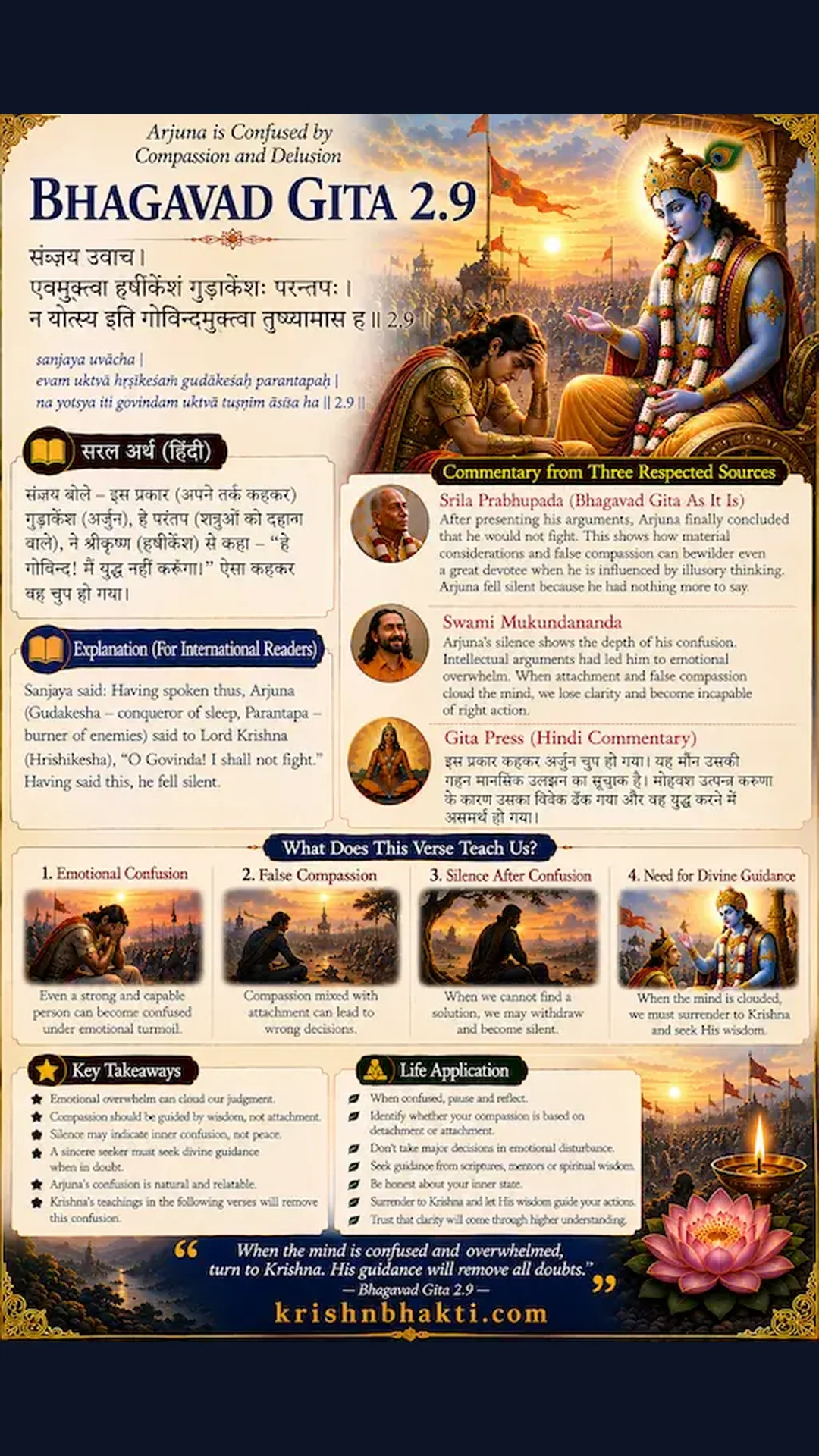
सञ्जय उवाच
एवमुक्त्वा हृषीकेशं गुडाकेशः परन्तपः ।
न योत्स्य इति गोविन्दमुक्त्वा तूष्णीं बभूव ह ॥
Simple Meaning: The Power of Silence
Sanjaya says to Dhritarashtra: 'O King! Having spoken thus, Arjuna, the conqueror of foes, said to Hrishikesha (Krishna)—O Govinda, I shall not fight—and became silent.' Here, 'Gudakesha' means one who has conquered sleep (ignorance), yet Arjuna is still caught in the shadow of confusion.
'Na yotsya' means 'I shall not fight.' 'Tushnim babhuva' means he presented his arguments, expressed his despair, and then stopped talking. This is identical to how we argue with life or ourselves, and eventually, out of exhaustion or frustration, we just fall silent.
There are three core takeaways: 1. Acknowledging your helplessness (Surrender), 2. Expressing your situation clearly, and 3. Becoming silent to wait for the answer. Arjuna stopped fighting, but he did not leave Krishna's side. He became silent so he could finally listen to Krishna.
Wisdom from the Masters
Swami Ramsukhdas Ji: Swami ji emphasizes that Arjuna's silence (Tushnim babhuva) was the foundation of his sadhana. As long as we keep debating with our own intellect, we cannot hear the voice of the Divine. He notes that Arjuna is called 'Gudakesha'—he had conquered ordinary sleep, but the sleep of attachment remained. Until you surrender your ego completely, Hrishikesha (the Lord of the senses) cannot guide you.
A.C. Bhaktivedanta Swami Prabhupada: Prabhupada explains that Arjuna's decision not to fight is the decision of a 'devotee.' He is compassionate, but it is 'ignorant compassion.' Prabhupada notes that when Arjuna addresses Krishna as 'Govinda,' he acknowledges Krishna as the master of his senses. By using this name, Arjuna signals that he no longer wants to be controlled by his own senses, but by Krishna.
Swami Mukundananda Ji: Swami Mukundananda calls this a 'Mental Reset' in modern parlance. He explains that when life becomes overwhelming, hitting the 'Pause' button is vital. Arjuna did exactly this. He was exhausted by his own overthinking and chose to stop. He teaches us how to move from being a victim of our thoughts to an 'observer' of our thoughts.
Real-Life Scenarios
Imagine you are working on a project at the office that feels soul-crushing. You feel the pressure building. You tell your manager, 'I cannot do this.' That is Arjuna's 'Na yotsya.' But then you come home, sit in silence, and acknowledge your frustration. That is 'Tushnim babhuva.'
When you meditate, your mind will wander. When it starts racing, don't force it to stop. Just say, 'Lord, my mind is restless, please calm it down.' This is the essence of Arjuna's surrender.
Your Questions Answered
Q: Should I just give up on everything? A: Swami Ramsukhdas ji clarifies that it is not about giving up, but about relinquishing the ego. Surrender to the Divine, not to the problem.
Q: Does silence actually help? A: Swami Mukundananda ji explains that silence gives you the clarity to see the situation from a higher perspective. Responding mindfully is always better than reacting impulsively.
🙏 Hare Krishna — Jai Shri Krishna 🙏
📖 Also Read: Feeling Empty Despite Having Everything? 😔 Arjuna's Realization